

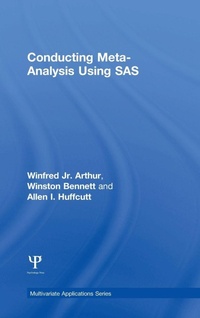
Conducting Meta-Analysis Using SAS
1st Edition
Published on 1. June 2001
Book
Hardback
202 pages
978-0-8058-3977-7 (ISBN)
Description
Conducting Meta-Analysis Using SAS reviews the meta-analysis statistical procedure and shows the reader how to conduct one using SAS. It presents and illustrates the use of the PROC MEANS procedure in SAS to perform the data computations called for by the two most commonly used meta-analytic procedures, the Hunter & Schmidt and Glassian approaches.
This book serves as both an operational guide and user's manual by describing and explaining the meta-analysis procedures and then presenting the appropriate SAS program code for computing the pertinent statistics. The practical, step-by-step instructions quickly prepare the reader to conduct a meta-analysis. Sample programs available on the Web further aid the reader in understanding the material.
Intended for researchers, students, instructors, and practitioners interested in conducting a meta-analysis, the presentation of both formulas and their associated SAS program code keeps the reader and user in touch with technical aspects of the meta-analysis process. The book is also appropriate for advanced courses in meta-analysis psychology, education, management, and other applied social and health sciences departments.
This book serves as both an operational guide and user's manual by describing and explaining the meta-analysis procedures and then presenting the appropriate SAS program code for computing the pertinent statistics. The practical, step-by-step instructions quickly prepare the reader to conduct a meta-analysis. Sample programs available on the Web further aid the reader in understanding the material.
Intended for researchers, students, instructors, and practitioners interested in conducting a meta-analysis, the presentation of both formulas and their associated SAS program code keeps the reader and user in touch with technical aspects of the meta-analysis process. The book is also appropriate for advanced courses in meta-analysis psychology, education, management, and other applied social and health sciences departments.
Reviews / Votes
"The authors have done a good job compiling a set of instructions that might encourage some researchers to successfully complete a reasonable empirical study in place of a more traditional qualitative literature review. The book presents a well-researched look at successful applications."-Journal of the American Statistical Association
"...a 'must have' for a researcher or professional interested in writing his or her own program for conducting meta-analysis."
-Dennis Doverspike
University of Akron
More details
Series
Language
English
Place of publication
Philadelphia
United States
Publishing group
Taylor & Francis Inc
Target group
College/higher education
Professional and scholarly
Dimensions
Height: 235 mm
Width: 157 mm
Thickness: 16 mm
Weight
454 gr
ISBN-13
978-0-8058-3977-7 (9780805839777)
Copyright in bibliographic data and cover images is held by Nielsen Book Services Limited or by the publishers or by their respective licensors: all rights reserved.
Schweitzer Classification
Other editions
Additional editions
Winfred Arthur, Jr. | Winston Bennett | Allen I. Huffcutt
Conducting Meta-Analysis Using SAS
E-Book
06/2001
1st Edition
Psychology Press Ltd
€55.49
Available for download
Winfred Arthur, Jr. | Winston Bennett | Allen I. Huffcutt
Conducting Meta-Analysis Using SAS
E-Book
06/2001
Psychology Press Ltd
€55.49
Available for download
Winfred Arthur, Jr. | Winston Bennett | Allen I. Huffcutt
Conducting Meta-Analysis Using SAS
Book
06/2001
1st Edition
Psychology Press
€62.80
Shipment within 10-20 days
Persons
Winfred Arthur Jr., Winston Bennett, Allen I. Huffcutt
Content
Contents: Preface. The Theory of Meta-Analysis--Sampling Error and the Law of Small Numbers. Meta-Analysis of Effect Sizes. Meta-Analysis of Correlations. Outliers in Meta-Analytic Data. Summary and Guidelines for Implementing a Meta-Analysis. Appendices: Reference and Information Sources for the Behavioral and Social Sciences. Equation for Computing the Pooled Within-Group Standard Deviation. Conversion and Transformation Equations. Upper Percentage Points for the Chi-Square Distribution.