

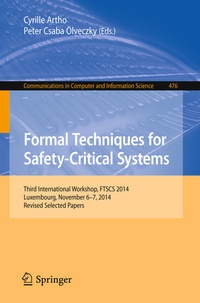
Formal Techniques for Safety-Critical Systems
Third International Workshop, FTSCS 2014, Luxembourg, November 6-7, 2014. Revised Selected Papers
Published on 23. April 2015
Book
Paperback/Softback
X, 257 pages
978-3-319-17580-5 (ISBN)
Description
This book constitutes the refereed proceedings of the Third International Workshop on Formal Techniques for Safety-Critical Systems, FTSCS 2014, held in Luxembourg, in November 2014. The 14 revised full papers presented together with two invited talks were carefully reviewed and selected from 40 submissions. The papers address various topics related to the application of formal and semi-formal methods to improve the quality of safety-critical computer systems.
More details
Series
Edition
2015 ed.
Language
English
Place of publication
Cham
Switzerland
Publishing group
Springer International Publishing
Target group
Professional and scholarly
Research
Illustrations
86 s/w Abbildungen
X, 257 p. 86 illus.
Dimensions
Height: 235 mm
Width: 155 mm
Thickness: 15 mm
Weight
411 gr
ISBN-13
978-3-319-17580-5 (9783319175805)
DOI
10.1007/978-3-319-17581-2
Schweitzer Classification
Other editions
Additional editions
Cyrille Artho | Peter Csaba Ölveczky
Formal Techniques for Safety-Critical Systems
Third International Workshop, FTSCS 2014, Luxembourg, November 6-7, 2014. Revised Selected Papers
E-Book
04/2015
Springer
€53.49
Available for download
Content
Case studies and experience reports on the use of formal methods for analyzing.- Safety-critical systems.- Methods, techniques, and tools to support automated analysis, certifcation, and debugging of complex safety/QoS-critical systems.- Analysis methods that address the limitations of formal methods in industry.- Formal analysis support for modeling languages used in industry.- Code generation from validated models.- Methods, techniques, and tools to support automated analysis, certifcation, and debugging of complex safety/QoS-critical systems.- Analysis methods that address the limitations of formal methods in industry.- Formal analysis support for modeling languages used in industry.- Code generation from validated models.