

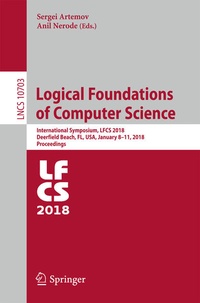
Logical Foundations of Computer Science
International Symposium, LFCS 2018, Deerfield Beach, FL, USA, January 8-11, 2018, Proceedings
Published on 28. November 2017
Book
Paperback/Softback
X, 369 pages
978-3-319-72055-5 (ISBN)
Description
This book constitutes the refereed proceedings of the International Symposium on Logical Foundations of Computer Science, LFCS 2018, held in Deerfield Beach, FL, USA, in January 2018.
The 22 revised full papers were carefully reviewed and selected from 22 submissions. The scope of the Symposium is broad and includes constructive mathematics and type theory; homotopy type theory; logic, automata, and automatic structures; computability and randomness; logical foundations of programming; logical aspects of computational complexity; parameterized complexity; logic programming and constraints; automated deduction and interactive theorem proving; logical methods in protocol and program verification; logical methods in program specification and extraction; domain theory logics; logical foundations of database theory; equational logic and term rewriting; lambda andcombinatory calculi; categorical logic and topological semantics; linear logic; epistemic and temporal logics; intelligent and multiple-agent system logics; logics of proof and justification; non-monotonic reasoning; logic in game theory and social software; logic of hybrid systems; distributed system logics; mathematical fuzzy logic; system design logics; and other logics in computer science.
The 22 revised full papers were carefully reviewed and selected from 22 submissions. The scope of the Symposium is broad and includes constructive mathematics and type theory; homotopy type theory; logic, automata, and automatic structures; computability and randomness; logical foundations of programming; logical aspects of computational complexity; parameterized complexity; logic programming and constraints; automated deduction and interactive theorem proving; logical methods in protocol and program verification; logical methods in program specification and extraction; domain theory logics; logical foundations of database theory; equational logic and term rewriting; lambda andcombinatory calculi; categorical logic and topological semantics; linear logic; epistemic and temporal logics; intelligent and multiple-agent system logics; logics of proof and justification; non-monotonic reasoning; logic in game theory and social software; logic of hybrid systems; distributed system logics; mathematical fuzzy logic; system design logics; and other logics in computer science.
More details
Series
Edition
1st ed. 2018
Language
English
Place of publication
Cham
Switzerland
Publishing group
Springer International Publishing
Target group
Professional and scholarly
Illustrations
17 s/w Abbildungen
X, 369 p. 17 illus.
Dimensions
Height: 235 mm
Width: 155 mm
Thickness: 21 mm
Weight
575 gr
ISBN-13
978-3-319-72055-5 (9783319720555)
DOI
10.1007/978-3-319-72056-2
Schweitzer Classification
Other editions
Additional editions
Sergei Artemov | Anil Nerode
Logical Foundations of Computer Science
International Symposium, LFCS 2018, Deerfield Beach, FL, USA, January 8-11, 2018, Proceedings
E-Book
12/2017
Springer
€53.49
Available for download
Content
Constructive mathematics and type theory.- Homotopy type theory.- Logic, automata, and automatic structures.- Computability and randomness.- Logical foundations of programming.- Logical aspects of computational complexity.- Parameterized complexity.- Logic programming and constraints.- Automated deduction and interactive theorem proving.- Logical methods in protocol and program verification.- Logical methods in program specification and extraction.- Domain theory logics.- Logical foundations of database theory.- Equational logic and term rewriting.- Lambda and combinatory calculi.- Categorical logic and topological semantics.- Linear logic.- Epistemic and temporal logics.- Intelligent and multiple-agent system logics.- Logics of proof and justification.- Non-monotonic reasoning.- Logic in game theory and social software.- Logic of hybrid systems.- Distributed system logics.- Mathematical fuzzy logic.- System design logics.