

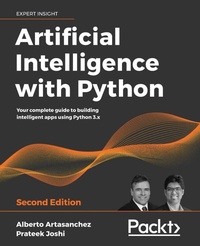
Artificial Intelligence with Python
Your complete guide to building intelligent apps using Python 3.x
2nd Edition
Published on 31. January 2020
Book
Paperback/Softback
618 pages
978-1-83921-953-5 (ISBN)
Description
New edition of the bestselling guide to artificial intelligence with Python, updated to Python 3.x, with seven new chapters that cover RNNs, AI and Big Data, fundamental use cases, chatbots, and more.
Key Features
Completely updated and revised to Python 3.x
New chapters for AI on the cloud, recurrent neural networks, deep learning models, and feature selection and engineering
Learn more about deep learning algorithms, machine learning data pipelines, and chatbots
Book DescriptionArtificial Intelligence with Python, Second Edition is an updated and expanded version of the bestselling guide to artificial intelligence using the latest version of Python 3.x. Not only does it provide you an introduction to artificial intelligence, this new edition goes further by giving you the tools you need to explore the amazing world of intelligent apps and create your own applications.
This edition also includes seven new chapters on more advanced concepts of Artificial Intelligence, including fundamental use cases of AI; machine learning data pipelines; feature selection and feature engineering; AI on the cloud; the basics of chatbots; RNNs and DL models; and AI and Big Data.
Finally, this new edition explores various real-world scenarios and teaches you how to apply relevant AI algorithms to a wide swath of problems, starting with the most basic AI concepts and progressively building from there to solve more difficult challenges so that by the end, you will have gained a solid understanding of, and when best to use, these many artificial intelligence techniques.What you will learn
Understand what artificial intelligence, machine learning, and data science are
Explore the most common artificial intelligence use cases
Learn how to build a machine learning pipeline
Assimilate the basics of feature selection and feature engineering
Identify the differences between supervised and unsupervised learning
Discover the most recent advances and tools offered for AI development in the cloud
Develop automatic speech recognition systems and chatbots
Apply AI algorithms to time series data
Who this book is forThe intended audience for this book is Python developers who want to build real-world Artificial Intelligence applications. Basic Python programming experience and awareness of machine learning concepts and techniques is mandatory.
Key Features
Completely updated and revised to Python 3.x
New chapters for AI on the cloud, recurrent neural networks, deep learning models, and feature selection and engineering
Learn more about deep learning algorithms, machine learning data pipelines, and chatbots
Book DescriptionArtificial Intelligence with Python, Second Edition is an updated and expanded version of the bestselling guide to artificial intelligence using the latest version of Python 3.x. Not only does it provide you an introduction to artificial intelligence, this new edition goes further by giving you the tools you need to explore the amazing world of intelligent apps and create your own applications.
This edition also includes seven new chapters on more advanced concepts of Artificial Intelligence, including fundamental use cases of AI; machine learning data pipelines; feature selection and feature engineering; AI on the cloud; the basics of chatbots; RNNs and DL models; and AI and Big Data.
Finally, this new edition explores various real-world scenarios and teaches you how to apply relevant AI algorithms to a wide swath of problems, starting with the most basic AI concepts and progressively building from there to solve more difficult challenges so that by the end, you will have gained a solid understanding of, and when best to use, these many artificial intelligence techniques.What you will learn
Understand what artificial intelligence, machine learning, and data science are
Explore the most common artificial intelligence use cases
Learn how to build a machine learning pipeline
Assimilate the basics of feature selection and feature engineering
Identify the differences between supervised and unsupervised learning
Discover the most recent advances and tools offered for AI development in the cloud
Develop automatic speech recognition systems and chatbots
Apply AI algorithms to time series data
Who this book is forThe intended audience for this book is Python developers who want to build real-world Artificial Intelligence applications. Basic Python programming experience and awareness of machine learning concepts and techniques is mandatory.
More details
Edition
2nd Revised edition
Language
English
Place of publication
Birmingham
United Kingdom
Target group
Professional and scholarly
US School Grade: College Graduate Student
Edition type
Revised edition
Dimensions
Height: 235 mm
Width: 191 mm
Thickness: 34 mm
Weight
1136 gr
ISBN-13
978-1-83921-953-5 (9781839219535)
Copyright in bibliographic data and cover images is held by Nielsen Book Services Limited or by the publishers or by their respective licensors: all rights reserved.
Schweitzer Classification
Other editions
Additional editions
Alberto Artasanchez | Prateek Joshi
Artificial Intelligence with Python
Your complete guide to building intelligent apps using Python 3.x
E-Book
09/2024
2nd Edition
Packt Publishing
€32.99
Available for download
Persons
Alberto Artasanchez is a solutions architect with expertise in the cloud, data solutions, and machine learning, with a career spanning over 28 years in various industries. He is an AWS Ambassador and publishes frequently in a variety of cloud and data science publications. He is often tapped as a speaker on topics including data science, big data, and analytics. He has a strong and extensive track record of designing and building end-to-end machine learning platforms at scale. He also has a long track record of leading data engineering teams and mentoring, coaching, and motivating them. He has a great understanding of how technology drives business value and has a passion for creating elegant solutions to complicated problems. Prateek Joshi is the founder of Plutoshift and a published author of 9 books on Artificial Intelligence. He has been featured on Forbes 30 Under 30, NBC, Bloomberg, CNBC, TechCrunch, and The Business Journals. He has been an invited speaker at conferences such as TEDx, Global Big Data Conference, Machine Learning Developers Conference, and Silicon Valley Deep Learning. Apart from Artificial Intelligence, some of the topics that excite him are number theory, cryptography, and quantum computing. His greater goal is to make Artificial Intelligence accessible to everyone so that it can impact billions of people around the world.
Content
Table of Contents
Introduction to Artificial Intelligence
Fundamental Use Cases for Artificial Intelligence
Machine Learning Pipelines
Feature Selection and Feature Engineering
Classification and Regression Using Supervised Learning
Predictive Analytics with Ensemble Learning
Detecting Patterns with Unsupervised Learning
Building Recommender Systems
Logic Programming
Heuristic Search Techniques
Genetic Algorithms and Genetic Programming
Artificial Intelligence on the Cloud
Building Games with Artificial Intelligence
Building a Speech Recognizer
Natural Language Processing
Chatbots
Sequential Data and Time Series Analysis
Image Recognition
Neural Networks
Deep Learning with Convolutional Neural Networks
Recurrent Neural Networks and Other Deep Learning Models
Creating Intelligent Agents with Reinforcement Learning
Artificial Intelligence and Big Data
Introduction to Artificial Intelligence
Fundamental Use Cases for Artificial Intelligence
Machine Learning Pipelines
Feature Selection and Feature Engineering
Classification and Regression Using Supervised Learning
Predictive Analytics with Ensemble Learning
Detecting Patterns with Unsupervised Learning
Building Recommender Systems
Logic Programming
Heuristic Search Techniques
Genetic Algorithms and Genetic Programming
Artificial Intelligence on the Cloud
Building Games with Artificial Intelligence
Building a Speech Recognizer
Natural Language Processing
Chatbots
Sequential Data and Time Series Analysis
Image Recognition
Neural Networks
Deep Learning with Convolutional Neural Networks
Recurrent Neural Networks and Other Deep Learning Models
Creating Intelligent Agents with Reinforcement Learning
Artificial Intelligence and Big Data