

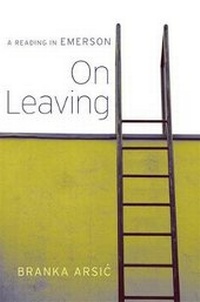
On Leaving
A Reading in Emerson
Published on 15. April 2010
Book
Hardback
404 pages
978-0-674-05073-0 (ISBN)
Description
In his essay "Compensation," Emerson makes a surprising claim: "Every soul is by this intrinsic necessity quitting its whole system of things, its friends, and home, and laws, and faith, as the shell-fish crawls out of its beautiful but stony case, because it no longer admits of its growth, and slowly forms a new house."
Branka Arsic unpacks Emerson's repeated assertion that our reality and our minds are in constant flux. Arsic's readings of a broad range of Emerson's writings-the Early Lectures, Journals and Notebooks, and later lectures-are guided by a central question: what does it really mean to maintain that everything fluctuates, is relational, and so changes its identity?
Reading Emerson through this lens, Arsic asks: How is the leaving of one's own consciousness actually to be performed? What kind of relationship is predicated on the necessity of leaving? What does it mean for our system of values, our ethics and our political allegiances, and even our personal identities to be on the move? The bold new understanding of Emerson that results redefines inherited concepts of the Emersonian individual as all-composed, willful, appropriative, and self-reliant. In its place, Arsic reveals an Emersonian individual whose ideal being is founded in mutability.
Branka Arsic unpacks Emerson's repeated assertion that our reality and our minds are in constant flux. Arsic's readings of a broad range of Emerson's writings-the Early Lectures, Journals and Notebooks, and later lectures-are guided by a central question: what does it really mean to maintain that everything fluctuates, is relational, and so changes its identity?
Reading Emerson through this lens, Arsic asks: How is the leaving of one's own consciousness actually to be performed? What kind of relationship is predicated on the necessity of leaving? What does it mean for our system of values, our ethics and our political allegiances, and even our personal identities to be on the move? The bold new understanding of Emerson that results redefines inherited concepts of the Emersonian individual as all-composed, willful, appropriative, and self-reliant. In its place, Arsic reveals an Emersonian individual whose ideal being is founded in mutability.
Reviews / Votes
Branka Arsic's On Leaving: A Reading in Emerson is an intellectual feast... Arsic calls herself an 'archaeologist of Emerson's thinking,' no easy task considering not just the amount of Emerson's writing (the journals alone run to sixteen volumes) but its relentless idiosyncrasy... Arsic makes Emerson into one of the great nineteenth-century moderns... It is no exaggeration to say that On Leaving will take its place among the benchmarks of Emerson scholarship of the past hundred years... One can't help but be captivated by Arsic's archaeology. And even if we remain (alertly, admiringly) skeptical about the idea of winding Emerson's unruly intelligence around a single idea, that doesn't make this book any less fun to read or any less essential. -- Paul Grimstad * Bookforum * Arsic unveils an Emerson we have not seen before, a compelling new Emerson, emphatically urban, modern, and cosmopolitan. Arsic gives us an Emerson to set next to Baudelaire (who admired and quoted Emerson) and Benjamin and Simmel. On Leaving, appropriately enough, demands our leaving, our abandonment, of the Emerson we thought we knew. -- Ross Posnock, Columbia University Branka Arsic's On Leaving excavates passages from Emerson's letters, lectures, and essays, both the celebrated and the less well known. These passages uncannily ground one another in Arsic's thrilling analysis, revealing something like a cross-section of Emersonian thinking. Her readings contribute to a broader investigation of the epistemological, ethical, and political implications of the transitory and the nomadic in everyday life. This book will be important to anyone who prizes a scrupulous and original examination of an intriguing and difficult topic. It contains some of the best writing on Emerson in the past decade. -- Sharon Cameron, Johns Hopkins University Arsic's book is essential reading for anyone thinking about Emerson. It is one of the most important and certainly most original books ever published on Emerson. No one should read his work seriously again without reading Arsic as a companion. She makes Emerson the thinker for our moment. -- Virginia Jackson, Tufts UniversityMore details
Language
English
Place of publication
Cambridge, Mass
United States
Target group
Professional and scholarly
Dimensions
Height: 235 mm
Width: 156 mm
ISBN-13
978-0-674-05073-0 (9780674050730)
Copyright in bibliographic data and cover images is held by Nielsen Book Services Limited or by the publishers or by their respective licensors: all rights reserved.
Schweitzer Classification
Person
Branka Arsic is Professor in the Department of English and Comparative Literature at Columbia University.