

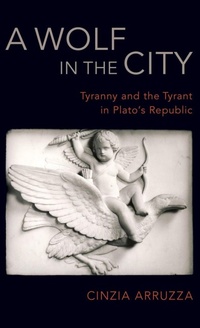
A Wolf in the City
Tyranny and the Tyrant in Plato's Republic
Published on 8. November 2018
Book
Hardback
312 pages
978-0-19-067885-2 (ISBN)
Description
The problem of tyranny preoccupied Plato, and its discussion both begins and ends his famous Republic. Though philosophers have mined the Republic for millennia, Cinzia Arruzza is the first to devote a full book to the study of tyranny and of the tyrant's soul in Plato's Republic.
In A Wolf in the City, Arruzza argues that Plato's critique of tyranny intervenes in an ancient debate concerning the sources of the crisis of Athenian democracy and the relation between political leaders and demos in the last decades of the fifth century BCE. Arruzza shows that Plato's critique of tyranny should not be taken as veiled criticism of the Syracusan tyrannical regime, but rather of Athenian democracy. In parsing Plato's discussion of the soul of the tyrant, Arruzza will also offer new and innovative insights into his moral psychology, addressing much-debated problems such as the nature of eros and of the spirited part of the soul, the unity or disunity of the soul, and the relation between the non-rational parts of the soul and reason.
In A Wolf in the City, Arruzza argues that Plato's critique of tyranny intervenes in an ancient debate concerning the sources of the crisis of Athenian democracy and the relation between political leaders and demos in the last decades of the fifth century BCE. Arruzza shows that Plato's critique of tyranny should not be taken as veiled criticism of the Syracusan tyrannical regime, but rather of Athenian democracy. In parsing Plato's discussion of the soul of the tyrant, Arruzza will also offer new and innovative insights into his moral psychology, addressing much-debated problems such as the nature of eros and of the spirited part of the soul, the unity or disunity of the soul, and the relation between the non-rational parts of the soul and reason.
Reviews / Votes
Arruzza brings to light important differences between democracy and liberalism (p. 99). Freedom and popular rule do not always go together, and through the cracks of this relation the wolf may well appear. This is, to my view, a precious contribution Arruzza makes both to Platonic scholarship and to the understanding of our own time. * Carolina Araujo, Federal University of Rio de Janeiro, Etudes Platoniennes * a fine and entirely commendable book on Plato's Republic. It provokes many questions and thoughts in interpreting Plato's political philosophy from a refreshingly new angle. * Jakub Jirsa, Bryn Mawr Classical Review * In sum, this is an excellent book. It feels genuinely original and fresh. Its main claims are based on meticulous analysis of the relevant texts. Relevant scholarly literature is closely engaged, and yet, thankfully, such engagement does not bog down the discussion. The writing is crisp and clear, and the argument moves briskly. The book can safely be recommended to anyone interested in Plato's Republic, his political philosophy, his moral psychology, or classical political thought more generally. * Mark A. Johnstone, Journal of the History of Philosophy * In her analysis of the textual details of theRepublic, Arruzza's work is masterful. She carefully handles everything from the historical minutiae of aristocratic clubs, to analyses of Plato's biological and animal metaphors. * Philosophical Quarterly * [The book] is major contribution to scholarship. Its detailed analysis of the psychological condition of the tyrant is the fullest and best treatment we have of this subject. Its setting of Plato's portrait into its literary and political context is equally impressive and valuable. It is a book that should be read by every scholar and student of Plato's moral and political philosophy. * Richard Kraut, Notre Dame Philosophical Reviews * Summing up: Recommended * CHOICE *More details
Language
English
Place of publication
New York
United States
Target group
College/higher education
Professional and scholarly
Dimensions
Height: 222 mm
Width: 145 mm
Thickness: 20 mm
Weight
526 gr
ISBN-13
978-0-19-067885-2 (9780190678852)
Copyright in bibliographic data and cover images is held by Nielsen Book Services Limited or by the publishers or by their respective licensors: all rights reserved.
Schweitzer Classification
Other editions
Additional editions
E-Book
09/2018
OUP eBook
€40.49
Available for download
E-Book
09/2018
OUP eBook
€52.49
Available for download
Person
Cinzia Arruzza is Associate Professor of Philosophy at the New School for Social Research in New York. She works on ancient philosophy and Marxist and feminist theory. She is the author of Plotinus. Ennead II 5. On What is Potentially and What Actually (Parmenides, 2015); Dangerous Liaisons. Marriages and Divorces of Marxism and Feminism (Merlin Press, 2013); Les Mesaventures de la theodicee. Plotin, Origene et Gregoire de Nysse (Brepols Publishers, 2011).
Content
Acknowledgments
Introduction Part I: Tyranny and Democracy
Introduction
Chapter 1: Tyranny in Athens: Aversion, Fascination, and Fear
Chapter 2: Plato's Tyrant and the Crisis of Athenian Democracy
Chapter 3: Tyrannical Democracy Part II: The Tyrant's Soul
Introduction
Chapter 4: The Tyranny of Eros and the Tyrannical Man's Appetites
Chapter 5: The Lion and the Wolf: The Tyrant's Spirit
Chapter 6: Clever Villains: The Tyrant's Reason
Conclusion References
General Index
Index Locorum
Introduction Part I: Tyranny and Democracy
Introduction
Chapter 1: Tyranny in Athens: Aversion, Fascination, and Fear
Chapter 2: Plato's Tyrant and the Crisis of Athenian Democracy
Chapter 3: Tyrannical Democracy Part II: The Tyrant's Soul
Introduction
Chapter 4: The Tyranny of Eros and the Tyrannical Man's Appetites
Chapter 5: The Lion and the Wolf: The Tyrant's Spirit
Chapter 6: Clever Villains: The Tyrant's Reason
Conclusion References
General Index
Index Locorum