

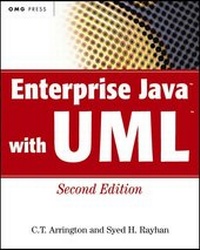
Enterprise Java with UML
2nd Edition
Published on 6. June 2003
Book
Paperback/Softback
688 pages
978-0-471-26778-2 (ISBN)
Description
* The first book to show Java programmers how to utilize UML when building applications is now completely up-to-date with new coverage on UML 2.0, JCP UML to EJB Mappings, J2EE 1.4, and Web services
* Breaks down common situations that a development team will most likely face in the field and discusses the tradeoffs of using different technologies in different combinations
* Companion Web site includes the code for the full working sample application used in the book as well as third-party software
* Breaks down common situations that a development team will most likely face in the field and discusses the tradeoffs of using different technologies in different combinations
* Companion Web site includes the code for the full working sample application used in the book as well as third-party software
More details
Series
Edition
2. Auflage
Language
English
Place of publication
New York
United States
Publishing group
John Wiley and Sons Ltd
Target group
Professional and scholarly
Edition type
Revised edition
Illustrations
Illustrations
Dimensions
Height: 23.4 cm
Width: 19.7 cm
Thickness: 3.6 cm
Weight
1240 gr
ISBN-13
978-0-471-26778-2 (9780471267782)
Schweitzer Classification
Other editions
Previous edition
C. T. Arrington
Enterprise Java with UML
How to Use UML to Model Enterprise JavaBeans, Swing Components, CORBA, and Other Popular Technologies
Book
02/2001
Wiley
€54.90
Article exhausted; check for reprint
Persons
C.T. ARRINGTON is an architect and development manager with Capital One, where he specializes in architecting N-tier systems in Java.
SYED H. RAYHAN is an architect specializing in enterprise applications in Java. He is currently working as a consultant for a Fortune 100 financial company where he is implementing a J2EE system to support the client's complex mortgage business.
SYED H. RAYHAN is an architect specializing in enterprise applications in Java. He is currently working as a consultant for a Fortune 100 financial company where he is implementing a J2EE system to support the client's complex mortgage business.
Content
Chapter 1. Introduction to Modeling Java with the UML.
Chapter 2. Gathering Requirements with UML.
Chapter 3. Gathering Requirements for the Timecard Application.
Chapter 4. A Brief Introduction to Object-Oriented Analysis with the UML.
Chapter 5. Analysis Model for the Timecard Application.
Chapter 6. Describing the System for Technology Selection.
Chapter 7. Evaluating Candidate Technologies for Shared Services.
Chapter 8. HTML Production.
Chapter 9. Evaluating Candidate Technologies for User Interface Classes.
Chapter 10. Evaluating Candidate Technologies for System Interface.
Chapter 11. Evaluating Web Service Technologies for System Interface.
Chapter 12. Evaluating Candidate Technologies for Control and Entity Classes.
Chapter 13. Software Architecture.
Chapter 14. Introduction to Design.
Chapter 15. Design for the Timecard Domain and Timecard Workflow.
Chapter 16. Design for the Timecard UI Package.
Chapter 17. Design for Billing System Interface.
Chapter 2. Gathering Requirements with UML.
Chapter 3. Gathering Requirements for the Timecard Application.
Chapter 4. A Brief Introduction to Object-Oriented Analysis with the UML.
Chapter 5. Analysis Model for the Timecard Application.
Chapter 6. Describing the System for Technology Selection.
Chapter 7. Evaluating Candidate Technologies for Shared Services.
Chapter 8. HTML Production.
Chapter 9. Evaluating Candidate Technologies for User Interface Classes.
Chapter 10. Evaluating Candidate Technologies for System Interface.
Chapter 11. Evaluating Web Service Technologies for System Interface.
Chapter 12. Evaluating Candidate Technologies for Control and Entity Classes.
Chapter 13. Software Architecture.
Chapter 14. Introduction to Design.
Chapter 15. Design for the Timecard Domain and Timecard Workflow.
Chapter 16. Design for the Timecard UI Package.
Chapter 17. Design for Billing System Interface.