

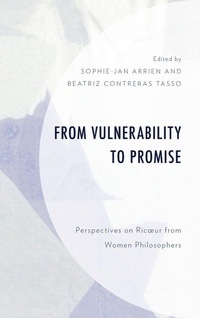
From Vulnerability to Promise
Perspectives on Ricoeur from Women Philosophers
Published on 12. February 2025
Book
Hardback
248 pages
978-1-6669-3359-8 (ISBN)
Description
From the outset, Paul Ricoeur's work gives centrality to man's bodily and sensitive nature-his primordial affectivity and fragility-as sources of free action. From Vulnerability to Promise: Perspectives on Ricoeur from Women Philosophers explores this dimension and its ethical, political, and conceptual implications, focusing on the embodied dimension of existence, its vulnerability, and its possibilities of attestation and recognition. Edited by Sophie-Jan Arrien and Beatriz Contreras, this book examines the relationships-passivity and activity, mind and body, singularity and sociality, finitude and transcendence-that lie at the heart of Ricoeur's philosophical anthropology, revealing its ontological richness and ethical significance. Within this dimension, the ten contributors approach personal human identity in Ricoeur's work from multiple perspectives: the narrative dimension of understanding; birth and privacy; freedom and recognition; love and consent; justice and respect in the face of abuse; the vulnerability of our natural environment; our inescapable finitude. These viewpoints are informed by both their vision as women philosophers, empowering their embodied condition in a reflexive way, and the urgency of reflecting on the human condition in order to find continuity between its passionate, affective, and finite forces.
Reviews / Votes
This is a timely and engaging volume on the hermeneutic conversation between affectivity, narrativity, and finitude in the work of Paul Ricoeur. It marks an invaluable contribution to the understanding of our fundamental human vulnerability. -- Richard Kearney, Boston College It is rightly argued that women scholars often contribute to intellectual domains in three overlapping ways: by gaining an equal voice within a discipline, by offering a new voice that raises original issues within the discipline, and by providing a different voice that challenges and rethinks the discipline. All three are evident in this important text, where ten women philosophers build on and respond to the work of Paul Ricoeur. Arguing against historically prevailing theories, the contributions argue for a self that is relational both internally-combining the rational and the affective, reason and embodiment, the voluntary and the involuntary, capability and fragility, narrative continuity and discontinuity-and externally-with others in horizontal recognition, including those often excluded and extending to relations with nature. In awareness of our finitude, the goal is situated practical wisdom. It is a tribute to Ricoeur that the authors find in his thought a sufficiently sympathetic sensibility that he is worth engaging, even as they enrich, extend, and restructure his work. The collection is also to be commended for bringing to readers in English the voices of talented women philosophers at varying stages of scholarly entry and of very diverse international and language backgrounds. -- George Taylor, University of Pittsburgh Exploring the question of the incarnated self and its existential condition of finitude in Ricoeur's philosophical anthropology and starting from it, by giving a voice to women philosophers, is the challenge this book wants to address . In a highly innovative and convincing manner, Beatriz Contreras Tasso and Sophie-Jan Arrien introduce us to the plural, embodied and situated gaze of women philosophers - from different generations, backgrounds, countries and languages - on phenomenological and hermeneutical approaches to the central questions of affectivity, the lived body, narrative identity, the vulnerability and capability of the self at work in Ricoeur's philosophy. -- Jean-Luc Amalric, EHESS Paris The aim of this timely and invigorating collection of essays is to display how women philosophers have responded to the diversified works of Paul Ricoeur, one of the 20th century's most influential French thinkers ... Thinking with and beyond Ricoeur when taken as a whole, they each are well written, instructive, and meritorious. Highly recommended [for] advanced undergraduates through faculty * CHOICE *More details
Series
Language
English
Place of publication
United States
Publishing group
Bloomsbury Publishing Plc
Target group
College/higher education
Dimensions
Height: 235 mm
Width: 157 mm
Thickness: 18 mm
Weight
537 gr
ISBN-13
978-1-6669-3359-8 (9781666933598)
Copyright in bibliographic data and cover images is held by Nielsen Book Services Limited or by the publishers or by their respective licensors: all rights reserved.
Schweitzer Classification
Other editions
Additional editions
E-Book
01/2025
1st Edition
Lexington Books
€90.99
Available for download
E-Book
01/2025
Lexington Books
€90.99
Available for download
Persons
Sophie-Jan Arrien is full professor of philosophy at Universite Laval, Quebec.
Beatriz Contreras Tasso is tenured professor of philosophy at Pontifical Catholic University.
Beatriz Contreras Tasso is tenured professor of philosophy at Pontifical Catholic University.
Content
Introduction: Paul Ricoeur: Reception of an Ontology of Finitude and Capability, by Beatriz Contreras Tasso and Sophie-Jan Arrien
Part I: Affectivity and Embodiment
Chapter 1: The Space of Affectivity in the Architecture of the Capable Self, by Beatriz Contreras Tasso
Chapter 2: Recognition and Consent: Images of Love in Paul Ricoeur, by Francesca d'Alessandris
Chapter 3: The Birth and Symbolism of Passivity: Thinking with Paul Ricoeur, by Carla Canullo (translated by Marco Dozzi)
Chapter 4: Body, Freedom and Recognition in the Beginnings of Paul Ricoeur Philosophy, by Alejandra Bertucci and Maria Lujan Ferrari
Part II: Identity and Narrative
Chapter 5: Are There Authentic Self-Narratives? A Discussion with Paul Ricoeur and Judith Butler, by Chiara Pavan
Chapter 6: Mirrors of Identity, by Monica Gorza
Chapter 7: No more Storyteller? Narrative Theories of Paul Ricoeur and Walter Benjamin in Dispute, by Jeanne Marie Gagnebin (translated by Samuel Lelievre)
Part III: Opening perspectives
Chapter 8: The Natural World as a Vulnerable Household: Paul Ricoeur and Erazim Kohak in Dialogue, by Maria Cristina Clorinda Vendra
Chapter 9: Just Distance in Interaction. Asymmetries and Abuses, by Gaelle Fiasse
Chapter 10: Thinking Finitude as a Finite Thinker. On the Philosophical Practice of Paul Ricoeur, by Sophie-Jan Arrien
Part I: Affectivity and Embodiment
Chapter 1: The Space of Affectivity in the Architecture of the Capable Self, by Beatriz Contreras Tasso
Chapter 2: Recognition and Consent: Images of Love in Paul Ricoeur, by Francesca d'Alessandris
Chapter 3: The Birth and Symbolism of Passivity: Thinking with Paul Ricoeur, by Carla Canullo (translated by Marco Dozzi)
Chapter 4: Body, Freedom and Recognition in the Beginnings of Paul Ricoeur Philosophy, by Alejandra Bertucci and Maria Lujan Ferrari
Part II: Identity and Narrative
Chapter 5: Are There Authentic Self-Narratives? A Discussion with Paul Ricoeur and Judith Butler, by Chiara Pavan
Chapter 6: Mirrors of Identity, by Monica Gorza
Chapter 7: No more Storyteller? Narrative Theories of Paul Ricoeur and Walter Benjamin in Dispute, by Jeanne Marie Gagnebin (translated by Samuel Lelievre)
Part III: Opening perspectives
Chapter 8: The Natural World as a Vulnerable Household: Paul Ricoeur and Erazim Kohak in Dialogue, by Maria Cristina Clorinda Vendra
Chapter 9: Just Distance in Interaction. Asymmetries and Abuses, by Gaelle Fiasse
Chapter 10: Thinking Finitude as a Finite Thinker. On the Philosophical Practice of Paul Ricoeur, by Sophie-Jan Arrien