

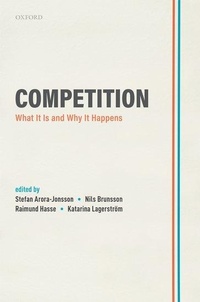
Competition
What It Is and Why It Happens
Published on 2. July 2021
Book
Hardback
258 pages
978-0-19-289801-2 (ISBN)
Description
One of the predominant trends of modern society is the pervasive presence of competition. No longer just a function of economic markets or democratic systems, competition has become a favoured tool for governing people and organizations, from the provision of schooling and elder care to the way we consume popular culture. Yet social scientists have played a surprisingly modest role in analysing its implications, as the discussion of competition has largely been confined to its narrow economic meaning.
This book opens up competition for the study of social scientists. Its central message is that while competition seems ubiquitous, it should not be taken for granted or be naturalized as an inevitable aspect of human existence. Its emergence, maintenance, and change are based on institutions and organizational efforts, and a central challenge for social science is to learn more about these processes and their outcomes.
With the use of a novel definition of competition, more fundamental questions can be addressed than merely whether or not competition works. How is competition constructed - and by whom? Which behaviours result from competition? What are its consequences? Can competition be removed? And, how do these factors vary with the object of competition - be it money, attention, status, or other scarce and desired objects? This book investigates these and more questions in studies of competition among and within schools, universities, multinational corporations, auditors, waste-disposal firms, fashion designers, and more.
This book opens up competition for the study of social scientists. Its central message is that while competition seems ubiquitous, it should not be taken for granted or be naturalized as an inevitable aspect of human existence. Its emergence, maintenance, and change are based on institutions and organizational efforts, and a central challenge for social science is to learn more about these processes and their outcomes.
With the use of a novel definition of competition, more fundamental questions can be addressed than merely whether or not competition works. How is competition constructed - and by whom? Which behaviours result from competition? What are its consequences? Can competition be removed? And, how do these factors vary with the object of competition - be it money, attention, status, or other scarce and desired objects? This book investigates these and more questions in studies of competition among and within schools, universities, multinational corporations, auditors, waste-disposal firms, fashion designers, and more.
Reviews / Votes
an inspiring contribution to the conceptual discussion of competition in the social sciences and beyond. * Ana Rogojanu, Georg Wolfmayr, Department of European Ethnology, University of Vienna, Economic Sociology * Competition offers a program for research, parsing competition into four elements: actors, relationships, desire, and scarcity (p. 6). That structure is valuable; it provides a framework for exploring how competition originates in and brings meaning to different sectors of society. * Mark J. Zbaracki, Ivey Business School, Administrative Science Quarterly * Prizes, contests, league tables-much of social life has been transformed into a sport. The essays in this fascinating volume make sense of both the allure and the costs of vying to be at the top of the charts, and reveal the massive social construction project that undergirds competing. * Walter W. Powell, Stanford University * In a welcome return to a classic theme in social science, this book goes beyond the standard economic analysis of competition in markets to help us understand who brokers competition and how it plays out, using case studies ranging from Christmas decorations to food waste rankings. A serious and important analysis. * Christopher Hood, University of Oxford * This exceptional volume gathers a variety of provocative papers that as a whole set a new, important agenda on the sources and consequences (good and bad) of competition. It is a must read for anyone interested in understanding how competition has become a default solution for many aspects of social and economic life, and how we should become more mindful about embracing it as a cure-all for problems we face. * Michael Lounsbury, University of Alberta * A strength...is the diverse settings they accumulate to show the range of settings in which competition and performance measures are used. * Mark J. Zbaracki, Administrative Science Quarterly *More details
Language
English
Place of publication
Oxford
United Kingdom
Target group
Professional and scholarly
Product notice
sewn/stitched
Cloth over boards
Dimensions
Height: 170 mm
Width: 183 mm
Thickness: 20 mm
Weight
567 gr
ISBN-13
978-0-19-289801-2 (9780192898012)
Copyright in bibliographic data and cover images is held by Nielsen Book Services Limited or by the publishers or by their respective licensors: all rights reserved.
Schweitzer Classification
Other editions
Additional editions
E-Book
06/2021
1st Edition
OUP eBook
€80.49
Available for download
E-Book
06/2021
1st Edition
OUP eBook
€80.49
Available for download
Persons
Stefan Arora-Jonsson is Chair in Organization and Society at Uppsala University, Sweden.
Nils Brunsson is Professor of Management affiliated with Uppsala University and the Stockholm Centre for Organizational Research (SCORE), Sweden.
Raimund Hasse is Professor of Sociology and Head of the Institute for Sociology at the University of Lucerne, Switzerland.
Katarina Lagerstroem is Associate Professor in Business Studies at Uppsala University, Sweden.
Nils Brunsson is Professor of Management affiliated with Uppsala University and the Stockholm Centre for Organizational Research (SCORE), Sweden.
Raimund Hasse is Professor of Sociology and Head of the Institute for Sociology at the University of Lucerne, Switzerland.
Katarina Lagerstroem is Associate Professor in Business Studies at Uppsala University, Sweden.
Editor
Chair in Organization and SocietyChair in Organization and Society, Uppsala University
Professor of ManagementProfessor of Management, Uppsala University
Professor of Sociology and Head of the Institute for SociologyProfessor of Sociology and Head of the Institute for Sociology, University of Lucerne
Associate Professor in Business StudiesAssociate Professor in Business Studies, Uppsala University
Content
1: Stefan Arora-Jonsson, Nils Brunsson, and Raimund Hasse: A New Understanding of Competition
2: Daniel Sands, Gino Cattani, Joseph Porac, and Jason Greenberg: Competition as Sensemaking
3: Patrik Aspers: Competition by Mutual Adjustment
4: Stefan Arora-Jonsson, Nils Brunsson, and Raimund Hasse: The Origins of Competition: Institution and Organization
5: Niklas Bomark, Peter Edlund, and Stefan Arora-Jonsson: Convincing Others That They are Competing: The Case of Schools
6: Nils Brunsson and Linda Wedlin: Constructing Competition for Status: Sports and Higher Education
7: Nadine Arnold: Avoiding Competition: The Effects of Rankings in the Food Waste Field
8: Karin Brunsson and Katarina Rahnert: Competition and Auditing: Esteemed but Incompatible Ideas
9: Michael Scroggins and Daniel Souleles: The Allure of Prizes: How Contests Trap Us in Competitive Relationships
10: Soren Christensen and Hanne Knudsen: The Organization of Competition and Non-Competition in Schools
11: Katarina Lagerstroem, Emilene Leite, Roger Schweizer, and Cecilia Pahlberg: Cooperating While Competing: The Case of Multinational Corporations
12: Fabien Foureault: Reversing Competition: The Case of Corporate Governance
13: Sebastian Kohl and Abraham Sapien: Debunking the Holy Trinity: Competition, Individualism, and Meritocracy
14: Stefan Arora-Jonsson, Nils Brunsson, Raimund Hasse & Katarina Lagerstroem: Competition Unbundled: Taking Stock and Looking Forward
2: Daniel Sands, Gino Cattani, Joseph Porac, and Jason Greenberg: Competition as Sensemaking
3: Patrik Aspers: Competition by Mutual Adjustment
4: Stefan Arora-Jonsson, Nils Brunsson, and Raimund Hasse: The Origins of Competition: Institution and Organization
5: Niklas Bomark, Peter Edlund, and Stefan Arora-Jonsson: Convincing Others That They are Competing: The Case of Schools
6: Nils Brunsson and Linda Wedlin: Constructing Competition for Status: Sports and Higher Education
7: Nadine Arnold: Avoiding Competition: The Effects of Rankings in the Food Waste Field
8: Karin Brunsson and Katarina Rahnert: Competition and Auditing: Esteemed but Incompatible Ideas
9: Michael Scroggins and Daniel Souleles: The Allure of Prizes: How Contests Trap Us in Competitive Relationships
10: Soren Christensen and Hanne Knudsen: The Organization of Competition and Non-Competition in Schools
11: Katarina Lagerstroem, Emilene Leite, Roger Schweizer, and Cecilia Pahlberg: Cooperating While Competing: The Case of Multinational Corporations
12: Fabien Foureault: Reversing Competition: The Case of Corporate Governance
13: Sebastian Kohl and Abraham Sapien: Debunking the Holy Trinity: Competition, Individualism, and Meritocracy
14: Stefan Arora-Jonsson, Nils Brunsson, Raimund Hasse & Katarina Lagerstroem: Competition Unbundled: Taking Stock and Looking Forward