

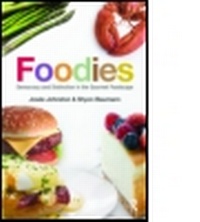
Foodies
Democracy and Distinction in the Gourmet Foodscape
1st Edition
Published on 21. January 2010
Book
Paperback/Softback
258 pages
978-0-415-96537-8 (ISBN)
Description
This important new cultural analysis tells two stories about food. The first depicts good food as democratic. Foodies frequent `hole in the wall' ethnic eateries, appreciate the pie found in working-class truck stops, and reject the snobbery of fancy French restaurants with formal table service. The second story describes how food operates as a source of status and distinction for economic and cultural elites, indirectly maintaining and reproducing social inequality. While the first storyline insists that anybody can be a foodie, the second asks foodies to look in the mirror and think about their relative social and economic privilege. By simultaneously considering both of these stories, and studying how they operate in tension, a delicious sociology of food becomes available, perfect for teaching a broad range of cultural sociology courses.
Reviews / Votes
"Food is an increasingly important status marker, but little systematic attention has been given to the subject until now. Johnston and Baumann use discourse analysis blending interviews of self-defined foodies with the "food writing" in contemporary American magazines, newspapers and books. This is a heavy topic presented with style and grace. Bravo!"-Richard A. Peterson, Vanderbilt University, USA
"In recent years the affluent classes have succeeded in appropriating regionally authentic comestibles and global cuisine as the newest markers of elite distinction and high-status snobbery. In their thoughtful book, sociologists Josee Johnston and Shyon Baumann artfully reveal the tensions and contradictions inherent in the postmodern American culinary landscape, and in our culture at large."
-David Grazian, University of Pennsylvania, USA
"Foodies offers dispassionate analysis of a passionate subculture: the people who pursue authenticity and cosmopolitanism through what they eat, where they get it, and how they talk/write/blog about it.? Bringing a wealth of sociological insights to food practices, the authors also step back to allow their subjects to speak their minds.?An excellent text for courses in cultural sociology or social movements."
-Wendy Griswold, Northwestern University, USA
"In the book, Johnston and Baumann rinse, chop, mix, and serve the foodie to the reader, and season it with adequate analytic tools and empirical material. The outcome is an interesting and convincing analysis of an American cultural phenomenon and a marriage between the sociology of food and the sociology of culture that can be replicated in other realms. The main strength of the book, in my opinion, is that it offers a pioneering attempt to explicate the motivations and historical trajectory of cultural omnivorousness (as it relates to the consumption of food), a phenomenon that has been thoroughly documented but rarely theorized."
-Tally Katz-Gerro, University of Haifa, Israel
More details
Series
Language
English
Place of publication
London
United Kingdom
Publishing group
Taylor & Francis Ltd
Target group
College/higher education
Product notice
Paperback (UK-B)
Illustrations
3 s/w Tabellen
Following Yes We Can/Cities & Creative Class; 3 Tables, black and white
Dimensions
Height: 229 mm
Width: 152 mm
Weight
384 gr
ISBN-13
978-0-415-96537-8 (9780415965378)
Copyright in bibliographic data and cover images is held by Nielsen Book Services Limited or by the publishers or by their respective licensors: all rights reserved.
Schweitzer Classification
Other editions
New editions
Book
12/2014
2nd Edition
Routledge
€72.00
Shipment within 10-20 days
Additional editions
Book
01/2010
1st Edition
Routledge
€119.20
Article exhausted; check for reprint
Persons
Josee Johnston is assistant professor of sociology at the University of Toronto. Her major area of research is the sociology of food. Her work ties together several research threads including globalization, political-ecology, culture and consumerism.
Shyon Baumann is associate professor of sociology at the University of Toronto. He studies the sociology of culture, the arts, and the media. He is the author of Hollywood Highbrow: From Entertainment to Art, and is currently studying the production and content of television advertising.
Shyon Baumann is associate professor of sociology at the University of Toronto. He studies the sociology of culture, the arts, and the media. He is the author of Hollywood Highbrow: From Entertainment to Art, and is currently studying the production and content of television advertising.
Content
1. Introduction: Gourmet Foodscapes & the Emergence of the `Foodie' 2. Eating Authenticity 3. The Culinary Other: Seeking Exoticism 4. Culinary "Classlessness" 5. Public Spaces and Food Politics: Whole Foods Market and Karma Coop 6. Consuming Gourmet Culture: Talking with Foodies 7. Conclusion