

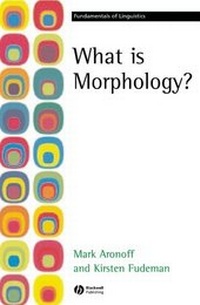
What is Morphology?
1st Edition
Published on 17. August 2004
Book
Paperback/Softback
280 pages
978-0-631-20319-3 (ISBN)
Description
Assuming only the most basic background in linguistics, What is Morphology? provides a concise, critical introduction to the central ideas and perennial problems of morphology. Designed to familiarize beginning students and specialists alike with the importance of morphology as a subject of research, this reader-friendly volume moves organically from the morphological facts of everyday life to important relationships with phonology, syntax, and semantics.What is Morphology? equips readers with the skills to analyze a wealth of classic morphological issues through engaging narration and by direct example. This includes detailed discussion of the complex morphology of one West African language, Kujamaat Jóola, and many useful exercises at the ends of the chapters.
Reviews / Votes
"Aronoff and Fudeman have provided an extremely pleasant tour of the issues in modern morphological theory for beginning students. The rich collection of exercises will be a godsend to instructors and students alike, and the thread of discussion of a single language throughout the book is a brilliant stroke that other texts should emulate." Stephen R. Anderson, Yale University"This unusual book combines a basic start on morphology with an introduction to Kujamaat Jóola. It is a fine addition to teaching materials on morphology: a book for beginners to use with a teacher, yet one from which any linguist could learn. The authors intend students to develop a lasting taste for morphology. I think many will."Greville Corbett, University of Surrey, Guildford"Morphology has its own organizing principles, distinct from those of syntax, phonology, and the lexicon. Too many morphology textbooks obscure this fascinating fact, but Aronoff and Fudeman refreshingly make it the cornerstone of their exposition."Andrew Carstairs-McCarthy, University of CanterburyMore details
Series
Edition
1., Auflage
Language
English
Place of publication
Oxford
United Kingdom
Publishing group
John Wiley and Sons Ltd
Target group
College/higher education
Professional and scholarly
undergraduate and graduate students studying morphology as well as general readers
Edition type
New edition
Dimensions
Height: 23 cm
Width: 15.6 cm
Thickness: 21 mm
Weight
410 gr
ISBN-13
978-0-631-20319-3 (9780631203193)
Schweitzer Classification
Other editions
New editions
Mark Aronoff | Kirsten Fudeman
What is Morphology?
Book
11/2010
2nd Edition
Wiley
Unfortunately, price unknown
Article exhausted; check for reprint
Persons
Mark Aronoff is Professor and Chair of Linguistics at the State University of New York, Stony Brook, and served as editor of the journal Language from 1995 to 2000. He is co-editor, with Janie Rees-Miller, of The Handbook of Linguistics (Blackwell 2001). Kirsten Fudeman is Professor of Linguistics and French at Ithaca College, and has published articles on morphology, syntax, and historical Romance linguistics.
Content
Preface.
Abbreviations.
1. Thinking about Morphology and Morphological Analysis:.
1.1 What is Morphology?.
1.2 Morphemes.
1.3 Morphology in Action.
1.4 Foundational Beliefs.
1.5 Introduction to Morphological Analysis.
1.6 Summary.
Introduction to Kujamaat Jóola.
Exercises.
2. Words and Lexemes:.
2.1 What is a Word?.
2.2 Empirical Tests for Wordhood.
2.3 Types of Words.
2.4 Inflection vs. Derivation.
2.5 Two Approaches to Morphology: Item-and-Arrangement, Item-and-Process.
2.6 The Lexicon.
2.7 Summary.
Kujamaat Jóola Noun Classes.
Exercises.
3. Morphology and Phonology:.
3.1 Allomorphs.
3.2 Prosodic Morphology.
3.3 Primary and Secondary Affixes.
3.4 Linguistic Exaptation, Leveling, and Analogy.
3.5 Morphophonology and Secret Languages.
3.6 Summary.
Kujamaat Jóola Morphophonology.
Exercises.
4. Derivation and the Lexicon:.
4.1 The Saussurean Sign.
4.2 Motivation and Compositionality.
4.3 Derivation and Structure.
4.4 Summary.
Derivation in Kujamaat Jóola.
Exercises.
5. Derivation and Semantics:.
5.1 The Polysemy Problem.
5.2 The Semantics of Derived Lexemes.
5.3 Summary.
Derivation and verbs in Kujamaat Jóola.
Exercises.
6. Inflection:.
6.1 What is Inflection?.
6.2 Inflection vs. Derivation.
6.3 Inventory of Inflectional Morphology Types.
6.4 Syncretism.
6.5 Typology.
6.6 Summary.
Agreement in Kujamaat Jóola.
Exercises.
7. Morphology and Syntax:.
7.1 Morphological vs. Syntactic Inflection.
7.2 Structural constraints on morphological inflection.
7.3 Inflection and Universal Grammar.
7.4 Grammatical function changing.
7.5 Summary.
Kujamaat Jóola verb morphology.
A brief survey of Kujamaat Jóola syntax.
Exercises.
8. Morphological Productivity:.
8.1 What is morphological productivity?.
8.2 Productivity and structure: Negative prefixes in English.
8.3 Degrees of productivity.
8.4 Salience and productivity.
8.5 Testing productivity.
8.6 Conclusion.
Exercises.
Glossary.
References.
Index