

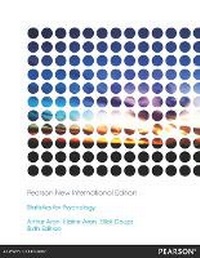
Statistics for Psychology
Pearson New International Edition
6th Edition
Published on 8. November 2013
Book
Paperback/Softback
728 pages
978-1-292-04029-5 (ISBN)
Description
Emphasising meaning and concepts, not just symbols and numbers
Statistics for Psychology, 6th edition places definitional formulas center stage to emphasise the logic behind statistics and discourage rote memorization. Each procedure is explained in a direct, concise language and both verbally and numerically.
Statistics for Psychology, 6th edition places definitional formulas center stage to emphasise the logic behind statistics and discourage rote memorization. Each procedure is explained in a direct, concise language and both verbally and numerically.
More details
Edition
6th edition
Language
English
Place of publication
Harlow
United Kingdom
Target group
College/higher education
Dimensions
Height: 100 mm
Width: 100 mm
Thickness: 100 mm
Weight
100 gr
ISBN-13
978-1-292-04029-5 (9781292040295)
Copyright in bibliographic data and cover images is held by Nielsen Book Services Limited or by the publishers or by their respective licensors: all rights reserved.
Schweitzer Classification
Other editions
New editions
Arthur Aron | Elaine Aron | Elliot Coups
Statistics for Psychology, Global Edition
Book
03/2025
7th Edition
Pearson Education Limited
€103.01
Shipment within 10-20 days
Additional editions

Arthur Aron | Elaine N. Aron | Elliot Coups
Statistics for Psychology: Pearson New International Edition
Pearson New International Edition
E-Book
10/2013
1st Edition
Pearson Education Limited
€46.01
Available for download
Previous edition
Book
08/2012
6th Edition
Pearson
€270.36
Article exhausted; check for reprint
Persons
Arthur Aron, PhD, is a Research Professor in the Department of Psychology at the State University of New York at Stony Brook. His research centres on the self-expansion model of motivation and cognition in personal relationships and intergroup relations, including its neural underpinnings and real-world applications. He has published more than 200 scientific papers, including a foundational paper (in collaboration with Dr. Elaine Aron) on his basic theoretical model that has more than 3,000 citations. Another, his earliest on the "shaky bridge study," has become a classic in the field and is cited in nearly every introductory psychology, social psychology and psychology methods text published in the last 20 years. He is also widely known publicly for his groundbreaking brain-scan studies of romantic love and, most recently, for his "36 Questions" for creating closeness. Dr. Aron currently serves on the editorial boards of the Personal Relationships- and Journal of Social and Personal Relationships. He is a Fellow of the American Psychological Association, the Association for Psychological Science, the Society of Personality and Social Psychology, the Society of Experimental Social Psychology and the Society for the Psychological Study of Social Issues. He has received major grants from the National Science Foundation, the Templeton Foundation, the Fetzer Foundation and the Social Science and Humanities Research Council of Canada. He also received the prestigious Distinguished Research Career Award from the International Association for Relationship Research.
Elliot J. Coups, PhD, who passed in 2020, received his PhD in social/health psychology from Rutgers University and completed a postdoctoral fellowship in cancer prevention and control at Memorial Sloan-Kettering Cancer Center. When he made his most recent contributions to this text, he was a faculty member in the Cancer Prevention and Control Program at Rutgers Cancer Institute of New Jersey, and associate professor of medicine at Rutgers Robert Wood Johnson Medical School and of health education and behavioural science at Rutgers School of Public Health.
Dr. Coups' primary area of research focused on understanding and promoting health-related behaviours among cancer survivors and individuals at risk for cancer. He had a particular interest in skin cancer prevention and control, and had published on a number of relevant topics, including skin cancer-related behaviours among melanoma survivors and their family members, sun protection behaviours among Hispanic individuals, physician screening for skin cancer and indoor tanning. Dr. Coups' research was supported by numerous federal and foundation grants, and he published more than 100 journal articles, book chapters and books.
Elaine N. Aron, PhD, is a researcher and writer. Her most widely cited research focuses on the innate temperament/personality trait of sensory processing sensitivity, with research ranging from in-depth qualitative interviews to laboratory experiments, representative surveys and neuroimaging studies. She is also well known for her research in collaboration with Dr. Arthur Aron on close relationships, including 2 seminal books. She has published more than 50 research papers and has given hundreds of invited talks, colloquia and continuing education workshops for professionals. In addition to her academic writing, she has published 8 books for the public based on her research, including the best-selling The Highly Sensitive Person and The Highly Sensitive Child, both translated into over 35 languages.
Elliot J. Coups, PhD, who passed in 2020, received his PhD in social/health psychology from Rutgers University and completed a postdoctoral fellowship in cancer prevention and control at Memorial Sloan-Kettering Cancer Center. When he made his most recent contributions to this text, he was a faculty member in the Cancer Prevention and Control Program at Rutgers Cancer Institute of New Jersey, and associate professor of medicine at Rutgers Robert Wood Johnson Medical School and of health education and behavioural science at Rutgers School of Public Health.
Dr. Coups' primary area of research focused on understanding and promoting health-related behaviours among cancer survivors and individuals at risk for cancer. He had a particular interest in skin cancer prevention and control, and had published on a number of relevant topics, including skin cancer-related behaviours among melanoma survivors and their family members, sun protection behaviours among Hispanic individuals, physician screening for skin cancer and indoor tanning. Dr. Coups' research was supported by numerous federal and foundation grants, and he published more than 100 journal articles, book chapters and books.
Elaine N. Aron, PhD, is a researcher and writer. Her most widely cited research focuses on the innate temperament/personality trait of sensory processing sensitivity, with research ranging from in-depth qualitative interviews to laboratory experiments, representative surveys and neuroimaging studies. She is also well known for her research in collaboration with Dr. Arthur Aron on close relationships, including 2 seminal books. She has published more than 50 research papers and has given hundreds of invited talks, colloquia and continuing education workshops for professionals. In addition to her academic writing, she has published 8 books for the public based on her research, including the best-selling The Highly Sensitive Person and The Highly Sensitive Child, both translated into over 35 languages.
Content
1. Displaying the Order in a Group of Numbers Using Tables and Graphs
2. Central Tendency and Variability
3. Some Key Ingredients for Inferential Statistics
4. Introduction to Hypothesis Testing
5. Hypothesis Tests with Means of Samples
6. Making Sense of Statistical Significance
7. Introduction to t Tests
8. The t Test for Independent Means
9. Introduction to the Analysis of Variance
10. Factorial Analysis of Variance
11. Correlation
12. Prediction
13. Chi-Square Tests
14. Overview of the Logic and Language of Psychology Research
15. Applying Statistical Methods in Your Own Research Project
16. Repeated Measures Analysis of Variance
17. Integration and the General Linear Model
2. Central Tendency and Variability
3. Some Key Ingredients for Inferential Statistics
4. Introduction to Hypothesis Testing
5. Hypothesis Tests with Means of Samples
6. Making Sense of Statistical Significance
7. Introduction to t Tests
8. The t Test for Independent Means
9. Introduction to the Analysis of Variance
10. Factorial Analysis of Variance
11. Correlation
12. Prediction
13. Chi-Square Tests
14. Overview of the Logic and Language of Psychology Research
15. Applying Statistical Methods in Your Own Research Project
16. Repeated Measures Analysis of Variance
17. Integration and the General Linear Model