

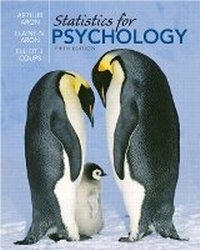
Statistics for Psychology
United States Edition
5th Edition
Published on 11. April 2008
Book
Hardback
744 pages
978-0-13-601057-9 (ISBN)
Description
This author team is committed to making statistics a highlight for psychology students! Now, in a 5th edition, Statistics for Psychology, continues to be an accessible, current, and interesting approach to statistics. With each revision, the authors have maintain those things about the book that have been especially appreciated, while reworking the text to take into account the feedback, their our own experiences, and advances and changes in the field.
The fifth edition of this popular text uses definitional formulas to emphasize concepts of statistics, rather than rote memorization. This approach constantly reminds students of the logic behind what they are learning, and each procedure is taught both verbally and numerically, which helps to emphasize the concepts. Thoroughly revised, with new content and many new practice examples, this text takes the reader from basic procedures through analysis of variance (ANOVA). While learning statistics, students also learn how to read and interpret current research.
The fifth edition of this popular text uses definitional formulas to emphasize concepts of statistics, rather than rote memorization. This approach constantly reminds students of the logic behind what they are learning, and each procedure is taught both verbally and numerically, which helps to emphasize the concepts. Thoroughly revised, with new content and many new practice examples, this text takes the reader from basic procedures through analysis of variance (ANOVA). While learning statistics, students also learn how to read and interpret current research.
More details
Edition
5th edition
Language
English
Place of publication
United States
Publishing group
Pearson Education (US)
Target group
Professional and scholarly
Dimensions
Height: 254 mm
Width: 203 mm
Weight
1450 gr
ISBN-13
978-0-13-601057-9 (9780136010579)
Copyright in bibliographic data and cover images is held by Nielsen Book Services Limited or by the publishers or by their respective licensors: all rights reserved.
Schweitzer Classification
Other editions
New editions
Arthur Aron | Elaine N. Aron | Elliot J. Coups
Statistics for Psychology Plus NEW MyStatLab with eText -- Access Card Package
Book
10/2012
6th Edition
Pearson
Unfortunately, price unknown
Article is exhausted; no reprint
Arthur Aron | Elliot Coups | Elaine Aron
Statistics for Psychology
Book
08/2012
6th Edition
Pearson
€334.24
Article exhausted; check different version
Previous edition

Book
10/2005
4th Edition
Pearson
€96.55
Article exhausted; check for reprint
Content
1. Displaying the order in a group of numbers.
2. Central tendency and variability.
3. Some key ingredients for inferential statistics: Z scores, the normal curve, sample versus population, and probability.
4. Introduction to hypothesis testing.
5. Hypothesis testing with means of samples.
6. Making sense of statistical significance: Effect size and statistical power.
7. Introduction to the t test: Single sample and dependent means.
8. The t test for independent means.
9. Introduction to the analysis of variance.
10. Factorial analysis of variance.
11. Correlation.
12. Prediction.
13. Chi-square tests.
14. Strategies when population distributions are not normal: Data transformations and rank-order tests.
15. Integration and the general linear model.
16. Making sense of advanced statistical procedures in research articles.
2. Central tendency and variability.
3. Some key ingredients for inferential statistics: Z scores, the normal curve, sample versus population, and probability.
4. Introduction to hypothesis testing.
5. Hypothesis testing with means of samples.
6. Making sense of statistical significance: Effect size and statistical power.
7. Introduction to the t test: Single sample and dependent means.
8. The t test for independent means.
9. Introduction to the analysis of variance.
10. Factorial analysis of variance.
11. Correlation.
12. Prediction.
13. Chi-square tests.
14. Strategies when population distributions are not normal: Data transformations and rank-order tests.
15. Integration and the general linear model.
16. Making sense of advanced statistical procedures in research articles.