

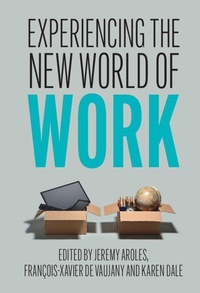
Experiencing the New World of Work
Published on 21. January 2021
Book
Hardback
286 pages
978-1-108-49607-0 (ISBN)
Description
Exploring the different facets of the new world of work (including the hacker and maker movements, platform work, and digital nomadism), this edited volume sets out to investigate and theorise how these new work practices are experienced by various actors. It explores such changes at both the micro and macro levels and sets out to link them back to wider social, managerial and political issues. In doing so, it aims to reflect on the similarities and differences between new and 'old' work practices and problematize discourses surrounding the future of work. This volume is characterized by the diversity of methods mobilized, the plurality of concepts, lenses and theories deployed as well as the richness of the empirical accounts used by the authors. It will appeal to a broad readership of management and organizational scholars as well as sociologists interested in current changes to the world of work.
Reviews / Votes
Is there one future of work? This excellent volume shows that employment continues to be contested. For some, the the digital frontier of control has moved into the home or the delivery van. For others, the care home or field continues to be the site of low paid manual work. If you want a serious and evidence based analysis of current trends and future possibilities, then read this book. Martin Parker, Professor of Organisation Studies, and Lead for the Bristol Inclusive Economy initiative, Department of Management, Bristol University In an increasingly volatile, but also strangely predictable world, it is more important than ever that we remain academically alert to both the changes and continuities that characterise the experience of work. This rich and timely collection, focusing on the impact of contemporary workplace practices of - amongst others - embodiment, spatiality, and digitisation, makes a vital and accessible contribution to this endeavour. Philip Hancock, Professor of Work and Organisation, Essex Business School, University of Essex Why, asked the poet Philip Larkin, did he find the toad work squatting on his life? His answer was typically laconic: because inside himself, he observed, there was something toad like too, cold and heavy, always weighing on him. Work was its outward expression. Without the in-trays, regular hours, pension rights, class exploitation, and doleful routine he would be like those roaming or stumbling around the parks mid-afternoon with only empty chairs for friends. Within work, well, he was at least distracted from the inevitability of death. Nowadays, the toad has become a pond skater, neither heavy nor cold: it is elusive, nebulous, and humming with mediating technologies, and the empty chairs around the park bandstand have become workstations. It is in such a setting that the essays in this volume become incredibly timely. They give voice to a new, mobile cast of characters in the world of work: hackers, nomads, teleworkers, learning algorithms, makers, and platforms, in short a veritable commedia dell arte for our technologically mediated times. We learn how working humans are being joined by (better?) working non-humans, how exploitation has become a lifestyle choice - or intensified by poverty and confined invisibly to the peripheral spaces of the globe - and how, if there is any meaning to be found in such fluid, often exaggerated, and transitory experiences, it comes doused in irony. The field of study that is still, rather quaintly, called human relations needs completely uprooting. This volume makes an admirable foray into this radical work. Robin Holt, Professor, Department of Management, Politics and Philosophy, Copenhagen Business SchoolMore details
Language
English
Place of publication
Cambridge
United Kingdom
Product notice
sewn/stitched
Cloth over boards
Illustrations
Worked examples or Exercises
Dimensions
Height: 229 mm
Width: 152 mm
Thickness: 18 mm
Weight
549 gr
ISBN-13
978-1-108-49607-0 (9781108496070)
Copyright in bibliographic data and cover images is held by Nielsen Book Services Limited or by the publishers or by their respective licensors: all rights reserved.
Schweitzer Classification
Other editions
Additional editions
Jeremy Aroles | Francois-Xavier de Vaujany | Karen Dale
Experiencing the New World of Work
Book
01/2021
Cambridge University Press
€44.00
Shipment within 15-20 days
Jeremy Aroles
Experiencing the New World of Work
E-Book
01/2021
Cambridge University Press
€21.99
Available for download
Jeremy Aroles | Francois-Xavier de Vaujany | Karen Dale
Experiencing the New World of Work
E-Book
01/2021
Cambridge University Press
€23.49
Available for download
Persons
Content
Foreword John Hassard and Jonathan Morris; Introduction: Experiencing the New World of Work Jeremy Aroles, Francois-Xavier de Vaujany and Karen Dale; Part I: Experiencing at Work; 1. Embodied Inter-Practices in Resonance as New Forms of Working in Organisations Wendelin Kuepers; 2. Wherever I Lay my Laptop, That's my Workplace - Experiencing the New World of Work in a Hotel Lobby Fiza Brakel-Ahmed; 3. 'So Many Cool Things to do!': Hacker Ethics and Work Practices Michael Peiro; 4. Experiencing Making: Silence, Atmosphere and Togetherness in Makerspaces Francois-Xavier de Vaujany and Jeremy Aroles; Part II: Digital Platforms and the New Work of Work; 5. Exploring Inequalities in Platform-Based Legal Work Debra Howcroft, Clare Mumfrod and Birgitta Bergvall-Kareborn; 6. Workers Inquiry and the Experience of Work: Using Ethnographic Accounts of the Gig Economy Jamie Woodcock; 7. Digital Nomads: A New Form of Leisure Class? Claudine Bonneau and Jeremy Aroles; Part III. Politics, Imaginaries and Others in the New World of Work; 8. Bypassing the Stage of Copper Wire? New Work Practices Amongst the Peasantry Gibson Burrell; 9. Critical Theory and the Post-Work Imaginary Edward Granter; 10. Exploring the New in Politics at Work: A Temporal Approach of Managerial Agencies Francois-Xavier de Vaujany and Aurelie Leclercq-Vandelannoitte; Conclusion: Experiences of Continuity and Change in the New World of Work Jeremy Aroles, Francois-Xavier de Vaujany and Karen Dale; Afterword Stewart Clegg.