

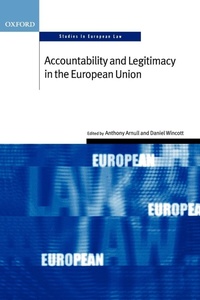
Accountability and Legitimacy in the European Union
Published on 9. January 2003
Book
Paperback/Softback
558 pages
978-0-19-925710-2 (ISBN)
Description
The European Union's growing accountability deficit threatens to undermine its legitimacy. This was acknowledged by the Member States in Nice in February 2001. Recognising the need to improve 'the democratic legitimacy and transparency of the Union and its institutions', they agreed to launch a debate on the Union's future. At Laeken in December 2001, the Member States decided that the debate should be carried forward in a Convention comprising the main parties involved. The debate will start to crystallise in 2004, when negotiations on a new set of Treaty changes will begin.
The outcome of those negotiations will profoundly affect the constitutional and political health of the Union as it confronts enlargement to the east and south and the challenges of the 21st century. However, the Union's accountability and legitimacy deficit is so deep-seated that it is unlikely to be eradicated completely by the changes agreed. The issue will therefore remain high on the political agenda for the foreseeable future. The contributors to this interdisciplinary collection of essays consider various aspects of accountability and legitimacy in the European Union. How open should the Union's decision-making be? What is the right balance between accountability and efficiency? Does the Union now need a formal constitution? How can respect for democracy, fundamental rights and the rule of law in the Union best be ensured? These are just some of the questions explored in this book. It will be of interest to anyone concerned with the future of Europe, from students and academics to policy-makers, and journalists
The outcome of those negotiations will profoundly affect the constitutional and political health of the Union as it confronts enlargement to the east and south and the challenges of the 21st century. However, the Union's accountability and legitimacy deficit is so deep-seated that it is unlikely to be eradicated completely by the changes agreed. The issue will therefore remain high on the political agenda for the foreseeable future. The contributors to this interdisciplinary collection of essays consider various aspects of accountability and legitimacy in the European Union. How open should the Union's decision-making be? What is the right balance between accountability and efficiency? Does the Union now need a formal constitution? How can respect for democracy, fundamental rights and the rule of law in the Union best be ensured? These are just some of the questions explored in this book. It will be of interest to anyone concerned with the future of Europe, from students and academics to policy-makers, and journalists
Reviews / Votes
... will interest academics, students, policy makers, journalists and anyone concerned with the development of the European Union. * KnowEurope *More details
Series
Language
English
Place of publication
Oxford
United Kingdom
Target group
Professional and scholarly
Illustrations
7 figures and 2 tables
Dimensions
Height: 234 mm
Width: 156 mm
Thickness: 30 mm
Weight
840 gr
ISBN-13
978-0-19-925710-2 (9780199257102)
Copyright in bibliographic data and cover images is held by Nielsen Book Services Limited or by the publishers or by their respective licensors: all rights reserved.
Schweitzer Classification
Other editions
Additional editions
Anthony Arnull | Daniel Wincott
Accountability and Legitimacy in the European Union
Book
01/2003
Oxford University Press
€121.60
Shipment within 15-20 days
Persons
Anthony Arnull graduated from the University of Sussex in 1980 and qualified as a solicitor in 1983. From 1983-1989, he was a lecturer in law at the University of Leicester, where he was awarded his PhD in 1988. He was a Legal Secretary at the Court of Justice of the European Communities in the Chambers of Advocate General FG Jacobs from 1989 to 1992, when he took up the Chair of European Law at the University of Birmingham. In 1994, he was awarded a Jean Monnet Chair by the European Commission. In 1998, he acted as Specialist Adviser to the House of Lords Select Committee on the European Communities. Professor Arnull is co-editor of the European Law Review. He is a member of the following: the JUSTICE Expert Panel on the European Union; the Advisory Board of the British Institute of International and Comparative Law and that Board's Community Law Section; and the editorial board of the Cambridge Yearbook of European Legal Studies
Daniel Wincott has undergraduate and Masters degrees from the University of Manchester and a PhD from the London School of Economics and Political Science. He has worked at the Universities of Leicester and Warwick (where he held a Jean Monnet Chair in Law and Politics) before moving to the University of Birmingham in 1995. In 2001 he was a special advisor on European Governance to Neil Kinnock, Vice President of the European Commission. He is an editor of the British Journal of Politics and International Relations. His main research interests concern the European Union (especially the politics of European law) and comparative public policy, and he has published papers in leading journals including The European Law Journal, Government and Opposition, Journal of Common Market Studies, Journal of European Public Policy, Political Studies and Public Administration.
Daniel Wincott has undergraduate and Masters degrees from the University of Manchester and a PhD from the London School of Economics and Political Science. He has worked at the Universities of Leicester and Warwick (where he held a Jean Monnet Chair in Law and Politics) before moving to the University of Birmingham in 1995. In 2001 he was a special advisor on European Governance to Neil Kinnock, Vice President of the European Commission. He is an editor of the British Journal of Politics and International Relations. His main research interests concern the European Union (especially the politics of European law) and comparative public policy, and he has published papers in leading journals including The European Law Journal, Government and Opposition, Journal of Common Market Studies, Journal of European Public Policy, Political Studies and Public Administration.
Content
FOREWORD BY THE RT HON CHRISTOPHER PATTEN, MEMBER, EUROPEAN COMMISSION ; LIST OF CONTRIBUTORS ; LIST OF ABBREVIATIONS ; PART I: INSTITUTIONS AND DECISION-MAKING ; PART II: CONSTITUTIONALISM AND THE FUTURE OF EUROPE ; PART III: FUNDAMENTAL RIGHTS AND SOCIAL RIGHTS ; PART IV: NEW GOVERNANCE AND THE EUROPEAN UNION ; PART V: ENLARGEMENT AND THE MOVEMENT OF PEOPLE ; CONCLUDING REMARKS ; SELECT BIBLIOGRAPHY ; INDEX