

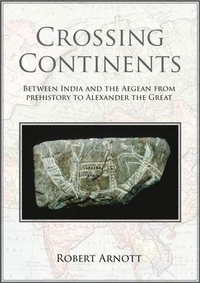
Crossing Continents
Between India and the Aegean from Prehistory to Alexander the Great
Published on 15. April 2022
Book
Paperback/Softback
160 pages
978-1-78925-554-6 (ISBN)
Description
The first contacts between Greece, the Aegean and India are thought to have occurred at the beginning of the sixth century BC. There is now evidence of much earlier indirect connections, starting in the middle of the third millennium BC, but greatly diminishing after 1800 BC. These were initially between India with its Indus Civilisation (Melu??a) and the Near East and then finally with the societies of the Early and Middle Bronze Age Aegean, with their slowly emerging palace-based economies and complex social structures. These connections point to a form of indirect or what might be called 'trickle-down' contact between the Aegean and India through objects, iconography and commodities, such as tin and lapis lazuli, that formed this contact.
This book views the Aegean as part of a greater trade network, that includes commodities as well as more recently discovered objects, which accumulated added value as they fi rst built up a distinguished pedigree of ownership in the Near East and Syro-Palestine. It was the natural extension of trade between the Near East and India. In the Early to Late Bronze Ages, India was an important resource for valuable and indispensable commodities destined for the elites and developing technologies of much of the Old World.
Finally, the period after the end of the Bronze Age to the time of Alexander the Great is examined and particularly after the sixth century, when Greeks were beginning to know about India. Within 200 years, India would be known to scholar and non-scholar alike, including those who witnessed the Persian invasions of Greece or who later became Macedonian and Greek foot soldiers marching east.
This book views the Aegean as part of a greater trade network, that includes commodities as well as more recently discovered objects, which accumulated added value as they fi rst built up a distinguished pedigree of ownership in the Near East and Syro-Palestine. It was the natural extension of trade between the Near East and India. In the Early to Late Bronze Ages, India was an important resource for valuable and indispensable commodities destined for the elites and developing technologies of much of the Old World.
Finally, the period after the end of the Bronze Age to the time of Alexander the Great is examined and particularly after the sixth century, when Greeks were beginning to know about India. Within 200 years, India would be known to scholar and non-scholar alike, including those who witnessed the Persian invasions of Greece or who later became Macedonian and Greek foot soldiers marching east.
More details
Language
English
Place of publication
Oxford
United Kingdom
Target group
Professional and scholarly
Product notice
Paperback (trade)
Unsewn / adhesive bound
Dimensions
Height: 236 mm
Width: 165 mm
Thickness: 9 mm
Weight
402 gr
ISBN-13
978-1-78925-554-6 (9781789255546)
Copyright in bibliographic data and cover images is held by Nielsen Book Services Limited or by the publishers or by their respective licensors: all rights reserved.
Schweitzer Classification
Other editions
Additional editions
Arnott Robert Arnott
Crossing Continents
Between India and the Aegean from Prehistory to Alexander the Great
E-Book
05/2022
OXBOW BOOKS
€20.99
Available for download
Arnott Robert Arnott
Crossing Continents
Between India and the Aegean from Prehistory to Alexander the Great
E-Book
05/2022
Oxbow Books
€20.99
Available for download
Person
Professor Robert Arnott is an archaeologist, palaeoepidemiologist and medical historian, He is a Fellow of Green Templeton College, University of Oxford and former Professor of the History and Archaeology of Medicine in the University of Birmingham.
Content
Summary
The Author
List of Table and Figures
Abbreviations
Acknowledgements
Introduction
1. Prehistory: The Background
The Harappan Civilisation
Discovery
The Decline of the Harappans
Trade and Long Distance Exchange, Seafaring and Caravans
Out of Melu??a
Farther Westwards
The Harappans and Egypt
Iconography
Weights and Measures
2. Prehistory: The Evidence of Objects
Pottery Kernoi
Spiral Double Headed Pins
Carnelian Beads
Agate Seals and Beads
Flat Disc Shaped Beads
Other Beads
Bronzes
Pottery
3. Prehistory: The Evidence of Commodities
The Role of Shortughai
Organic Commodities
Spices and Foodstuffs
Wood
Ivory
Textiles
Inorganic Commodities
Lapis Lazuli: An Indian commodity
Jade
Gold: An Indian Commodity?
Tin: Another Indian commodity
4. Prehistory: A Conclusion
Earlier Work
Summary of the Evidence
5. From the Iron Age to Alexander the Great
The Late Bronze Age to the Iron Age
Transition
From the Sixth Century BC
Greeks in Ancient Sanskrit Literature
Early Geographers and Historians
Religion and Philosophy
Greeks, Macedonians and their Legacy in India
Appendix 1. Indica of Ctesias of Cnidus
Bibliography
The Author
List of Table and Figures
Abbreviations
Acknowledgements
Introduction
1. Prehistory: The Background
The Harappan Civilisation
Discovery
The Decline of the Harappans
Trade and Long Distance Exchange, Seafaring and Caravans
Out of Melu??a
Farther Westwards
The Harappans and Egypt
Iconography
Weights and Measures
2. Prehistory: The Evidence of Objects
Pottery Kernoi
Spiral Double Headed Pins
Carnelian Beads
Agate Seals and Beads
Flat Disc Shaped Beads
Other Beads
Bronzes
Pottery
3. Prehistory: The Evidence of Commodities
The Role of Shortughai
Organic Commodities
Spices and Foodstuffs
Wood
Ivory
Textiles
Inorganic Commodities
Lapis Lazuli: An Indian commodity
Jade
Gold: An Indian Commodity?
Tin: Another Indian commodity
4. Prehistory: A Conclusion
Earlier Work
Summary of the Evidence
5. From the Iron Age to Alexander the Great
The Late Bronze Age to the Iron Age
Transition
From the Sixth Century BC
Greeks in Ancient Sanskrit Literature
Early Geographers and Historians
Religion and Philosophy
Greeks, Macedonians and their Legacy in India
Appendix 1. Indica of Ctesias of Cnidus
Bibliography