

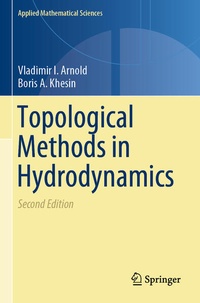
Topological Methods in Hydrodynamics
2nd Edition
Published on 14. May 2022
Book
Paperback/Softback
XX, 455 pages
978-3-030-74280-5 (ISBN)
Description
The first monograph to treat topological, group-theoretic, and geometric problems of ideal hydrodynamics and magnetohydrodynamics from a unified point of view. It describes the necessary preliminary notions both in hydrodynamics and pure mathematics with numerous examples and figures. The book is accessible to graduates as well as pure and applied mathematicians working in hydrodynamics, Lie groups, dynamical systems, and differential geometry.
More details
Product info
Paperback
Series
Edition
2nd ed. 2021
Language
English
Place of publication
Cham
Switzerland
Publishing group
Springer International Publishing
Target group
Professional and scholarly
Edition type
Revised edition
Illustrations
79
79 s/w Abbildungen
XX, 455 p. 79 illus.
Dimensions
Height: 235 mm
Width: 155 mm
Thickness: 26 mm
Weight
715 gr
ISBN-13
978-3-030-74280-5 (9783030742805)
DOI
10.1007/978-3-030-74278-2
Schweitzer Classification
Other editions
Additional editions

Vladimir I. Arnold | Boris A. Khesin
Topological Methods in Hydrodynamics
Book
05/2021
2nd Edition
Springer
€139.09
Shipment within 7-9 days
Persons
Vladimir Arnold (1937-2010) graduated from Moscow State University, Russia. While a student of Andrey Kolmogorov, Arnold showed in 1957 that any continuous function of several variables can be constructed with a finite number of two-variable functions, thereby completing the solution of Hilbert's thirteenth problem. Arnold worked at Moscow State University, the Steklov Mathematical Institute in Moscow, Russia, and at Paris Dauphine University, France. His groundbreaking contributions enriched such areas as the Kolmogorov-Arnold-Moser theory, dynamical systems, singularity theory, algebraic geometry, symplectic geometry and topology, differential equations, classical mechanics, topological Galois theory, and hydrodynamics. Arnold was also well known as a popularizer of mathematics, the author of many textbooks (such as the famous Mathematical Methods of Classical Mechanics), and outspoken critic of the Bourbaki style in mathematics.His awards include Shaw Prize, Wolf Prize, Lobachevsky Prize, Crafoord Prize, and many others.
Boris Khesin studied mathematics at Moscow State University, Russia. After obtaining his PhD in 1990 under the guidance of Vladimir Arnold, he spent several years at UC Berkeley and Yale University, USA, before moving to Toronto, Canada. Currently he is a Professor of Mathematics at the University of Toronto. His research interests include infinite-dimensional groups, Hamiltonian and integrable dynamics. The book "Topological Methods in Hydrodynamics" authored by Arnold and Khesin appears to be accepted as one of the main references in the field.
Vladimir Arnold (1937-2010) graduated from Moscow State University, Russia. While a student of Andrey Kolmogorov, Arnold showed in 1957 that any continuous function of several variables can be constructed with a finite number of two-variable functions, thereby completing the solution of Hilbert's thirteenth problem. Arnold worked at Moscow State University, the Steklov Mathematical Institute in Moscow, Russia, and at Paris Dauphine University, France. His groundbreaking contributions enriched such areas as the Kolmogorov-Arnold-Moser theory, dynamical systems, singularity theory, algebraic geometry, symplectic geometry and topology, differential equations, classical mechanics, topological Galois theory, and hydrodynamics. Arnold was also well known as a popularizer of mathematics, the author of many textbooks (such as the famous Mathematical Methods of Classical Mechanics), and outspoken critic of the Bourbaki style in mathematics.His awards include Shaw Prize, Wolf Prize, Lobachevsky Prize, Crafoord Prize, and many others.
Boris Khesin studied mathematics at Moscow State University, Russia. After obtaining his PhD in 1990 under the guidance of Vladimir Arnold, he spent several years at UC Berkeley and Yale University, USA, before moving to Toronto, Canada. Currently he is a Professor of Mathematics at the University of Toronto. His research interests include infinite-dimensional groups, Hamiltonian and integrable dynamics. The book "Topological Methods in Hydrodynamics" authored by Arnold and Khesin appears to be accepted as one of the main references in the field.
Vladimir Arnold (1937-2010) graduated from Moscow State University, Russia. While a student of Andrey Kolmogorov, Arnold showed in 1957 that any continuous function of several variables can be constructed with a finite number of two-variable functions, thereby completing the solution of Hilbert's thirteenth problem. Arnold worked at Moscow State University, the Steklov Mathematical Institute in Moscow, Russia, and at Paris Dauphine University, France. His groundbreaking contributions enriched such areas as the Kolmogorov-Arnold-Moser theory, dynamical systems, singularity theory, algebraic geometry, symplectic geometry and topology, differential equations, classical mechanics, topological Galois theory, and hydrodynamics. Arnold was also well known as a popularizer of mathematics, the author of many textbooks (such as the famous Mathematical Methods of Classical Mechanics), and outspoken critic of the Bourbaki style in mathematics.His awards include Shaw Prize, Wolf Prize, Lobachevsky Prize, Crafoord Prize, and many others.
Boris Khesin studied mathematics at Moscow State University, Russia. After obtaining his PhD in 1990 under the guidance of Vladimir Arnold, he spent several years at UC Berkeley and Yale University, USA, before moving to Toronto, Canada. Currently he is a Professor of Mathematics at the University of Toronto. His research interests include infinite-dimensional groups, Hamiltonian and integrable dynamics. The book "Topological Methods in Hydrodynamics" authored by Arnold and Khesin appears to be accepted as one of the main references in the field.
Content
Group and Hamiltonian Structures of Fluid Dynamics.- Topology of Steady Fluid Flows.- Topological Properties of Magnetic and Vorticity Fields.- Differential Geometry of Diffeomorphism Groups.- Kinematic Fast Dynamo Problems.- Dynamical Systems with Hydrodynamical Background.