

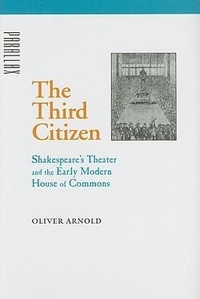
The Third Citizen
Shakespeare's Theater and the Early Modern House of Commons
Published on 7. May 2007
Book
Hardback
328 pages
978-0-8018-8504-4 (ISBN)
Description
The new practices and theories of parliamentary representation that emerged during Elizabeth's and James' reigns shattered the unity of human agency, redefined the nature of power, transformed the image of the body politic, and unsettled constructs and concepts as fundamental as the relation between presence and absence. In The Third Citizen, Oliver Arnold argues that recovering the formation of political representation as an effective ideology should radically change our understanding of early modern political culture, Shakespeare's political art, and the way Anglo-American critics, for whom representative democracy is second nature, construe both. In magisterial readings of Titus Andronicus, Julius Caesar, Coriolanus, and the First Tetralogy, Arnold discovers a new Shakespeare who was neither a conservative apologist for monarchy nor a prescient, liberal champion of the House of Commons but instead a radical thinker and artist who demystified the ideology of political representation in the moment of its first flowering.
Shakespeare believed that political representation produced (and required for its reproduction) a new kind of subject and a new kind of subjectivity, and he fashioned a new kind of tragedy to represent the loss of power, the fall from dignity, the false consciousness, and the grief peculiar to the experiences of representing and of being represented. Representationalism and its subject mark the beginning of political modernity; Shakespeare's tragedies greet political representationalism with skepticism, bleakness, and despair.
Shakespeare believed that political representation produced (and required for its reproduction) a new kind of subject and a new kind of subjectivity, and he fashioned a new kind of tragedy to represent the loss of power, the fall from dignity, the false consciousness, and the grief peculiar to the experiences of representing and of being represented. Representationalism and its subject mark the beginning of political modernity; Shakespeare's tragedies greet political representationalism with skepticism, bleakness, and despair.
Reviews / Votes
Arnold's dense book explores the fertile ground left mostly unturned by new historicist approaches of early modern politics... Brilliant and well-documented analysis of Shakespeare's 'representational plays'. -- Marie-Dominique Garnier Cercles 2007 A compelling historical refinement... Recommended. Choice 2007 Remarkably scholarly... This seminal redrawing of power and politics in late Tudor and early Stuart England takes its authority from the tight analogies it makes between political events and governmental practice in Shakespeare's time and its detailed examination of key scenes in a half-dozen of his plays. In confronting our common assumptions of the period, it forces us to rethink our own historical beliefs. -- Arthur F. Kinney Renaissance Quarterly 2007 Intelligent and important book... A bracing riposte to revisionist historians. -- Anne McLaren English Historical Review 2008 A superb look at Shakespearean politics. Studies in English Literature 2008 Promises a fresh and original approach. -- Richard McCoy Comparative Drama 2008 Provides some needed and very stimulating ideas and evidence with which to develop scholarly analysis of the ways in which contemporaries thought about parliamentary representation, and about the problems involved in making such a system both meaningful and practicable. -- Jason Peacey H-Net Reviews 2008 A serious book about an important subject and a work that anyone interested in Shakespeare's political thought should read carefully... I admire The Third Citizen. Clio 2008 Arnold quite convincingly documents his major claim. -- Maurice Hunt English Studies 2008More details
Series
Language
English
Place of publication
Baltimore, MD
United States
Target group
Professional and scholarly
Edition type
Annotated edition
Product notice
sewn/stitched
Cloth over boards
With dust jacket
Illustrations
9 s/w Photographien bzw. Rasterbilder
9 Halftones, black and white
Dimensions
Height: 163 mm
Width: 233 mm
Thickness: 25 mm
Weight
590 gr
ISBN-13
978-0-8018-8504-4 (9780801885044)
DOI
10.1353/book.3331
Copyright in bibliographic data and cover images is held by Nielsen Book Services Limited or by the publishers or by their respective licensors: all rights reserved.
Schweitzer Classification
Other editions
Additional editions
E-Book
05/2007
Johns Hopkins University Press
€43.99
Available for download
Person
Oliver Arnold is an associate professor of English at Princeton University.
Content
Acknowledgments
Note on References and Abbreviations
Introduction
Part I: Parliament in Shakespeare's England
1. "An epitome of the whole realme": Absorption and Representation in the Elizabethan and Jacobean House of Commons
2. Cade's Mouth: Swallowing Parliament in the First Tetralogy
Part II: Political Representation in Shakespeare's Rome
3. "Their tribune and their trust": Political Representation, Property, and Rape in Titus Andronicus and The Rape of Lucrece
4. "Caesar is turn'd to hear": Theater, Popular Dictatorship, and the Conspiracy of Republicanism in Julius Caesar
5. "Worshipful mutineers": From Demos to Electorate in Coriolanus
Epilogue: Losing Power, Losing Oneself: The Third Citizen and Tragedy
Notes
Works Cited
Index
Note on References and Abbreviations
Introduction
Part I: Parliament in Shakespeare's England
1. "An epitome of the whole realme": Absorption and Representation in the Elizabethan and Jacobean House of Commons
2. Cade's Mouth: Swallowing Parliament in the First Tetralogy
Part II: Political Representation in Shakespeare's Rome
3. "Their tribune and their trust": Political Representation, Property, and Rape in Titus Andronicus and The Rape of Lucrece
4. "Caesar is turn'd to hear": Theater, Popular Dictatorship, and the Conspiracy of Republicanism in Julius Caesar
5. "Worshipful mutineers": From Demos to Electorate in Coriolanus
Epilogue: Losing Power, Losing Oneself: The Third Citizen and Tragedy
Notes
Works Cited
Index