

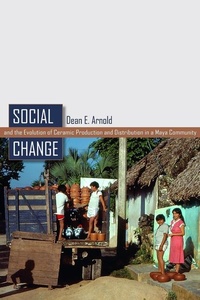
Social Change and the Evolution of Ceramic Production and Distribution in a Maya Community
Will be published approx. on 30. November 2008
Book
Hardback
432 pages
978-0-87081-923-0 (ISBN)
Description
How and why do ceramics and their production change through time? Social Change and the Evolution of Ceramic Production and Distribution in a Maya Community is a unique ethno-archaeological study that attempts to answer these questions by tracing social change among potters and changes in the production and distribution of their pottery in a the Mexican community of Ticul between 1965 and 1997. Dean E. Arnold made ten visits to Ticul, Yucatan, Mexico, witnessing the changes in transportation infrastructure, the use of piped water, and the development of tourist resorts. Even in this context of social change and changes in the demand for pottery, most of the potters in 1997 came from the families that had made pottery in 1965. This book traces changes and continuities in that population of potters, in the demand and distribution of pottery, and in the procurement of clay and temper, paste composition, forming, and firing.
In this volume, Arnold bridges the gap between archaeology and ethnography, using his analysis of contemporary ceramic production and distribution to generate new theoretical explanations for archaeologists working with pottery from antiquity. When the descriptions and explanations of Arnold's findings in Ticul are placed in the context of the literature on craft specialization, a number of insights can be applied to the archaeological record that confirm, contradict, and nuance generalizations concerning the evolution of ceramic specialization. This book will be of special interest to anthropologists, archaeologists, and ethnographers.
In this volume, Arnold bridges the gap between archaeology and ethnography, using his analysis of contemporary ceramic production and distribution to generate new theoretical explanations for archaeologists working with pottery from antiquity. When the descriptions and explanations of Arnold's findings in Ticul are placed in the context of the literature on craft specialization, a number of insights can be applied to the archaeological record that confirm, contradict, and nuance generalizations concerning the evolution of ceramic specialization. This book will be of special interest to anthropologists, archaeologists, and ethnographers.
Reviews / Votes
Please read the following attachment for a detailed review from The Journal of the Royal Anthropological Institute (N.S.) 16, 905-951More details
Series
Language
English
Place of publication
Colorado
United States
Product notice
Laminated cover
Dimensions
Height: 239 mm
Width: 162 mm
Thickness: 32 mm
Weight
658 gr
ISBN-13
978-0-87081-923-0 (9780870819230)
Copyright in bibliographic data and cover images is held by Nielsen Book Services Limited or by the publishers or by their respective licensors: all rights reserved.
Schweitzer Classification
Person
Dean E. Arnold adjunct curator of anthropology at the Field Museum of Natural History in Chicago and professor emeritus of anthropology at Wheaton College in Illinois. He has taught anthropology for forty-three years; done field work in Peru, Mexico, Bolivia, Guatemala, and the Southwest; and has published three books, including the highly regarded seminal work Ceramic Theory and Cultural Process and more than sixty articles about potters, pottery, and pottery production and related subjects (such as Maya Blue). Arnold was a Fulbright Scholar in Mexico and Peru, a Visiting Fellow at Clare Hall at University of Cambridge in 1985, and a Visiting Scholar at the Department of Archeology there in 1985, 1992, and 2000. He received the Society for American Archaeology's Award for Excellence in Ceramic Studies in 1996. In 2003, he received the Charles R. Jenkins Award for Distinguished Achievement from the National Executive Council of Lambda Alpha (the National Collegiate Honor Society for Anthropology). He received the Wheaton College Senior Faculty Scholarship Achievement Award in 2001 and the Wheaton College Alumni Association Award for Distinguished Service to Alma Mater in 2008.
Content
; Contents; List of Figures; List of Tables; Preface; Acknowledgments; Chapter 1: Introduction; Paradigms of Pottery and Social Change; The Limits of Ethnographic Analogy; Collecting Data in the Field; Data Reduction and Analysis; The Plan of the Book; Chapter 2: How Have the Population and Organization of Potters Changed?; The Social Context; Changing Production Organization; Forces of Social Continuity; Forces of Social Change; Social Change and Increased Production-unit Size; Conclusion; Chapter 3: How Have Demand and Consumption Changed?; Demand and Cultural Evolution; Demand from Traditional Uses of Pottery; New Demand and New Uses of Pottery; Cycles of Demand and Their Changes; Quantitative Measures of Change in Demand; Conclusion; Chapter 4: How Has Distribution of the Pottery Changed?; Changes in Transportation Infrastructure; Changes in the Types of Distribution; Vertical Integration; Conclusion; Chapter 5: How Has Clay Procurement Changed?; Under What Conditions Does Clay Procurement Change?; How Do Changes in Clay Procurement Affect Procurement Organization?; A Surrogate Measure of Production Intensity; Procurement Intensity, Organization, and Production-unit Size; Do Changing Clay Sources Reflect Evolutionary Social Change?; Chapter 6: How Has Temper Procurement Changed?; Changes in Temper for Cooking Pottery; Changes in Temper for Non-cooking Pottery; A Surrogate Measure of Production Intensity; Control and Access to Temper Sources; Conclusion; Chapter 7: How Has Composition of the Pottery Fabric Changed?; Behavioral Changes in Paste Preparation; Changes in Paste Composition over Time; Conclusion; Chapter 8: How Has the Forming Technology Changed?; Why Were New Fabrication Techniques Adopted?; Changes in Forming Technology; Choosing a Technique; Changing Explanations of Dimensional Variability; Conclusion; Chapter 9: How Has Firing Technology Changed?; Changes in the Procurement and Use of Fuel; Changes in Kiln-making Technology; Task Segmentation and Specialization in Firing; Changes in Kiln Sizes and Their Distribution among Potters; Conclusion; Chapter 10: Conclusion; Summary of Changes; The Conservative Nature of Household Production; Efficiency; Paradigms: Social Change and Specialization; References Cited; Index;