

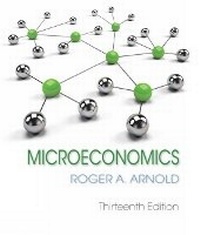
Microeconomics
13th Edition
Published on 1. January 2018
Book
Paperback/Softback
624 pages
978-1-337-61740-6 (ISBN)
Description
Ever wonder why colleges use GPAs, ACTs, and SATs for purposes of admission, or how supply and demand play out on a freeway, or what price has to do with being late to class, or how you might end up paying for good weather? ECONOMICS, 13E answers these questions and many more as this book opens up the world of economic analysis. This edition offers more detailed coverage of how economists build theories to explain everyday life than any other principles of economics text on the market. Memorable examples from pop culture illustrate the unexpected places economics occur and show you how economic forces link to every day events.
This edition offers complete video assets to assist you in learning economics. There are short video lectures to assist you with key economic concepts and theories. In addition, Video Office Hours (longer video lectures) is a digital video asset that answers questions that students often have for their instructors during office hours. There are also videos assets - such as What's Wrong with this Diagram? "Working with Diagrams" and "Progression Graphs" that assist you in learning and working with all the diagrams that are in an economics principles course. A new Adaptive Test Prep available on MindTap Enables you to assess your personal economic understanding. Powerful digital resources, including Aplia and MindTap, work with the book's latest content to reflect today's changing economy and equip you with a thorough understanding of contemporary microeconomics.
This edition offers complete video assets to assist you in learning economics. There are short video lectures to assist you with key economic concepts and theories. In addition, Video Office Hours (longer video lectures) is a digital video asset that answers questions that students often have for their instructors during office hours. There are also videos assets - such as What's Wrong with this Diagram? "Working with Diagrams" and "Progression Graphs" that assist you in learning and working with all the diagrams that are in an economics principles course. A new Adaptive Test Prep available on MindTap Enables you to assess your personal economic understanding. Powerful digital resources, including Aplia and MindTap, work with the book's latest content to reflect today's changing economy and equip you with a thorough understanding of contemporary microeconomics.
More details
Edition
13th edition
Language
English
Place of publication
Florence
United States
Publishing group
Cengage Learning, Inc
Target group
College/higher education
Dimensions
Height: 20 mm
Width: 213 mm
Thickness: 251 mm
Weight
1040 gr
ISBN-13
978-1-337-61740-6 (9781337617406)
Copyright in bibliographic data and cover images is held by Nielsen Book Services Limited or by the publishers or by their respective licensors: all rights reserved.
Schweitzer Classification
Other editions
New editions
Roger A. Arnold | Daniel Arnold | David Arnold
Microeconomics
Book
01/2022
14th Edition
South-Western College Publishing
€343.50
Shipment within 15-20 days
Previous edition

Book
01/2015
12th Edition
South-Western College Publishing
€148.79
Article not available at the moment
Person
Dr. Roger Arnold is at California State University San Marcos, where his fields of specialization are general microeconomic theory and monetary theory. Dr. Arnold earned his BS in economics from the University of Birmingham in England. He received his Ph.D. in economics from Virginia Tech.
Content
AN INTRODUCTION TO ECONOMICS.
Part I: ECONOMICS: THE SCIENCE OF SCARCITY.
1. What Economics Is About.
Appendix A Working with Diagrams.
Appendix B Should You Major in Economics?
2. Production Possibilities Frontier Framework.
3. Supply and Demand: Theory.
4. Prices: Free, Controlled, and Relative.
5. Supply, Demand, and Price: Applications.
MICROECONOMICS.
Part II: MICROECONOMIC FUNDAMENTALS.
6. Elasticity.
7. Consumer Choice: Maximizing Utility and Behavioral Economics.
Appendix C Budget Constraint and Indifference Curve Analysis.
8. Production and Costs.
Part III: PRODUCT MARKETS AND POLICIES.
9. Perfect Competition.
10. Monopoly.
11. Monopolistic Competition, Oligopoly, and Game Theory.
12. Government and Product Markets: Antitrust and Regulation.
Part IV: FACTOR MARKETS AND RELATED ISSUES.
13. Factor Markets: With Emphasis on the Labor Market.
14. Wages, Union, and Labor.
15. The Distribution of Income and Poverty.
16. Interest, Rent, and Profit.
Part V: MARKET FAILURE, PUBLIC CHOICE, AND SPECIAL-INTEREST-GROUP POLITICS.
17. Market Failure: Externalities, Public Goods, and Asymmetric Information.
18. Public Choice and Special-Interest-Group Politics.
Part VI: ECONOMICS THEORY-BUILDING AND EVERYDAY LIFE.
19. Building Theories to Explain Everyday Life: From Observations to Questions to Theories to Predictions.
THE GLOBAL ECONOMY.
Part VII: INTERNATIONAL ECONOMICS AND GLOBALIZATION.
20. International Trade.
21. International Finance.
WEB CHAPTERS.
22. The Economic Case For and Against Government: Five Topics Considered.
23. Stocks, Bonds, Futures, and Options.
Part I: ECONOMICS: THE SCIENCE OF SCARCITY.
1. What Economics Is About.
Appendix A Working with Diagrams.
Appendix B Should You Major in Economics?
2. Production Possibilities Frontier Framework.
3. Supply and Demand: Theory.
4. Prices: Free, Controlled, and Relative.
5. Supply, Demand, and Price: Applications.
MICROECONOMICS.
Part II: MICROECONOMIC FUNDAMENTALS.
6. Elasticity.
7. Consumer Choice: Maximizing Utility and Behavioral Economics.
Appendix C Budget Constraint and Indifference Curve Analysis.
8. Production and Costs.
Part III: PRODUCT MARKETS AND POLICIES.
9. Perfect Competition.
10. Monopoly.
11. Monopolistic Competition, Oligopoly, and Game Theory.
12. Government and Product Markets: Antitrust and Regulation.
Part IV: FACTOR MARKETS AND RELATED ISSUES.
13. Factor Markets: With Emphasis on the Labor Market.
14. Wages, Union, and Labor.
15. The Distribution of Income and Poverty.
16. Interest, Rent, and Profit.
Part V: MARKET FAILURE, PUBLIC CHOICE, AND SPECIAL-INTEREST-GROUP POLITICS.
17. Market Failure: Externalities, Public Goods, and Asymmetric Information.
18. Public Choice and Special-Interest-Group Politics.
Part VI: ECONOMICS THEORY-BUILDING AND EVERYDAY LIFE.
19. Building Theories to Explain Everyday Life: From Observations to Questions to Theories to Predictions.
THE GLOBAL ECONOMY.
Part VII: INTERNATIONAL ECONOMICS AND GLOBALIZATION.
20. International Trade.
21. International Finance.
WEB CHAPTERS.
22. The Economic Case For and Against Government: Five Topics Considered.
23. Stocks, Bonds, Futures, and Options.