

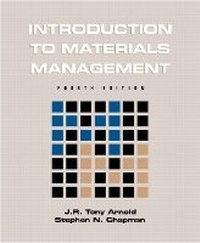
Introduction to Materials Management
United States Edition
4th Edition
Published on 10. October 2000
Book
Hardback
466 pages
978-0-13-014490-4 (ISBN)
Description
For courses in Materials Management, Production and Inventory Control, and Logistics taught out of business and industrial technology departments.
This is the only text listed in the American Production and Inventory Control Society (APICS) DPIM Exam Content Manual as the text reference for the Basics of Supply Chain Management (BSCM) CPIM certification examination. Written in a simple and user-friendly style, it covers all the basics of supply chain management and production and inventory control.
This is the only text listed in the American Production and Inventory Control Society (APICS) DPIM Exam Content Manual as the text reference for the Basics of Supply Chain Management (BSCM) CPIM certification examination. Written in a simple and user-friendly style, it covers all the basics of supply chain management and production and inventory control.
Reviews / Votes
"Overall, the text remains one of the best, most straightforward texts on the market. I enjoy using it in my undergraduate Production Planning and Control course."-Daniel C. Steele, The Darla Moore School of Business, University of South CarolinaMore details
Edition
4th edition
Language
English
Place of publication
United States
Publishing group
Pearson Education (US)
Target group
Professional and scholarly
Dimensions
Height: 242 mm
Width: 195 mm
Thickness: 24 mm
Weight
886 gr
ISBN-13
978-0-13-014490-4 (9780130144904)
Copyright in bibliographic data and cover images is held by Nielsen Book Services Limited or by the publishers or by their respective licensors: all rights reserved.
Schweitzer Classification
Other editions
New editions
Book
10/2003
5th Edition
Pearson
€100.27
Article exhausted; check for reprint
Previous edition

J. R. Tony Arnold
Introduction to Materials Management
Book
12/1997
3rd Edition
Pearson
€37.13
Article exhausted; check for reprint
Content
(Note:Each Chapter includes an Introduction, Summary, Key Terms, Questions, and Problems.)
1. Introduction to Materials Management.
Operating Environment. The Supply Chain Concept. What Is Materials Management?
2. Production Planning System.
Manufacturing Planning and Control System. Sales and Operations Planning (SOP). Manufacturing Resource Planning (MRP II). Enterprise Resource Planning (ERP). Making the Production Plan.
3. Master Scheduling.
Relationship to Production Plan. Developing a Master Production Schedule. Production Planning, Master Scheduling, and Sales.
4. Material Requirements Planning.
Bills of Material. Material Requirements Planning Process. Using the Material Requirements Plan.
5. Capacity Management.
Definition of Capacity. Capacity Planning. Capacity Requirements Planning (CRP). Capacity Available. Capacity Required (Load). Schedule Orders. Making the Plan.
6. Production Activity Control.
Data Requirements Order Preparation. Scheduling. Load Leveling. Scheduling Bottlenecks. Theory of Contraints and Drum-Buffer-Rope. Implementation. Control. Production Reporting.
7. Purchasing.
Establishing Specifications. Functional Specification Description. Selecting Suppliers. Price Determination. Impact of Material Requirements Planning on Purchasing.
8. Forecasting.
Demand Management. Demand Forecasting. Characteristics of Demand. Principles of Forecasting. Collection and Prepartation of Data. Forecasting Techniques. Some Important Intrinsic Techniques. Seasonality. Tracking the Forecast.
9. Inventory Fundamentals.
Aggregate Inventory Management. Item Inventory Management. Inventory and the Flow of Material. Supply and Demand Patterns. Functions of Inventory Management. Inventory Costs. Financial Statements and Inventory. ABC Inventory Control.
10. Order Quantities.
Econimic-Order Quantity (EOQ). Variations of the EOQ Model. Quanitity Discounts. Use of EOQ When Costs are Not Known. Period-Order Quantity (POQ).
11. Independent Demand Ordering Systems.
Order Point System. Determining Safety Stock. Determining Service Levels. Different Forecast and Lead-Time Intervals. Determining When the Order Point is Reached. Periodic Review System. Distribution Inventory.
12. Physical Inventory and Warehouse Management.
Warehouse Management. Physical Control and Security. Inventory Record Accuracy.
13. Physical Distribution.
Physical Distribution System. Interfaces. Transportation. Legal Types of Carriage. Transportation Cost Elements. Warehousing. Packaging. Materials Handling. Multi-Warehouse Systems.
14. Products and Processes.
Need for New Products. Product Development Principles. Product Specification and Design. Process Design. Factors Specification and Design. Processing Equipment. Process Systems. Selecting the Process. Continuous Process Improvement (CPI).
15. Just-In-Time Manufacturing.
Just-In-Time Philosophy. Waste. Just-in-Time Environment. Manufacturing Planning and Control in a JIT Environment. Which to Choose-MPR (ERP), Kanban, or Theory of Contraints.
16. Total Quality Management.
What Is Quality? Total Quality Management (TQM). Quality Cosr Concepts. Variation as a Way of Life. Process Capability. Process Control. Smaple Inspection. ISO 9000. Benchmarking. JIT, TQM, and MRP II.
Readings.
Index.
1. Introduction to Materials Management.
Operating Environment. The Supply Chain Concept. What Is Materials Management?
2. Production Planning System.
Manufacturing Planning and Control System. Sales and Operations Planning (SOP). Manufacturing Resource Planning (MRP II). Enterprise Resource Planning (ERP). Making the Production Plan.
3. Master Scheduling.
Relationship to Production Plan. Developing a Master Production Schedule. Production Planning, Master Scheduling, and Sales.
4. Material Requirements Planning.
Bills of Material. Material Requirements Planning Process. Using the Material Requirements Plan.
5. Capacity Management.
Definition of Capacity. Capacity Planning. Capacity Requirements Planning (CRP). Capacity Available. Capacity Required (Load). Schedule Orders. Making the Plan.
6. Production Activity Control.
Data Requirements Order Preparation. Scheduling. Load Leveling. Scheduling Bottlenecks. Theory of Contraints and Drum-Buffer-Rope. Implementation. Control. Production Reporting.
7. Purchasing.
Establishing Specifications. Functional Specification Description. Selecting Suppliers. Price Determination. Impact of Material Requirements Planning on Purchasing.
8. Forecasting.
Demand Management. Demand Forecasting. Characteristics of Demand. Principles of Forecasting. Collection and Prepartation of Data. Forecasting Techniques. Some Important Intrinsic Techniques. Seasonality. Tracking the Forecast.
9. Inventory Fundamentals.
Aggregate Inventory Management. Item Inventory Management. Inventory and the Flow of Material. Supply and Demand Patterns. Functions of Inventory Management. Inventory Costs. Financial Statements and Inventory. ABC Inventory Control.
10. Order Quantities.
Econimic-Order Quantity (EOQ). Variations of the EOQ Model. Quanitity Discounts. Use of EOQ When Costs are Not Known. Period-Order Quantity (POQ).
11. Independent Demand Ordering Systems.
Order Point System. Determining Safety Stock. Determining Service Levels. Different Forecast and Lead-Time Intervals. Determining When the Order Point is Reached. Periodic Review System. Distribution Inventory.
12. Physical Inventory and Warehouse Management.
Warehouse Management. Physical Control and Security. Inventory Record Accuracy.
13. Physical Distribution.
Physical Distribution System. Interfaces. Transportation. Legal Types of Carriage. Transportation Cost Elements. Warehousing. Packaging. Materials Handling. Multi-Warehouse Systems.
14. Products and Processes.
Need for New Products. Product Development Principles. Product Specification and Design. Process Design. Factors Specification and Design. Processing Equipment. Process Systems. Selecting the Process. Continuous Process Improvement (CPI).
15. Just-In-Time Manufacturing.
Just-In-Time Philosophy. Waste. Just-in-Time Environment. Manufacturing Planning and Control in a JIT Environment. Which to Choose-MPR (ERP), Kanban, or Theory of Contraints.
16. Total Quality Management.
What Is Quality? Total Quality Management (TQM). Quality Cosr Concepts. Variation as a Way of Life. Process Capability. Process Control. Smaple Inspection. ISO 9000. Benchmarking. JIT, TQM, and MRP II.
Readings.
Index.