

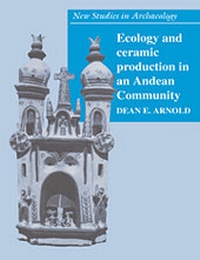
Ecology and Ceramic Production in an Andean Community
Published on 28. October 1993
Book
Hardback
310 pages
978-0-521-43289-4 (ISBN)
Description
Following the theoretical perspective of his earlier book, Ceramic Theory and Cultural Process (1985), Dean Arnold's ethnoarchaeological study explores the relationships of ceramic production to society and its environment in the Peruvian Andes. The book traces these contemporary linkages through the production, decoration, and use of pottery and relates them to the analysis and interpretation of ancient ceramic production. Utilizing an ecological approach within a single community, Arnold expands the scope of previous ceramic theory by focusing on the population as the unit of analysis in production and decoration.
More details
Series
Language
English
Place of publication
Cambridge
United Kingdom
Target group
Professional and scholarly
Illustrations
9 Tables, unspecified; 4 Maps; 49 Halftones, unspecified; 74 Line drawings, unspecified
Dimensions
Height: 255 mm
Width: 179 mm
Thickness: 22 mm
Weight
941 gr
ISBN-13
978-0-521-43289-4 (9780521432894)
Copyright in bibliographic data and cover images is held by Nielsen Book Services Limited or by the publishers or by their respective licensors: all rights reserved.
Schweitzer Classification
Other editions
New editions
Dean E. Arnold
Ecology and Ceramic Production in an Andean Community
Book
10/2003
Cambridge University Press
€58.70
Shipment within 15-20 days
Additional editions
Dean E. Arnold
Ecology and Ceramic Production in an Andean Community
Book
10/2003
Cambridge University Press
€58.70
Shipment within 15-20 days
Person
Content
1. Introduction; 2. The community: its physical environment and adaptation; 3. The environment and culture history; 4. Ecological interrelationships of the community of potters; 5. Ceramic production in Quinua; 6. Ceramic products and society; 7. Design correlates of the community; 8. Design and society; 9. Archaeological implications: the Ayacucho Valley; 10. Conclusion.