

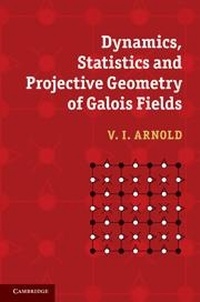
Dynamics, Statistics and Projective Geometry of Galois Fields
Will be published approx. on 2. December 2010
Book
Hardback
90 pages
978-0-521-87200-3 (ISBN)
Description
V. I. Arnold reveals some unexpected connections between such apparently unrelated theories as Galois fields, dynamical systems, ergodic theory, statistics, chaos and the geometry of projective structures on finite sets. The author blends experimental results with examples and geometrical explorations to make these findings accessible to a broad range of mathematicians, from undergraduate students to experienced researchers.
Reviews / Votes
"Throughout, Arnold's characteristic style of writing and thinking are evident. Ideas, intuitions, and well-presented examples abound, joined in only a few places by formal proofs... students and working mathematicians will find it accessible, provoctive, and maybe even inspiring."Rafe Jones, Mathematical Reviews
More details
Language
English
Place of publication
Cambridge
United Kingdom
Target group
Professional and scholarly
College/higher education
Product notice
sewn/stitched
Cloth over boards
Illustrations
10 Line drawings, black and white
Dimensions
Height: 229 mm
Width: 150 mm
Thickness: 10 mm
Weight
259 gr
ISBN-13
978-0-521-87200-3 (9780521872003)
Copyright in bibliographic data and cover images is held by Nielsen Book Services Limited or by the publishers or by their respective licensors: all rights reserved.
Schweitzer Classification
Other editions
Additional editions
E-Book
01/2011
1st Edition
Cambridge University Press
€26.49
Available for download
Book
12/2010
Cambridge University Press
€43.80
Shipment within 15-20 days
Person
V. I. Arnold is Professor of Mathematics at the Universite de Paris IX (Paris-Dauphine) and the Steklov Mathematical Institute in the Russian Academy of Sciences.
Content
Preface; 1. What is a Galois field?; 2. The organisation and tabulation of Galois fields; 3. Chaos and randomness in Galois field tables; 4. Equipartition of geometric progressions along a finite one-dimensional torus; 5. Adiabatic study of the distribution of geometric progressions of residues; 6. Projective structures generated by a Galois field; 7. Projective structures: example calculations; 8. Cubic field tables; Index.