

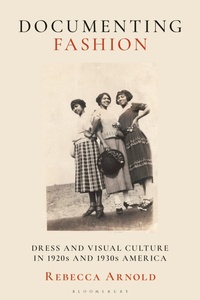
Documenting Fashion
Dress and Visual Culture in 1920s and 1930s America
Published on 5. February 2026
Book
Paperback/Softback
256 pages
978-1-350-60379-0 (ISBN)
Description
This is the story of clothes as pictures and of the importance and meanings of the way we picture clothes.
Focusing on the rapid changes of the interwar period, fashion is explored as a sensory interplay of images. From illustrations to editorial spreads, and amateur snapshots to Hollywood film, Documenting Fashion considers how American fashion was represented and created by visual culture. The chapters comprise thematic case studies of interconnected images that build to create a discussion of fashion as embodied experience, foregrounding the way that all viewers are also wearers, consuming magazines and other types of images, just as they purchase clothing and accessories.
Examining how mediums constructed and impacted the meaning of fashion during the 1920s and 1930s, the book tracks interconnections between technologies that developed in, for example, handheld cameras and Technicolor and Kodachrome color film. Aspects of photography itself are also considered such as hybrid and manipulated images, as well as light, shadow and colour's impact on depictions of fashion and the body. Newspapers, fashion and women's magazines such as Vogue and The Delineator are analysed alongside examples from the Black media, including Abbott's Monthly Magazine and The Afro-American.
Conceived as a revisionist history, diverse types of images of Black, white and Chinese Americans are analysed to argue for a more rounded examination of the ways dress, style and self-image were represented in still and moving images and how such imagery created a particularly American vision of vernacular modernity.
Focusing on the rapid changes of the interwar period, fashion is explored as a sensory interplay of images. From illustrations to editorial spreads, and amateur snapshots to Hollywood film, Documenting Fashion considers how American fashion was represented and created by visual culture. The chapters comprise thematic case studies of interconnected images that build to create a discussion of fashion as embodied experience, foregrounding the way that all viewers are also wearers, consuming magazines and other types of images, just as they purchase clothing and accessories.
Examining how mediums constructed and impacted the meaning of fashion during the 1920s and 1930s, the book tracks interconnections between technologies that developed in, for example, handheld cameras and Technicolor and Kodachrome color film. Aspects of photography itself are also considered such as hybrid and manipulated images, as well as light, shadow and colour's impact on depictions of fashion and the body. Newspapers, fashion and women's magazines such as Vogue and The Delineator are analysed alongside examples from the Black media, including Abbott's Monthly Magazine and The Afro-American.
Conceived as a revisionist history, diverse types of images of Black, white and Chinese Americans are analysed to argue for a more rounded examination of the ways dress, style and self-image were represented in still and moving images and how such imagery created a particularly American vision of vernacular modernity.
Reviews / Votes
Arnold's book gives us a fascinating and more inclusive look at radical shifts in self-fashioning in 1920s and 1930s America. Documenting Fashion enhances our own view of how technologies and embodied experiences of dress played out on camera, on screen and in advertising and print media. * Alison Matthews David, Toronto Metropolitan University, Canada *More details
Language
English
Place of publication
London
United Kingdom
Publishing group
Bloomsbury Publishing PLC
Target group
College/higher education
Illustrations
47 color illus
Dimensions
Height: 232 mm
Width: 154 mm
Thickness: 16 mm
Weight
552 gr
ISBN-13
978-1-350-60379-0 (9781350603790)
Copyright in bibliographic data and cover images is held by Nielsen Book Services Limited or by the publishers or by their respective licensors: all rights reserved.
Schweitzer Classification
Other editions
Additional editions
E-Book
02/2026
1st Edition
Bloomsbury Visual Arts
€22.99
Available for download
E-Book
02/2026
1st Edition
Bloomsbury Visual Arts
€22.99
Available for download
Person
Rebecca Arnold is a historian who has held posts at The Courtauld Institute, Royal College of Art & Central Saint Martins, London, UK. Her publications include The American Look, Fashion: A Very Short Introduction, and Avedon Advertising with Laura Avedon and James Martin.
Content
Acknowledgements
Introduction
Part 1: 1920s 1: Fashion, Images and Materiality
Camera and Materiality
Camera and Body
Looking, Wearing
2: Leisure, Work and Surveillance
Travel, Trends and Aspirations
Cities, Anonymity and Spectacle
3: Documenting, Passing and Resisting
Adapting and Performing
Passing
Identifying with Images
Part 2: 1930s 4: Between Illustration and Photography
Flou
Picturing Fashion
5: Shadows, Light and Hollywood
Gold Diggers of 1933
Light and Shadow
6: Colour, Emotion and Modernity
Colour Processes and 'Intimate Publics'
Colour, Luxury and Modernity
Coda
Notes
Bibliography
Index
Introduction
Part 1: 1920s 1: Fashion, Images and Materiality
Camera and Materiality
Camera and Body
Looking, Wearing
2: Leisure, Work and Surveillance
Travel, Trends and Aspirations
Cities, Anonymity and Spectacle
3: Documenting, Passing and Resisting
Adapting and Performing
Passing
Identifying with Images
Part 2: 1930s 4: Between Illustration and Photography
Flou
Picturing Fashion
5: Shadows, Light and Hollywood
Gold Diggers of 1933
Light and Shadow
6: Colour, Emotion and Modernity
Colour Processes and 'Intimate Publics'
Colour, Luxury and Modernity
Coda
Notes
Bibliography
Index