

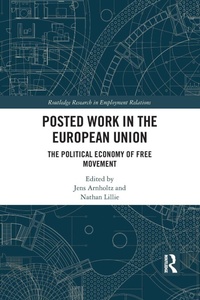
Posted Work in the European Union
The Political Economy of Free Movement
1st Edition
Published on 30. June 2021
Book
Paperback/Softback
228 pages
978-1-032-08786-3 (ISBN)
Description
Focusing on posting of workers, where workers employed in one country are send to work in another country, this edited volume is at the nexus of industrial relations and European Union studies. The central aim is to understand how the regulatory regime of worker "posting" is driving institutional changes to national industrial relations systems. In the introduction, the editors develop a framework for understanding the relationship of supra-national EU regulation, transnational actors and national industrial relations systems, which we then apply in the empirical chapters. This unique volume brings together scholars from diverse academic fields, all of whom are experts on the topic of "worker posting." The book examines different aspects of the posting debate, including the interactions of actors such as labour inspectorates, trade unions, European legal/political regulators, manpower firms, transnational subcontractors and posted workers.
The main objective of this book is to explore the dynamics of institutional change, by showing how trans- and supra-national dynamics affect European industrial relations systems. This volume will represent the "state of the art" in research on worker posting. It will also contribute to debates on European integration, social dumping, labour market dualization and precariousness and will be of value to those with an interest employment relations, law and regulation.
The main objective of this book is to explore the dynamics of institutional change, by showing how trans- and supra-national dynamics affect European industrial relations systems. This volume will represent the "state of the art" in research on worker posting. It will also contribute to debates on European integration, social dumping, labour market dualization and precariousness and will be of value to those with an interest employment relations, law and regulation.
Reviews / Votes
"This edited volume is a much-needed contribution from leading scholars that addresses key contradictions of free movement of labour within the European single market from the perspective of a critical political economy of regulation. In so doing, it breaks new ground and repositions previously disparate disciplinary preoccupations. As such, it will be a key reference for those interested in industrial relations, labour law and regulation theory, as well as for policy-makers and practitioners at national and European level concerned with the increasingly contentious labour market implications of the cross-border movement of migrant workers." -Charles Woolfson, Linkoeping University, Sweden"Posted workers are the critical test of free movement of workers, and thereby of the whole EU project. This book provides the ultimate analysis of a phenomenon that is still not clearly understood, and does not refrain from providing sharp policy recommendations." -Guglielmo Meardi, University of Warwick, UK
More details
Series
Language
English
Place of publication
London
United Kingdom
Publishing group
Taylor & Francis Ltd
Target group
College/higher education
Postgraduate
Dimensions
Height: 229 mm
Width: 152 mm
Thickness: 12 mm
Weight
337 gr
ISBN-13
978-1-032-08786-3 (9781032087863)
Copyright in bibliographic data and cover images is held by Nielsen Book Services Limited or by the publishers or by their respective licensors: all rights reserved.
Schweitzer Classification
Other editions
Additional editions
Jens Arnholtz | Nathan Lillie
Posted Work in the European Union
The Political Economy of Free Movement
Book
10/2019
1st Edition
Routledge
€206.30
Shipment within 15-20 days
Jens Arnholtz | Nathan Lillie
Posted Work in the European Union
The Political Economy of Free Movement
E-Book
10/2019
1st Edition
Routledge
€59.49
Available for download
Jens Arnholtz | Nathan Lillie
Posted Work in the European Union
The Political Economy of Free Movement
E-Book
10/2019
1st Edition
Routledge
€59.49
Available for download
Persons
Jens Arnholtz received his PhD from the Department of Sociology, University of Copenhagen. He is now an Associate Professor at the Employment Relations Research Center (FAOS) at that department.
Nathan Lillie is Professor of Social and Public Policy at the University of Jyvaeskylae, Finland.
Nathan Lillie is Professor of Social and Public Policy at the University of Jyvaeskylae, Finland.
Content
Chapter 1 - European Integration and the Reconfiguration of National Industrial Relations: Posted Work as a Driver of Institutional Change
1.1 The socio-economic drivers of EU posting
1.2 Competing legal principles and the fundamental tension of posted work
1.3 Firm practices as the driver of change
1.4 Pressure on domestic institutions and incremental change
1.5 Enforcement actors and creative re-enactment of institutions
1.6 National institutional change in response to posted work
1.7 Feedback and European level changes
1.8 The chapters and their contribution to the argument
1.9 Conclusions
References
Chapter 2 - The benefits of posting: Facts and figures on the use and impact of intra-EU posting
2.1 Introduction
2.2 'The posted worker': A multifaceted notion with a very concentrated impact
2.2.1 Intra-EU posting 'at a glance'
2.2.2 The evolution of intra-EU posting
2.2.3 Some characteristics of intra-EU posting
2.2.4 The impact of intra-EU posting on national labour markets
2.3 Are we blinded by the potential negative consequences of intra-EU posting?
2.3.1 Benefits of intra-EU posting from the perspective of the Member State of origin
2.3.2 Higher wages and purchasing power for posted workers
2.3.3 Higher tax revenues from posted workers
2.3.4 Intra-EU posting as adjustment mechanism for economic shocks
2.4 Benefits of intra-EU posting from the perspective of the host Member State
2.4.1 Various motives to use intra-EU posting
2.4.2 Does intra-EU posting lead to lower costs and prices?
2.5 The more we know about posting, the better we can discuss it: Perception vs reality
1.1 The socio-economic drivers of EU posting
1.2 Competing legal principles and the fundamental tension of posted work
1.3 Firm practices as the driver of change
1.4 Pressure on domestic institutions and incremental change
1.5 Enforcement actors and creative re-enactment of institutions
1.6 National institutional change in response to posted work
1.7 Feedback and European level changes
1.8 The chapters and their contribution to the argument
1.9 Conclusions
References
Chapter 2 - The benefits of posting: Facts and figures on the use and impact of intra-EU posting
2.1 Introduction
2.2 'The posted worker': A multifaceted notion with a very concentrated impact
2.2.1 Intra-EU posting 'at a glance'
2.2.2 The evolution of intra-EU posting
2.2.3 Some characteristics of intra-EU posting
2.2.4 The impact of intra-EU posting on national labour markets
2.3 Are we blinded by the potential negative consequences of intra-EU posting?
2.3.1 Benefits of intra-EU posting from the perspective of the Member State of origin
2.3.2 Higher wages and purchasing power for posted workers
2.3.3 Higher tax revenues from posted workers
2.3.4 Intra-EU posting as adjustment mechanism for economic shocks
2.4 Benefits of intra-EU posting from the perspective of the host Member State
2.4.1 Various motives to use intra-EU posting
2.4.2 Does intra-EU posting lead to lower costs and prices?
2.5 The more we know about posting, the better we can discuss it: Perception vs reality