

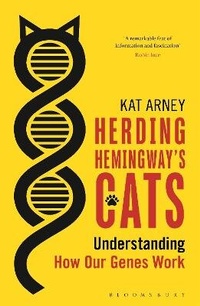
Herding Hemingway's Cats
Understanding how our genes work
Published on 9. February 2017
Book
Paperback/Softback
288 pages
978-1-4729-1007-3 (ISBN)
Description
How DNA is packed, unpacked and read - a companion reader to the book of life itself.
The language of genes has become common parlance. We know they make your eyes blue, your hair curly or your nose straight. The media tells us that our genes affect the risk of cancer, heart disease, alcoholism or Alzheimer's. The cost of DNA sequencing has plummeted from billions of pounds to a few hundred, and gene-based advances in medicine hold huge promise.
So we've all heard of genes, but how do they actually work?
There are 2.2 metres of DNA inside every one of your cells, encoding roughly 20,000 genes. These are the 'recipes' that tell our cells how to make the building blocks of life, along with myriad control switches ensuring they're turned on and off at the right time and in the right place. But rather than a static string of genetic code, this is a dynamic, writhing biological library. Figuring out how it all works - how your genes build your body - is a major challenge for researchers around the world. And what they're discovering is that far from genes being a fixed, deterministic blueprint, things are much more random and wobbly than anyone expected.
Drawing on stories ranging from six-toed cats and stickleback hips to Mickey Mouse mice and zombie genes - told by researchers working at the cutting edge of genetics - Kat Arney explores the mysteries in our genomes with clarity, flair and wit, creating a companion reader to the book of life itself.
The language of genes has become common parlance. We know they make your eyes blue, your hair curly or your nose straight. The media tells us that our genes affect the risk of cancer, heart disease, alcoholism or Alzheimer's. The cost of DNA sequencing has plummeted from billions of pounds to a few hundred, and gene-based advances in medicine hold huge promise.
So we've all heard of genes, but how do they actually work?
There are 2.2 metres of DNA inside every one of your cells, encoding roughly 20,000 genes. These are the 'recipes' that tell our cells how to make the building blocks of life, along with myriad control switches ensuring they're turned on and off at the right time and in the right place. But rather than a static string of genetic code, this is a dynamic, writhing biological library. Figuring out how it all works - how your genes build your body - is a major challenge for researchers around the world. And what they're discovering is that far from genes being a fixed, deterministic blueprint, things are much more random and wobbly than anyone expected.
Drawing on stories ranging from six-toed cats and stickleback hips to Mickey Mouse mice and zombie genes - told by researchers working at the cutting edge of genetics - Kat Arney explores the mysteries in our genomes with clarity, flair and wit, creating a companion reader to the book of life itself.
Reviews / Votes
A witty, clued-up report from the front lines of genetics ... Kat Arney unravels the intricacies of the discipline with a romp through 'thumbed' cats, hipped fish and frank interviews with scientists. * Nature * Arney's chirpy tour through the mysteries of modern genetics is engrossing and fun ... a lively update on the phenomenal complexity of the molecular inheritance that make us us. -- Stephen Curry * The Guardian * Arney's delightful book is accessible to those without a scientific background and its breezy anecdotal style makes for entertaining reading. -- Mark Pagel * BBC Focus * ...a gorgeously written, surprisingly gripping introduction to everything we've learned about genes since the famous Human Genome Project several years ago. -- Robert Krulwich * National Geographic * A sprightly, energetic tour through the minds of those trying to understand genes. each snappy chapter is a remarkable feat of information and fascination. -- Robin Ince, comedian, writer and co-presenter of The Infinite Monkey Cage and The Quest for Wonder Kay Arney explores the mysteries of the genome, shedding light on the complex and ever-changing world of genetics. * Science Focus * If you want to find out for whom the cell mutates, then Herding Hemingway's Cats is for you ... Kat Arney decodes the greatest works of nature, written in the language of the genes. -- Roger Highfield, author, science journalist and museum executive A great addition to the rapidly growing field of books giving us an insight into just how complex biology is at the molecular level ... a great piece of popular science. -- Brian Clegg * Popular Science * Kat is one of the world's finest science communicators and enthusiasts. Herding Hemingway's Cats will instantly turn you into the most interesting guest at any party - it's a joy to read and a masterclass in making the complex story of life accessible, entertaining and relevant. -- Mark Stevenson, author of An Optimist's Tour of the Future Injecting personality, enthusiasm and humour into the topic, geneticist Kat Arney uses bizarre stories ... to show how genes give our cells the recipe for life. * How It Works *More details
Language
English
Place of publication
London
United Kingdom
Publishing group
Bloomsbury Publishing PLC
Dimensions
Height: 198 mm
Width: 134 mm
Thickness: 36 mm
Weight
320 gr
ISBN-13
978-1-4729-1007-3 (9781472910073)
Copyright in bibliographic data and cover images is held by Nielsen Book Services Limited or by the publishers or by their respective licensors: all rights reserved.
Schweitzer Classification
Other editions
Additional editions
E-Book
01/2016
1st Edition
Bloomsbury Sigma
€18.49
Available for download
Person
Following a doctorate and subsequent research career in genetics, Kat Arney went on to become Science Communications Manager for Cancer Research UK, where she translated science into plain English to help people understand more about the disease. Now a freelance science writer and broadcaster, Kat's writing has appeared in the Guardian, Science, New Scientist, BBC Online and Al-Jazeera Online.
Kat regularly appears on national TV and radio shows, including Today, BBC Breakfast and GMTV, talking about the latest cancer research. She has presented several BBC Radio 4 science documentaries and programmes in the Costing the Earth series, is a regular presenter with the Naked Scientists, and presents and produces the Naked Genetics monthly podcast.
@harpistkat / katarney.com
Kat regularly appears on national TV and radio shows, including Today, BBC Breakfast and GMTV, talking about the latest cancer research. She has presented several BBC Radio 4 science documentaries and programmes in the Costing the Earth series, is a regular presenter with the Naked Scientists, and presents and produces the Naked Genetics monthly podcast.
@harpistkat / katarney.com
Content
Introduction: It's All About that Base
1. It's Not What You've Got, It's What You Do With It That Counts
2. Taking Out the Garbage
3. A Bit of Dogma
4. Throwing the Switch
5. The Secret's in the Blend
6. Cats with Thumbs
7. Fish with Hips
8. Mice and Men and Mole Rats, Oh My!
9. Party Town
10. Pimp My Genome
11. Cut and Paste
12. Nature's Red Pen
13. Ever Increasing Circles
14. Silence of the Genes
15. Night of the Living Dead
16. On the Hop
17. Opening a Can of Wobbly Worms
18. Everyone's a Little Bit Mutant
19. Opening the Black Box
20. Blame the Parents
21. Meet the Mickey Mouse Mice
22. In Search of the 21st-Century Gene
Glossary
I'd like to thank ...
References
Index
1. It's Not What You've Got, It's What You Do With It That Counts
2. Taking Out the Garbage
3. A Bit of Dogma
4. Throwing the Switch
5. The Secret's in the Blend
6. Cats with Thumbs
7. Fish with Hips
8. Mice and Men and Mole Rats, Oh My!
9. Party Town
10. Pimp My Genome
11. Cut and Paste
12. Nature's Red Pen
13. Ever Increasing Circles
14. Silence of the Genes
15. Night of the Living Dead
16. On the Hop
17. Opening a Can of Wobbly Worms
18. Everyone's a Little Bit Mutant
19. Opening the Black Box
20. Blame the Parents
21. Meet the Mickey Mouse Mice
22. In Search of the 21st-Century Gene
Glossary
I'd like to thank ...
References
Index