

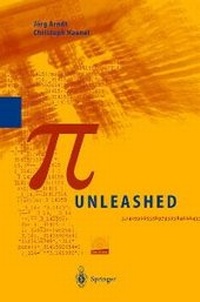
Pi - Unleashed
Translation by C. Lischka and D. Lischka
Published on 12. December 2000
Book
Mixed media product
XII, 270 pages
978-3-540-66572-4 (ISBN)
Description
In the 4,000-year history of research into Pi, results have never been as prolific as present. This book describes, in easy-to-understand language, the latest and most fascinating findings of mathematicians and computer scientists in the field of Pi. Attention is focused on new methods of high-speed computation.
Reviews / Votes
From the reviews:
SIGACT NEWS
"The book is sprinkled with many gems . . The book is a treasure of information and is fun to read . . I loved this book. In fact, I've pretty much run out of superlatives . . I would recommend it to anyone who is just curious about pi, or about large-precision arithmetic in general, as well as to the professional who is looking to break the next N-digit barrier. Who knows, perhaps a reader will be inspired to invent a faster yet method for such algorithms."
More details
Edition
Softcover reprint of the original 1st ed. 2001
Language
English
Place of publication
Berlin
Germany
Publishing group
Springer Berlin
Target group
College/higher education
Professional/practitioner
Product notice
Paperback (trade)
Illustrations
XII, 270 p. With online files/update., 1 s/w Abbildung
1 black & white illustrations, biography
Dimensions
Height: 23.5 cm
Width: 15.5 cm
Thickness: 15 mm
Weight
444 gr
ISBN-13
978-3-540-66572-4 (9783540665724)
DOI
10.1007/978-3-642-56735-3
Schweitzer Classification
Other editions
New editions
Book
10/1999
2nd Edition
Springer
€59.99
Shipment within 10-15 days
Additional editions
Persons
Content
1. The State of Pi Art.- 2. How Random is ??.- 2.1Probabilities.- 2.2 Is ? normal?.- 2.3 So is ? not normal?.- 2.4 The 163 phenomenon.- 2.5 Other statistical results.- 2.6 The Intuitionists and ?.- 2.7 Representation of continued fractions.- 3. Shortcuts to ?.- 3.1Obscurer approaches to ?.- 3.2 Small is beautiful.- 3.3 Squeezing ? through a sieve.- 3.4 ? and chance (Monte Carlo methods).- 3.5 Memorabilia.- 3.6 Bit for bit.- 3.7 Refinements.- 3.8 The ? room in Paris.- 4. Approximations for ?and Continued Fractions.- 4.1Rational approximations.- 4.2 Other approximations.- 4.3 Youthful approximations.- 4.4 On continued fractions.- 5. Arcus Tangens.- 5.1 John Machin's arctan formula.- 5.2 Other arctan formulae.- 6. Spigot Algorithms.- 6.1 The spigot algorithm in detail.- 6.2 Sequence of operations.- 6.3 A faster variant.- 6.4 Spigot algorithm for e.- 7.Gauss and ?.- 7.1 The ? AGM formula.- 7.2 The Gauss AGM algorithm.- 7.3 Schönhage variant.- 7.4 History of a formula.- 8. Ramanujan and ?.- 8.1 Ramanujan's series.- 8.2 Ramanujan's unusual biography.- 8.3 Impulses.- 9. The Borweins and ?.- 10. The BBP Algorithm.- 10.1Binary modulo exponentiation.- 10.2 A C program on the BBP series.- 10.3 Refinements.- 11. Arithmetic.- 11.1Multiplication.- 11.2 Karatsuba multiplication.- 11.3 FFT multiplication.- 11.4 Division.- 11.5 Square root.- 11.6 nth root.- 11.7 Series calculation.- 12. Miscellaneous.- 12.1 A ? quiz.- 12.2 Let numbers speak.- 12.3 A proof that ? = 2.- 12.4 The big change.- 12.5 Almost but not quite.- 12.6 Why always more?.- 12.7 ? and hyperspheres.- 12.8 Viète × Wallis = Osler.- 12.9 Squaring the circle with holes.- 12.10 An (in)finite funnel.- 13.The History of ?.- 13.1 Antiquity.- 13.2 Polygons.- 13.3 Infinite expressions.- 13.4 High-performance algorithms.- 13.5 The hunt for single ? digits.- Table: History of ? in the pre-computer era.- Table: History of ? in the computer era.- Table: History of digit extraction records.- 14. Historical Notes.- 14.1 The earliest squaring the circle in history?.- 14.2 A ? law.- 14.3 The Bieberbach story.- 15.The Future: ?Calculations on the Internet.- 15.1 The binsplit algorithm.- 15.2 The ? project on the Internet.- 16. ?Formula Collection.- 17. Tables.- 17.1 Selected constants to 100 places (base 10).- 17.2 Digits 0 to 2,500 of ? (base 10).- 17.3 Digits 2,501 to 5,000 of ? (base 10).- 17.4 Digits 0 to 2,500 of ? (base 16).- 17.5 Digits 2,501 to 5,000 of ? (base 16).- 17.6 Continued fraction elements 0 to 1,000 of ?.- 17.7 Continued fraction elements 1,001 to 2,000 of ?.- A. Documentation for the hfloat Library.- A.1 What hfloat is (good for).- A.2 Compiling the library.- A.3 Functions of the hfloat library.- A.4 Using hfloats in your own code.- A.5 Computations with extreme precision.- A.6 Precision and radix.- A.7 Compiling & running the ?-example-code.- A.8 Structure of hfloat.- A.9 Organisation of the files.- A. 10 Distribution policy & no warranty.