

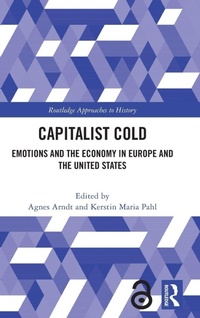
Capitalist Cold
Emotions and the Economy in Europe and the United States
1st Edition
Published on 24. January 2025
Book
Hardback
238 pages
978-1-032-39912-6 (ISBN)
Description
The capitalist system has often been described by its critics as a heartless economic structure corroding social bonds and symbolic values. Its defenders and analysts likewise use narratives that position emotions as central to the economy. This book enquires into the history of these framings.
To explore the role of emotions in economic practices and imaginaries, the volume presents case studies including original rereadings of well-known texts such as Theodor Adorno and Max Horkheimer's Dialectic of Enlightenment, as well as forays into little-known histories such as representations of capitalists in post-war Turkey, and how art dealers strategically used emotions for navigating the market in interwar Germany. Rather than simply reproducing the image of "cold capitalism", however, it offers nuanced investigations into the ambivalent images evoked by living and working within economic structures. In late-socialist Poland, capitalism felt "warm" and "fuzzy", while pop culture of the seventies found it not destructive but cool, hip, and edgy.
This book is aimed at students and scholars of social, economic, and cultural history.
The Open Access version of this book, available at www.taylor francis.com, has been made available under a Creative Commons Attribution- Non- Commercial- No Derivatives
(CC- BY- NC- ND) 4.0 license.
To explore the role of emotions in economic practices and imaginaries, the volume presents case studies including original rereadings of well-known texts such as Theodor Adorno and Max Horkheimer's Dialectic of Enlightenment, as well as forays into little-known histories such as representations of capitalists in post-war Turkey, and how art dealers strategically used emotions for navigating the market in interwar Germany. Rather than simply reproducing the image of "cold capitalism", however, it offers nuanced investigations into the ambivalent images evoked by living and working within economic structures. In late-socialist Poland, capitalism felt "warm" and "fuzzy", while pop culture of the seventies found it not destructive but cool, hip, and edgy.
This book is aimed at students and scholars of social, economic, and cultural history.
The Open Access version of this book, available at www.taylor francis.com, has been made available under a Creative Commons Attribution- Non- Commercial- No Derivatives
(CC- BY- NC- ND) 4.0 license.
More details
Series
Language
English
Place of publication
London
United Kingdom
Publishing group
Taylor & Francis Ltd
Target group
Professional and scholarly
Academic
Illustrations
11 s/w Abbildungen, 11 s/w Photographien bzw. Rasterbilder
11 Halftones, black and white; 11 Illustrations, black and white
Dimensions
Height: 235 mm
Width: 157 mm
Thickness: 18 mm
Weight
515 gr
ISBN-13
978-1-032-39912-6 (9781032399126)
Copyright in bibliographic data and cover images is held by Nielsen Book Services Limited or by the publishers or by their respective licensors: all rights reserved.
Schweitzer Classification
Other editions
Additional editions
Agnes Arndt | Kerstin Maria Pahl
Capitalist Cold
Emotions and the Economy in Europe and the United States
Book
approx. 07/2026
1st Edition
Routledge
€57.50
Not yet published
Persons
Agnes Arndt is a senior researcher at the Hannah Arendt Institute for Totalitarianism Studies and has worked extensively on Modern European History and the Cultural History of Economics. She is the author of Intellektuelle in der Oppostion (2007) and Rote Buerger (2013) and the co-author of Feeling Political (2022). agnes.arndt@mailbox.tu-dresden.de
Kerstin Maria Pahl is a post-doctoral researcher at the Max Planck Institute for Human Development specializing in the cultural history of the Anglophone world. Her publications include Revisiting the History of Emotions (ed. 2023) and The Visual Worlds of Life Writing. Portraits and Biographies in England, 1680-1750 (2024). Pahl@mpib-berlin.mpg.de
Kerstin Maria Pahl is a post-doctoral researcher at the Max Planck Institute for Human Development specializing in the cultural history of the Anglophone world. Her publications include Revisiting the History of Emotions (ed. 2023) and The Visual Worlds of Life Writing. Portraits and Biographies in England, 1680-1750 (2024). Pahl@mpib-berlin.mpg.de
Content
Part I
A Cold System?
Chapter 1
The Cold Bourgeoisie. Affect and Colonial Property
By Henrike Kohpeiss
Chapter 2
Cold Pop. How West German Pop Culture Began to Embrace the Modern World
By Florian Voelker
Part II
Cold Capitalists?
Chapter 3
Cold Melancholy. Tempers of Financial Pathology in Charles Dickens' A Christmas Carol
By Timothy Attanucci
Chapter 4
Citizen-Subjects of Capitalism. Comparing the Autobiographies of John Kenneth Galbraith and Milton and Rose Friedman
By Maurice Cottier
Chapter 5
Hope, Indignation, Nostalgia. The Emotional Navigation of Urban Modernity in Post-War Istanbul
By Emre Goenlueguer
Part III
Cold Markets?
Chapter 6
Warm Socialism and Cold Capitalism? The Ongoing Debate Over the Economic Reconstruction of Eastern Germany After Revolution and Reunification, 1989-1990
By Marcus Boeick
Chapter 7
"Small Group, Big Business". Imagining Capitalism and Capitalists in Late-Socialist Poland
By Florian Peters
Chapter 8
"Closed Doors, Sealed Lips". Emotional Practices on Legal and Illegal Art Markets in Early Twentieth-Century Germany
By Paul Franke
A Cold System?
Chapter 1
The Cold Bourgeoisie. Affect and Colonial Property
By Henrike Kohpeiss
Chapter 2
Cold Pop. How West German Pop Culture Began to Embrace the Modern World
By Florian Voelker
Part II
Cold Capitalists?
Chapter 3
Cold Melancholy. Tempers of Financial Pathology in Charles Dickens' A Christmas Carol
By Timothy Attanucci
Chapter 4
Citizen-Subjects of Capitalism. Comparing the Autobiographies of John Kenneth Galbraith and Milton and Rose Friedman
By Maurice Cottier
Chapter 5
Hope, Indignation, Nostalgia. The Emotional Navigation of Urban Modernity in Post-War Istanbul
By Emre Goenlueguer
Part III
Cold Markets?
Chapter 6
Warm Socialism and Cold Capitalism? The Ongoing Debate Over the Economic Reconstruction of Eastern Germany After Revolution and Reunification, 1989-1990
By Marcus Boeick
Chapter 7
"Small Group, Big Business". Imagining Capitalism and Capitalists in Late-Socialist Poland
By Florian Peters
Chapter 8
"Closed Doors, Sealed Lips". Emotional Practices on Legal and Illegal Art Markets in Early Twentieth-Century Germany
By Paul Franke