

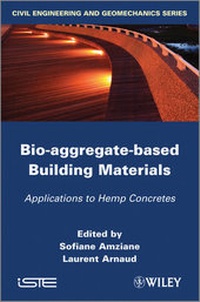
Bio-aggregate-based Building Materials
Applications to Hemp Concretes
Published on 18. January 2013
Book
Hardback
332 pages
978-1-84821-404-0 (ISBN)
Description
Using plant material as raw materials for construction is a relatively recent and original topic of research. This book presents an overview of the current knowledge on the material properties and environmental impact of construction materials made from plant particles, which are renewable, recyclable and easily available. It focuses on particles and as well on fibers issued from hemp plant, as well as discussing hemp concretes. The book begins by setting the environmental, economic and social context of agro-concretes, before discussing the nature of plant-based aggregates and binders. The formulation, implementation and mechanical behavior of such building materials are the subject of the following chapters. The focus is then put upon the hygrothermal behavior and acoustical properties of hempcrete, followed by the use of plant-based concretes in structures. The book concludes with the study of life-cycle analysis (LCA) of the environmental characteristics of a banked hempcrete wall on a wooden skeleton.
Contents
1. Environmental, Economic and Social Context of Agro-Concretes, Vincent Nozahic and Sofiane Amziane.
2. Characterization of Plant-Based Aggregates. Vincent Picandet.
3. Binders, Gilles Escadeillas, Camille Magniont, Sofiane Amziane and Vincent Nozahic.
4. Formulation and Implementation, Christophe Lanos, Florence Collet, Gérard Lenain and Yves Hustache.
5. Mechanical Behavior, Laurent Arnaud, Sofiane Amziane, Vincent Nozahic and Etienne Gourlay.
6. Hygrothermal Behavior of Hempcrete, Laurent Arnaud, Driss Samri and Étienne Gourlay.
7. Acoustical Properties of Hemp Concretes, Philippe Glé, Emmanuel Gourdon and Laurent Arnaud.
8. Plant-Based Concretes in Structures: Structural Aspect - Addition of a Wooden Support to Absorb the Strain, Philippe Munoz and Didier Pipet.
9. Examination of the Environmental Characteristics of a Banked Hempcrete Wall on a Wooden Skeleton, by Lifecycle Analysis: Feedback on the LCA Experiment from 2005, Marie-Pierre Boutin and Cyril Flamin.
About the Authors
Sofiane Amziane is Professor and head of the Civil Engineering department at POLYTECH Clermont-Ferrand in France. He is also in charge of the research program dealing with bio-based building materials at Blaise Pascal University (Institut Pascal, Clermont Ferrand, France). He is the secretary of the RILEM Technical Committee 236-BBM dealing with bio-based building materials and the author or co-author of over one hundred papers in scientific journals such as Cement and Concrete Research, Composite Structures or Construction Building Materials as well as international conferences.
Laurent Arnaud is a Bridges, Waters and Forestry Engineer (Ingénieur des Ponts, Eaux et Forêts) and researcher at Joseph Fourier University in Grenoble, France. He is also Professor at ENTPE (Ecole Nationale des Travaux Publics de l'Etat). Trained in the field of mechanical engineering, his research has been directed toward the characterization and development of new materials for civil engineering and construction. He is head of the international committee at RILEM - BBM, as well as the author of more than one hundred publications, and holder of an international invention patent.
More details
Product info
gebunden
Edition
1. Auflage
Language
English
Place of publication
London
United Kingdom
Target group
Professional and scholarly
Product notice
sewn/stitched
Paper over boards
Dimensions
Height: 240 mm
Width: 161 mm
Thickness: 22 mm
Weight
665 gr
ISBN-13
978-1-84821-404-0 (9781848214040)
Schweitzer Classification
Other editions
Additional editions
E-Book
02/2013
Wiley-ISTE
€154.99
Available for download
E-Book
02/2013
Wiley-ISTE
€154.99
Available for download
Persons
Sofiane Amziane is Professor and head of the Civil Engineering department at POLYTECH Clermont-Ferrand in France. He is also in charge of the research program dealing with bio-based building materials at Blaise Pascal University (Institut Pascal, Clermont Ferrand, France). He is the secretary of the RILEM Technical Committee 236-BBM dealing with bio-based building materials and the author or co-author of over one hundred papers in scientific journals such as Cement and Concrete Research, Composite Structures or Construction Building Materials as well as international conferences.
Laurent Arnaud is a Bridges, Waters and Forestry Engineer (Ingenieur des Ponts, Eaux et Forets) and researcher at Joseph Fourier University in Grenoble, France. He is also Professor at ENTPE (Ecole Nationale des Travaux Publics de l'Etat). Trained in the field of mechanical engineering, his research has been directed toward the characterization and development of new materials for civil engineering and construction. He is head of the international committee at RILEM - BBM, as well as the author of more than one hundred publications, and holder of an international invention patent.
Laurent Arnaud is a Bridges, Waters and Forestry Engineer (Ingenieur des Ponts, Eaux et Forets) and researcher at Joseph Fourier University in Grenoble, France. He is also Professor at ENTPE (Ecole Nationale des Travaux Publics de l'Etat). Trained in the field of mechanical engineering, his research has been directed toward the characterization and development of new materials for civil engineering and construction. He is head of the international committee at RILEM - BBM, as well as the author of more than one hundred publications, and holder of an international invention patent.
Content
Foreword
Chapter 1 Environmental, Economic and Social Context of Agro-Concretes
Vincent NOZAHIC and Sofiane AMZIANE
Sustainable development, construction and materials
Environmental impacts of the construction sector
Standardization and regulation: toward a global approach
Standardization and regulation in force
Limitations of the normative and regulatory framework
The materials: an increasingly crucial element
Role of the materials in energy consumption
What is a low-environmental-impact material?
Constantly-changing regulations
The specific case of concretes made from lignocellular particles
Development of agro-concretes in the context of France
What does the term "Agro-concrete" mean?
General definition
Lignocellular resources
General characteristics of lignocellular agro-resources
Conclusions
Bibliography
Chapter 2 Characterization of Plant-Based Aggregates
Vincent PICANDET
Microstructure of the shiv particles
Structure of the stem of fibrous plants
SEM observation of hemp shiv particles
Chemistry of the cell walls
Density and porosity, in the case of hemp shiv
Particle Size Distribution (PSD)
General characteristics of aggregates made from fibrous plants
Fiber content
Methods for characterizing the PSD
PSD analyses
Comparison of the results obtained by image analysis
Characterization of the geometry of the particles
Characterization of the PSD
Conclusions
Compactness and compressibility
Water absorption capacity
Bibliography
Chapter 3 Binders
Gilles ESCADEILLAS, Camille MAGNIONT, Sofiane AMZIANE and Vincent NOZAHIC
Portland cements
Chemical and mineral composition
Environmental impacts
Lime
Aerial lime
Natural hydraulic limes
Lime-pozzolan mixtures
Natural pozzolans
Calcined natural pozzolans: metakaolin
Fly ash
Blast furnace slag
Plaster
Chemical and mineralogical composition
Environmental impacts
Summary
Bibliography
Chapter 4 Formulation and Implementation
Christophe LANOS, Florence COLLET, Gérard LENAIN and Yves HUSTACHE
Objectives
Preamble
Traditional applications
Constituents and mixture
Methods of implementation
Rules of formulation
Basis of usual formulations
Influence of the proportion of paste in the mixture
Quality of the paste and water content
Homogeneity of the paste
The relationship between formulation and strength
The relationship between formulation and thermo-hydric properties
Examples of formulations
Origin of the data
Walling application
Flooring application
Roofing application
Other applications
Installation techniques
Building a wall using formwork
Application by spraying
Laying of a floor
Creating a roof
Other uses
Professional rules for buildings using hempcrete and hemp mortars
History
Principles and content of the professional regulations
Bibliography
Chapter 5 Mechanical Behavior
Laurent ARNAUD, Sofiane AMZIANE, Vincent NOZAHIC and Etienne GOURLAY
Composite material
Making of the test tubes
Mechanical behavior
Effect of initial compression
Effect of the nature of the binder
Influence of the binder content
Influence of the particle size
Influence of the curing conditions
Evolution over time
Interaction between particles and binder
Anisotropic behavior
Modeling of the mechanical behavior
Empirical approach
Self-consistent homogenization approach
Toward the study of a stratified composite
Conclusion
Bibliography
Chapter 6 Hygrothermal Behavior of Hempcrete
Laurent ARNAUD, Driss SAMRI and Étienne GOURLAY
Introduction
Heat conductivity
Measurement of the conductivity
Modeling of the heat conductivity in dry and humid conditions
Heat transfers
Hygrothermal transfers
Experimental device
Stresses
Phase changes
Hygrothermal transfers
Role of coating products applied to hempcrete
Thermal characterization of various construction materials
Autoclaved aerated concrete
Vertically perforated brick
Hempcrete
Modeling of coupled heat- and mass transfers
Transfer laws
Transfer model: the Künzel model
Determination of the transfer coefficients
Numerical modeling
Chapter 7 Acoustical Properties of Hemp Concretes
Philippe GLÉ, Emmanuel GOURDON and Laurent ARNAUD
Introduction
Acoustical properties of the material on the basis of the main mechanisms
Influence of the components
Influence of the casting method
Modeling the acoustical properties
Physical analysis of the acoustical properties being measured
The adapted double porosity model and its parameters
Experimental validation of the model
Application of the model to the acoustical characterization of shiv
Porosity of shiv
Resistivity
Conclusion
Bibliography
Chapter 8 Plant-Based Concretes in Structures: Structural
Aspect - Addition of a Wooden Support to Absorb the Strain
Philippe MUNOZ and Didier PIPET
Introduction
Preliminary test
Description of the panel
Putting the panel in place on the bracing bank
Longitudinal loading and measurement of the movements
Behavior of the test bank
Behavior of the wooden panel
Test on a composite panel of a wooden skeleton and hempcrete
Description of the panel
Emplacement of the panel on the bracing bank
Vertical loading
Longitudinal loading and measurement of the movements
Running of the test
Feature of the ruin of the panel
Results and comparative analysis
Conclusions and reflections
Acknowledgements
Bibliography
Chapter 9 Examination of the Environmental Characteristics of a Banked Hempcrete Wall on a Wooden Skeleton, by Lifecycle
Analysis: Feedback on the LCA Experiment from
Marie-Pierre BOUTIN and Cyril FLAMIN
Introduction
Description of the products studied
Method for environmental evaluation of bio-sourced materials
Lifecycle Analysis on hempcrete - methodology, working hypotheses and results
Delimitation of the system under study
Inventory analysis
Impact evaluation
Results and interpretation of the lifecycle
Interpretations of the lifecycle, conclusions and reflections
Bibliography
List of Authors
Index