

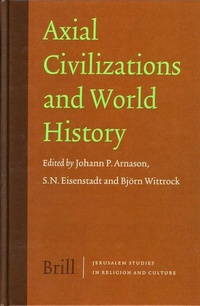
Axial Civilizations and World History
Published on 1. September 2004
Book
Hardback
574 pages
978-90-04-13955-8 (ISBN)
Description
The overarching theme of the book is the historical meaning of the Axial Age, commonly defined as a period of several centuries around the middle of the last millennium BCE, and its cultural innovations. The civilizational patterns that grew out of this exceptionally creative phase are a particularly rewarding theme for comparative analysis.
The book contains essays on cultural transformations in Ancient Greece, Ancient Israel, Iran, India and China, as well as background developments in the core civilizations of the Ancient Near East. An introductory section deals with the history of the debate on the AxialAge, the theoretical questions that have emerged from it, and the present state of the discussion.
The book will be useful for comparative historians of cultures and religions, as well as for historical sociologists interested in the comparative analysis of civilizations. It should also help linking the fields of classical, biblical and Asian studies to broader interdisciplinary debates within the humanities sciences.
Contributors include: Johann P. Arnason, Bjoern Wittrock, Peter Wagner, Arpad Szakolczai, Jan Assmann, Piotr Michalowski, Shaul Shaked, Israel Knohl, S.N. Eisenstadt, Kurt A. Raaflaub, Guy G. Stroumsa, David J. Levy, Jan Retsoe, David Shulman, Sheldon Pollock, Hsu Cho-yun, Christoph Harbsmeier, and Frederic Wakeman Jr.
The book contains essays on cultural transformations in Ancient Greece, Ancient Israel, Iran, India and China, as well as background developments in the core civilizations of the Ancient Near East. An introductory section deals with the history of the debate on the AxialAge, the theoretical questions that have emerged from it, and the present state of the discussion.
The book will be useful for comparative historians of cultures and religions, as well as for historical sociologists interested in the comparative analysis of civilizations. It should also help linking the fields of classical, biblical and Asian studies to broader interdisciplinary debates within the humanities sciences.
Contributors include: Johann P. Arnason, Bjoern Wittrock, Peter Wagner, Arpad Szakolczai, Jan Assmann, Piotr Michalowski, Shaul Shaked, Israel Knohl, S.N. Eisenstadt, Kurt A. Raaflaub, Guy G. Stroumsa, David J. Levy, Jan Retsoe, David Shulman, Sheldon Pollock, Hsu Cho-yun, Christoph Harbsmeier, and Frederic Wakeman Jr.
More details
Series
Language
English
Place of publication
Leiden
Netherlands
Target group
College/higher education
Product notice
sewn/stitched
Cloth over boards
Dimensions
Height: 243 mm
Width: 162 mm
Thickness: 40 mm
Weight
1152 gr
ISBN-13
978-90-04-13955-8 (9789004139558)
Copyright in bibliographic data and cover images is held by Nielsen Book Services Limited or by the publishers or by their respective licensors: all rights reserved.
Schweitzer Classification
Other editions
Additional editions

Johann P. Arnason | Shmuel N. Eisenstadt | Björn Wittrock
Axial Civilizations and World History
Software
09/2004
Brill
Unfortunately, price unknown
Available (delivery time upon request)
Persons
Johann P. Arnason, dr.habil. in Sociology, University of Bielefeld 1975 is now Emeritus Professor in Sociology at La Trobe University, Melbourne. His major publications include Social Theory and Japanese Experience (London, 1997) and Civilizations in Dispute (Leiden-Boston, 2003).
S.N. Eisenstadt, Ph.D. (1947), Jerusalem, is Professor Emeritus at the Hebrew University of Jerusalem. He is member of many academies, recipient of honorary doctoral degrees of the Universities of Tel Aviv, Helsinki, Harvard, Duke, Budapest and Hebrew Union College. Recipient of many prizes and awards, he is author of more than 50 books.
Bjoern Wittrock, Ph.D. (1974), formerly Lars Hierta Professor of Government at Stockholm University, is now University Professor at Uppsala University and Principal of the Swedish Collegium for Advanced Study in the Social Sciences, Uppsala. He has published extensively in the fields of intellectual history, historical social science and social theory. His publications include fourteen books, among them: Public Spheres and Collective Identities (New Brunswick, N.J., 2001).
S.N. Eisenstadt, Ph.D. (1947), Jerusalem, is Professor Emeritus at the Hebrew University of Jerusalem. He is member of many academies, recipient of honorary doctoral degrees of the Universities of Tel Aviv, Helsinki, Harvard, Duke, Budapest and Hebrew Union College. Recipient of many prizes and awards, he is author of more than 50 books.
Bjoern Wittrock, Ph.D. (1974), formerly Lars Hierta Professor of Government at Stockholm University, is now University Professor at Uppsala University and Principal of the Swedish Collegium for Advanced Study in the Social Sciences, Uppsala. He has published extensively in the fields of intellectual history, historical social science and social theory. His publications include fourteen books, among them: Public Spheres and Collective Identities (New Brunswick, N.J., 2001).
Content
General Introduction
Part I. Theoretical Approaches
Part II. The Ancient Near East and its Axial Peripheries
Part III. Late Antiquity and Beyond
Part IV. Indian and Chinese Perspectives
Part V. Concluding Reflections
Bibliography
Index
Part I. Theoretical Approaches
Part II. The Ancient Near East and its Axial Peripheries
Part III. Late Antiquity and Beyond
Part IV. Indian and Chinese Perspectives
Part V. Concluding Reflections
Bibliography
Index