

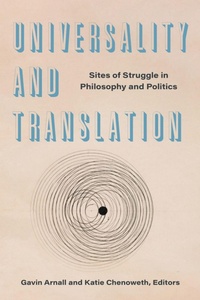
Universality and Translation
Sites of Struggle in Philosophy and Politics
Published on 7. January 2025
Book
Hardback
320 pages
978-1-5315-0856-2 (ISBN)
Description
Within contemporary theory, the concepts of translation and universality have frequently been associated with different and even opposed philosophical and political projects: watchwords of either domination or liberation, the erasure of difference or the defense of difference. The universalizing drives of capitalism, colonialism, and other systems of oppression have precipitated widespread suspicion of any appeal to universality. This has led some, in turn, to champion the very notion of universality as antithetical to these systems of oppression. Similarly, recent scholarship has begun to grapple with the fundamental role of translation not only in forging inclusive democratic politics but also, by contrast, in violence, including imperial expansion and global war.
The present volume advocates neither for nor against translation or universality as such. Instead, it attends to their insurmountable ambiguity and equivocity, the tensions and contradictions that are internal to both concepts and that exist between them. Indeed, the wager of this volume is that translation, universality, and their relationship name irreducible yet overlapping sites of struggle for a diverse array of struggles on the Left.
Drawing from multiple intellectual traditions and orientations, with a special emphasis on deconstruction and Marxism, this volume both reveals and participates in a subterranean current of thought committed to theorizing the dynamic, plural, and ultimately inextricable relationship between translation and universality. Its contributors approach this problem in ways that challenge and unsettle dominant trends within translation studies and critical and postcolonial theory, thereby opening new lines of inquiry within and beyond these fields.
The present volume advocates neither for nor against translation or universality as such. Instead, it attends to their insurmountable ambiguity and equivocity, the tensions and contradictions that are internal to both concepts and that exist between them. Indeed, the wager of this volume is that translation, universality, and their relationship name irreducible yet overlapping sites of struggle for a diverse array of struggles on the Left.
Drawing from multiple intellectual traditions and orientations, with a special emphasis on deconstruction and Marxism, this volume both reveals and participates in a subterranean current of thought committed to theorizing the dynamic, plural, and ultimately inextricable relationship between translation and universality. Its contributors approach this problem in ways that challenge and unsettle dominant trends within translation studies and critical and postcolonial theory, thereby opening new lines of inquiry within and beyond these fields.
More details
Edition
New edition
Language
English
Place of publication
New York
United States
Target group
Professional and scholarly
College/higher education
Edition type
New edition
Product notice
Cloth over boards
Illustrations
1 b/w illustration
Dimensions
Height: 229 mm
Width: 152 mm
Thickness: 22 mm
Weight
626 gr
ISBN-13
978-1-5315-0856-2 (9781531508562)
Copyright in bibliographic data and cover images is held by Nielsen Book Services Limited or by the publishers or by their respective licensors: all rights reserved.
Schweitzer Classification
Other editions
Additional editions
Gavin Arnall | Katie Chenoweth
Universality and Translation
Sites of Struggle in Philosophy and Politics
E-Book
01/2025
Fordham University Press
€63.99
Available for download
Persons
Gavin Arnall (Edited By)
Gavin Arnall is Associate Professor of Romance Languages and Literatures and Director of the Center for Latin American and Caribbean Studies at the University of Michigan, Ann Arbor. His research and teaching converge at the intersection of aesthetics, politics, and philosophy, with a special focus on Marxism and its (missed) encounters with Black and Indigenous radicalisms. He is the author of Subterranean Fanon: An Underground Theory of Radical Change (Columbia University Press, 2020), the translator of Emilio de Ipola's Althusser, The Infinite Farewell (Duke University Press, 2018), and the coeditor of Between Revolution and Democracy: Jose Arico, Marxism, and Latin America (Brill's Historical Materialism Book Series, forthcoming).
Katie Chenoweth (Edited By)
Katie Chenoweth is Associate Professor of French at Princeton University. She is the author of The Prosthetic Tongue: Printing Technology and the Rise of the French Language (University of Pennsylvania Press, 2019). Her articles on Renaissance culture, media history, and deconstruction have appeared in venues such as Discourse, Montaigne Studies, Symploke, and The Comparatist. She is director of the Bibliotheque Derrida at Editions du Seuil, a collection that includes Derrida's unpublished seminars and other posthumous works. At Princeton, she is the director of Derrida's Margins, an ongoing digital humanities project dedicated to Derrida's personal library.
Gavin Arnall is Associate Professor of Romance Languages and Literatures and Director of the Center for Latin American and Caribbean Studies at the University of Michigan, Ann Arbor. His research and teaching converge at the intersection of aesthetics, politics, and philosophy, with a special focus on Marxism and its (missed) encounters with Black and Indigenous radicalisms. He is the author of Subterranean Fanon: An Underground Theory of Radical Change (Columbia University Press, 2020), the translator of Emilio de Ipola's Althusser, The Infinite Farewell (Duke University Press, 2018), and the coeditor of Between Revolution and Democracy: Jose Arico, Marxism, and Latin America (Brill's Historical Materialism Book Series, forthcoming).
Katie Chenoweth (Edited By)
Katie Chenoweth is Associate Professor of French at Princeton University. She is the author of The Prosthetic Tongue: Printing Technology and the Rise of the French Language (University of Pennsylvania Press, 2019). Her articles on Renaissance culture, media history, and deconstruction have appeared in venues such as Discourse, Montaigne Studies, Symploke, and The Comparatist. She is director of the Bibliotheque Derrida at Editions du Seuil, a collection that includes Derrida's unpublished seminars and other posthumous works. At Princeton, she is the director of Derrida's Margins, an ongoing digital humanities project dedicated to Derrida's personal library.
Content
Introduction 1
Gavin Arnall
"Plus d'une langue": The Paradigm of Translation 57
Barbara Cassin
The Philosopher as Translator 74
Souleymane Bachir Diagne
Babel as Opportunity: Translating Solidarity 87
Gary Wilder
Primitive Accumulation, Again 115
Ben Conisbee Baer
Psychoanalytic States: Translating from Lenin to Freud and Au-dela 183
Cate I. Reilly
Against Ion's Chain: Translatability in Antonio Gramsci's Prison Notebooks 221
Peter D. Thomas
Universal Eco-homophony: Overtaking Translation 248
Naomi Waltham-Smith
The Relapses of the Universal: Translation and the Language of the Political 274
Gavin Walker
Acknowledgments 303
Contributors 305
Index 309
Gavin Arnall
"Plus d'une langue": The Paradigm of Translation 57
Barbara Cassin
The Philosopher as Translator 74
Souleymane Bachir Diagne
Babel as Opportunity: Translating Solidarity 87
Gary Wilder
Primitive Accumulation, Again 115
Ben Conisbee Baer
Psychoanalytic States: Translating from Lenin to Freud and Au-dela 183
Cate I. Reilly
Against Ion's Chain: Translatability in Antonio Gramsci's Prison Notebooks 221
Peter D. Thomas
Universal Eco-homophony: Overtaking Translation 248
Naomi Waltham-Smith
The Relapses of the Universal: Translation and the Language of the Political 274
Gavin Walker
Acknowledgments 303
Contributors 305
Index 309