

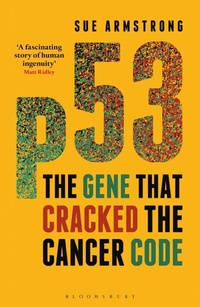
p53
The Gene that Cracked the Cancer Code
Published on 5. November 2015
Book
Paperback/Softback
288 pages
978-1-4729-1052-3 (ISBN)
Description
The BMA Medical Book Award-shortlisted story of the search for p53 - the most important gene in medicine.
All of us have lurking in our DNA a most remarkable gene, which has a crucial job - it protects us from cancer. Known simply as p53, this gene constantly scans our cells to ensure that they grow and divide without mishap. If a cell makes a mistake in copying its DNA during the process of division, p53 stops it in its tracks, summoning a repair team before allowing the cell to carry on dividing. If the mistake is irreparable and the rogue cell threatens to grow out of control, p53 commands the cell to commit suicide. Cancer cannot develop unless p53 itself is damaged or prevented from functioning normally.
This book tells the story of medical science's mission to unravel the mysteries of this crucial gene, and to get to the heart of what happens in our cells when they turn cancerous. Through the personal accounts of key researchers, p53: The Gene that Cracked the Cancer Code reveals the fascination of the quest for scientific understanding, as well as the excitement of the chase for new cures - the hype, the enthusiasm, the lost opportunities, the blind alleys, and the breakthroughs. And as the long-anticipated revolution in cancer treatment tailored to individual patient's symptoms begins to take off at last, p53 remains at the cutting edge.
This tale of scientific discovery highlights the tremendous recent advances made in our understanding of cancer, a disease that affects more than one in three of us at some point in our lives.
All of us have lurking in our DNA a most remarkable gene, which has a crucial job - it protects us from cancer. Known simply as p53, this gene constantly scans our cells to ensure that they grow and divide without mishap. If a cell makes a mistake in copying its DNA during the process of division, p53 stops it in its tracks, summoning a repair team before allowing the cell to carry on dividing. If the mistake is irreparable and the rogue cell threatens to grow out of control, p53 commands the cell to commit suicide. Cancer cannot develop unless p53 itself is damaged or prevented from functioning normally.
This book tells the story of medical science's mission to unravel the mysteries of this crucial gene, and to get to the heart of what happens in our cells when they turn cancerous. Through the personal accounts of key researchers, p53: The Gene that Cracked the Cancer Code reveals the fascination of the quest for scientific understanding, as well as the excitement of the chase for new cures - the hype, the enthusiasm, the lost opportunities, the blind alleys, and the breakthroughs. And as the long-anticipated revolution in cancer treatment tailored to individual patient's symptoms begins to take off at last, p53 remains at the cutting edge.
This tale of scientific discovery highlights the tremendous recent advances made in our understanding of cancer, a disease that affects more than one in three of us at some point in our lives.
Reviews / Votes
More than any textbook, article, or lecture could, this book offers a sip of contagious enthusiasm and a conviction that scientists will eventually "crack the cancer code" * Science * Armstrong's book is genuinely engrossing on many levels, and the story is very well told. It has considerable depth, yet sufficient clarity to be able to reach a wide audience ... a highly readable, well-written and crafted book. * Cell * A succinct, accessible study of humanity's genetic bulwark against cancer. * Nature * One of the best accounts I've read of how science is actually performed. -- Peter Forbes * The Guardian * Armstrong paints a very human picture ... Not only does Armstrong make p53 understandable but she also sheds light on the scientific method. In an age of government austerity, highlighting the importance of scientific research is also a gift. * The Lancet * Ms. Armstrong (1)s book comes alive in the sections where she explores cancer (1)s human toll, including the devastating experience of families with rare genetic mutations, such as Li-Fraumeni syndrome, which leaves children of parents with a faulty gene vulnerable to cancer at almost any age. She also captures the excitement of researchers as they come upon eureka moments. * Wall Street Journal *More details
Language
English
Place of publication
London
United Kingdom
Publishing group
Bloomsbury Publishing PLC
Dimensions
Height: 198 mm
Width: 128 mm
Thickness: 25 mm
Weight
238 gr
ISBN-13
978-1-4729-1052-3 (9781472910523)
Copyright in bibliographic data and cover images is held by Nielsen Book Services Limited or by the publishers or by their respective licensors: all rights reserved.
Schweitzer Classification
Other editions
Additional editions
E-Book
11/2014
1st Edition
Bloomsbury Sigma
€11.49
Available for download
Person
Sue Armstrong is a science writer and broadcaster based in Edinburgh. She has worked for a variety of media organisations, including New Scientist, and since the 1980s has undertaken regular assignments for the World Health Organization (WHO) and UNAIDS, writing about women's health issues and the AIDS pandemic, among many other topics, and reporting from the frontline in countries as diverse as Haiti, Papua New Guinea, Uganda, Thailand, Namibia and Serbia. Sue has been involved, as presenter, writer and researcher, in several major medical documentaries for BBC Radio 4.
Content
Preface
Chapter 1: Flesh of our Own Flesh
Chapter 2: The Enemy Within
Chapter 3: Discovery
Chapter 4: Unseeable Biology
Chapter 5: Cloning the Gene
Chapter 6: A Case of Mistaken Identity
Chapter 7: A New Angle on Cancer
Chapter 8: p53 Reveals its True Colours
Chapter 9: Master Switch
Chapter 10: 'Guardian of the Genome'
Chapter 11: Of Autumn Leaves and Cell Death
Chapter 12: Of Mice and Men
Chapter 13: The Guardian's Gatekeeper
Chapter 14: The Smoking Gun
Chapter 15: Following the Fingerprints
Chapter 16: Cancer in the Family
Chapter 17: The Tropeiro Connection?
Chapter 18: Jekyll and Hyde
Chapter 19: Cancer and Ageing: A Balancing Act
Chapter 20: The Treatment Revolution
Dramatis Personae
Glossary
Notes on Sources
Acknowledgements
Index
Chapter 1: Flesh of our Own Flesh
Chapter 2: The Enemy Within
Chapter 3: Discovery
Chapter 4: Unseeable Biology
Chapter 5: Cloning the Gene
Chapter 6: A Case of Mistaken Identity
Chapter 7: A New Angle on Cancer
Chapter 8: p53 Reveals its True Colours
Chapter 9: Master Switch
Chapter 10: 'Guardian of the Genome'
Chapter 11: Of Autumn Leaves and Cell Death
Chapter 12: Of Mice and Men
Chapter 13: The Guardian's Gatekeeper
Chapter 14: The Smoking Gun
Chapter 15: Following the Fingerprints
Chapter 16: Cancer in the Family
Chapter 17: The Tropeiro Connection?
Chapter 18: Jekyll and Hyde
Chapter 19: Cancer and Ageing: A Balancing Act
Chapter 20: The Treatment Revolution
Dramatis Personae
Glossary
Notes on Sources
Acknowledgements
Index