

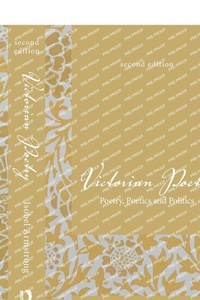
Victorian Poetry
Poetry, Poetics and Politics
2nd Edition
Published on 21. January 2023
Book
Paperback/Softback
570 pages
978-1-032-47576-9 (ISBN)
Description
In Victorian Poetry: Poetry, Poetics and Politics, Isobel Armstrong rescued Victorian poetry from its longstanding sepia image as 'a moralised form of romantic verse' and unearthed its often subversive critique of nineteenth-century culture and politics. In this uniquely comprehensive and theoretically astute new edition, Armstrong provides an entirely new preface that notes the key advances in the criticism of Victorian poetry since her classic work was first published in 1993. A new chapter on the alternative fin de siecle sees Armstrong discuss Michael Field, Rudyard Kipling, Alice Meynell and a selection of Hardy lyrics. The extensive bibliography acts as a key resource for students and scholars alike.
More details
Edition
2nd edition
Language
English
Place of publication
London
United Kingdom
Publishing group
Taylor & Francis Ltd
Target group
College/higher education
Postgraduate and Undergraduate
Dimensions
Height: 234 mm
Width: 156 mm
Thickness: 31 mm
Weight
857 gr
ISBN-13
978-1-032-47576-9 (9781032475769)
Copyright in bibliographic data and cover images is held by Nielsen Book Services Limited or by the publishers or by their respective licensors: all rights reserved.
Schweitzer Classification
Other editions
Additional editions
Book
02/2019
2nd Edition
Routledge
€263.40
Shipment within 15-20 days
E-Book
01/2019
2nd Edition
Routledge
€55.49
Available for download
E-Book
01/2019
2nd Edition
Routledge
€55.49
Available for download
Previous edition
Book
03/1996
1st Edition
Routledge
€58.43
Article exhausted; check for reprint
Person
Isobel Armstrong is Emeritus Professor of English at Birkbeck College, University of London, UK.
Content
Preface to the second edition Preface to the first edition Acknowledgements Introduction: Re-Reading Victorian Poetry Part 1: Conservative and Benthamite aesthetics of the avant-garde: Tennyson and Browning in the 1830s 1. Two systems of concentric circles 2. Experiments of 1830: Tennyson and the formation of subversive conservative poetry 3. 1832: Critique of the poetry of sensation 4. Experiments in the 1830s: Browning and the Benthamite formation 5. The politics of dramatic form Part 2: Mid-century: European revolution and Crimean War - democratic, liberal, radical and feminine voices 6. Individualism under pressure 7. The radical in crisis: Clough 8. The liberal in crisis: Arnold 9. A new radical aesthetic - the Grotesque as cultural critique: Morris 10. Tennyson in the 1850s: new experiments in conservative poetry and the Type 11. Browning in the 1850s and after: new experiments in radical poetry and the Grotesque 12. 'A music of thine own': women's poetry - an expressive tradition? Part 3: Another culture? Another poetics? Introduction: the 1860s and after: aesthetics, language, power and high finance 13. Swinburne: agonistic republican - the poetry of sensation as democratic critique 14. Hopkins: agonistic reactionary - the Grotesque as conservative form 15. Meredith and others: hard, gem-like dissidence 16. James Thomson: atheist, blasphemer and anarchist - the Grotesque sublime 17. Alternative fin de siecles: Rudyard Kipling, Michael Field, Thomas Hardy and Alice Meynell Notes Indicative bibliography