

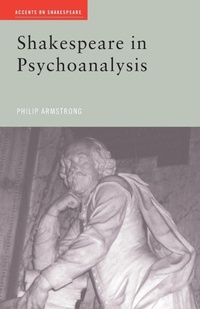
Shakespeare in Psychoanalysis
1st Edition
Published on 17. May 2001
Book
Paperback/Softback
284 pages
978-0-415-20722-5 (ISBN)
Description
The link between psychoanalysis as a mode of interpretation and Shakespeare's works is well known. But rather than merely putting Shakespeare on the couch, Philip Armstrong focuses on the complex and fascinatingly fruitful mutual relationship between Shakespeare's texts and psychoanalytic theory. He shows how the theories of Freud, Rank, Jones, Lacan, Erikson, and others are themselves in a large part the product of reading Shakespeare.
Armstrong provides an introductory cultural history of the relationship between psychoanalytic concepts and Shakespearean texts.
This is played out in a variety of expected and unexpected contexts, including:
*the early modern stage
*Hamlet and The Tempest
*Freud's analytic session
*the Parisian intellectual scene
*Hollywood
*the virtual space of the PC.
Armstrong provides an introductory cultural history of the relationship between psychoanalytic concepts and Shakespearean texts.
This is played out in a variety of expected and unexpected contexts, including:
*the early modern stage
*Hamlet and The Tempest
*Freud's analytic session
*the Parisian intellectual scene
*Hollywood
*the virtual space of the PC.
Reviews / Votes
I have personally purchased and studied every one of the new Accents on Shakespeare volumes in the new series edited by Terence Hawkes and repeatedly turn to them as resources for my own research and teaching. My students - graduate and undergraduate alike - find them invaluable, as I do. They are remarkably comprehensive, timely, and informative, and essential way to keep current with the fundamental ideas in Shakespearean criticism. - Arthur F. Kinney, Thomas W. Copeland Professor of Literary History, University of Massachusetts,Accents on Shakespeare is shaping up as everything a streetwise series of books on the Bard should be:engaged, imaginative, heretical and occasionally outrageous. No one who aims to have their finger on the pulse of Shakespeare studies can afford to ignore it. - Kiernan Ryan Professor of English, Royal Holloway, University of London and Fellow of New Hall, University of Cambridge
' ... of interest to anyone engaged with the reinterpretation of Shakespeare through modern theories and modern media, this book is a solid and detailed analysis of it's subject.' - New Theatre Quarterly 'I have personally purchased and studied every one of the newAccents on Shakespeare volumes in the new series edited by Terence Hawkes and repeatedly turn to them as resources for my own research and teaching. My students - graduate and undergraduate alike - find them invaluable, as I do. They are remarkably comprehensive, timely, and informative, and essential way to keep current with the fundamental ideas in Shakespearean criticism.' - Arthur F. Kinney, Thomas W. Copeland Professor of Literary History, University of Massachusetts,
'Accents on Shakespeareis shaping up as everything a streetwise series of books on the Bard should be:engaged, imaginative, heretical and occasionally outrageous. No one who aims to have their finger on the pulse of Shakespeare studies can afford to ignore it.' - Kiernan Ryan Professor of English, Royal Holloway, University of London and Fellow of New Hall, University of Cambridge
More details
Series
Language
English
Place of publication
London
United Kingdom
Publishing group
Taylor & Francis Ltd
Target group
College/higher education
Dimensions
Height: 216 mm
Width: 140 mm
Thickness: 15 mm
Weight
361 gr
ISBN-13
978-0-415-20722-5 (9780415207225)
Copyright in bibliographic data and cover images is held by Nielsen Book Services Limited or by the publishers or by their respective licensors: all rights reserved.
Schweitzer Classification
Other editions
Additional editions
Philip Armstrong
Shakespeare in Psychoanalysis
Book
05/2001
1st Edition
Routledge
€206.30
Shipment within 15-20 days
Person
Philip Armstrong teaches at the University of Canterbury in Christchurch, New Zealand. He is the author of Shakespeare's Visual Regime: Tragedy, Psychoanalysis and the Gaze, and has also published articles on New Zealand literature.
Content
General Editor's Preface Acknowledgements A Note on References Introducing. Part One:Shakespeare in Psychoanalysis 1. In Vienna 2. In Paris 3. In Johannesburg Part Two:Psychoanalysis out of Shakespeare 4. Shakespeare's Memory 5. Shakespeare's Sex Conclusion Bibliography