

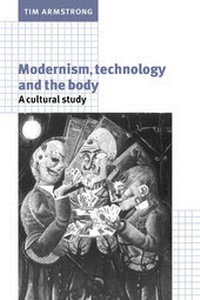
Modernism, Technology, and the Body
A Cultural Study
Published on 28. February 1998
Book
Hardback
319 pages
978-0-521-59004-4 (ISBN)
Description
This book is a study of the relations between the body and its technologies in modernism. Tim Armstrong traces the links between modernist literary texts and medical, psychological and social theory across a range of writers, including Yeats, Henry James, Eliot, Stein, and Pound. Armstrong shows how modernist texts enact experimental procedures which have their origins in nineteenth-century psychophysics, biology, and bodily reform techniques, but within a context in which the body is reconceived and subjected to new modes of production, representation and commodification. Drawing on a wide range of disciplines, Armstrong challenges the received oppositions between technology and literature, the instrumental and the aesthetic, by demonstrating the leaky boundaries and complex interconnections between these domains. This book offers a cultural history of modernism as it negotiated the enduring fact of the human body in a period of rapid technological change.
More details
Language
English
Place of publication
Cambridge
United Kingdom
Target group
Professional and scholarly
Illustrations
10 Halftones, unspecified
Dimensions
Height: 235 mm
Width: 157 mm
Thickness: 23 mm
Weight
535 gr
ISBN-13
978-0-521-59004-4 (9780521590044)
Copyright in bibliographic data and cover images is held by Nielsen Book Services Limited or by the publishers or by their respective licensors: all rights reserved.
Schweitzer Classification
Other editions
New editions
Book
02/1998
Cambridge University Press
€57.80
Shipment within 15-20 days
Additional editions
Book
02/1998
Cambridge University Press
€57.80
Shipment within 15-20 days
Person
Content
Introduction; Part I. The Regulation of Energies: 1. Electrifying the body; 2. Waste products; Part II. Reshaping the Body: 3. Prosthetic modernism; 4. Auto-facial construction; Part III. Technologies of Gender: 5. Seminal Economies; 6. Making a woman; Part IV. Interruption and Suture: 7. Distracted writing; 8. Film finds a tongue.