

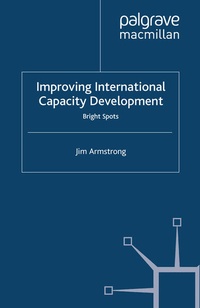
Improving International Capacity Development
Bright Spots
Published on 1. January 2013
Book
Paperback/Softback
XIV, 249 pages
978-1-349-45652-9 (ISBN)
Description
Nothing is more important to a new, fragile or developing nation than developing the capacity of its government to support national well-being. Every society is complex; every government is complex. Yet, well-intentioned international development aid, born in an era of infrastructure projects, continues to apply simplistic technical solutions to these wickedly complex development problems. It's an outside-in approach that rarely succeeds, even by the development industry's own admission. But out there, amongst the billions of dollars of failed interventions, there are bright spots of success places where capacity is harnessed, not just for today, but for tomorrow, too. What is working so well? Drawing on research, practical experience, and stories of success, Jim Armstrong explores these emerging approaches.
More details
Edition
1st ed. 2013
Language
English
Place of publication
London
United Kingdom
Target group
Professional and scholarly
Illustrations
XIV, 249 p.
Dimensions
Height: 216 mm
Width: 140 mm
Thickness: 15 mm
Weight
337 gr
ISBN-13
978-1-349-45652-9 (9781349456529)
DOI
10.1057/9781137310118
Schweitzer Classification
Other editions
Additional editions
Book
05/2013
Palgrave Macmillan
€53.49
Shipment within 10-20 days
Person
Jim Armstrong is President of The Governance NetworkT, Canada, and has been involved with major change projects with national leaders around the globe. He has a PhD in Applied Management form the University of Birmingham, UK, a Masters from the University of Guelph, Canada, and a Masters from the University of Oxford, UK.
Content
Foreword; Karl Moore 1. One Size Fits All 2. Wicked Problems 3. Positivism and Constructivism 4. The Central Case Study 5. Non-linear Process 6. Co-diagnosing 7. Co-learning 8. Evaluation As Co-learning 9. Co-designing 10. Co-acting 11. Trinidad and Tobago Example Conclusion: The Way Ahead