

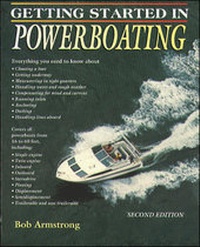
Getting Started in Powerboating
2nd Edition
Published on 16. March 1995
Book
Paperback/Softback
224 pages
978-0-07-003095-4 (ISBN)
Description
Getting Started in Powerboating is a friendly beginner's guide that concentrates on what you need to know when you first take the helm. This second edition includes a revised gallery of good powerboats, new material on basic safety, preparations to go offshore, and improved illustrations of tricky maneuvers.
Getting Started in Powerboating covers all powerboats--big and small; single-engine, twin-engine, outboard, and sterndrive; trailerable and non-trailerable; fast planing hulls and slow but seaworthy displacement hulls; and everything in between. It can help you decide what kind of boat is right for you, and it describes fully the characteristic handling and behavior of each type.
Bob Armstrong tells you how to dock any boat under any conditions of wind, current, and crowding, and how to leave a slip with a minimum of fuss. He explains how to handle docklines, how to execute close-quarters maneuvers, how to anchor, run inlets, adjust trim for a better ride, and cope with heavy weather. He offers hints for judging the quality of a boat, tips for quick mastery of a boat you've never handled before, and an expert's views on the types of powerboats available--from runabouts to motoryachts to houseboats, jetboats, and catamarans--and what to expect from each.
Getting Started in Powerboating covers all powerboats--big and small; single-engine, twin-engine, outboard, and sterndrive; trailerable and non-trailerable; fast planing hulls and slow but seaworthy displacement hulls; and everything in between. It can help you decide what kind of boat is right for you, and it describes fully the characteristic handling and behavior of each type.
Bob Armstrong tells you how to dock any boat under any conditions of wind, current, and crowding, and how to leave a slip with a minimum of fuss. He explains how to handle docklines, how to execute close-quarters maneuvers, how to anchor, run inlets, adjust trim for a better ride, and cope with heavy weather. He offers hints for judging the quality of a boat, tips for quick mastery of a boat you've never handled before, and an expert's views on the types of powerboats available--from runabouts to motoryachts to houseboats, jetboats, and catamarans--and what to expect from each.
More details
Edition
2nd edition
Language
English
Place of publication
New York
United States
Publishing group
McGraw-Hill Education - Europe
Target group
Adult education
Illustrations
230 Illustrations
Dimensions
Height: 234 mm
Width: 191 mm
Thickness: 13 mm
Weight
499 gr
ISBN-13
978-0-07-003095-4 (9780070030954)
Copyright in bibliographic data and cover images is held by Nielsen Book Services Limited or by the publishers or by their respective licensors: all rights reserved.
Schweitzer Classification
Content
PrefacePart 1 Choosing the Right BoatChapter 1 No Boat is Right for EveryoneChapter 2 Displacement HullsChapter 3 Planing HullsChapter 4 Semidisplacement HullsChapter 5 Comparing the Three Hull TypesChapter 6 Drive SystemsChapter 7 How to Read Boat Reviews and TestsChapter 8 Twenty Questions to Codify Boat SelectionPart 2 The Whys of Powerboat HandlingChapter 9 Why Boats Don't Behave Like CarsChapter 10 The Twin-Screw AdvantageChapter 11 Transom PowerChapter 12 The Influence of the WindChapter 13 What Current DoesPart 3 The Hows of Powerboat HandlingChapter 14 Know Your BoatChapter 15 Boathandling in Wind and CurrentChapter 16 Docking a Single-Screw InboardChapter 17 The "Impossible" Moves with a Single-Screw BoatChapter 18 Docking a Twin-Screw InboardChapter 19 Docking Transom-Powered BoatsChapter 20 Using Springlines for ManeuveringChapter 21 Using DocklinesChapter 22 Anchors and Anchoring TechniquesChapter 23 Inlet RunningChapter 24 How to Handle Heavy WeatherChapter 25 Practice Makes PerfectAppendix 1 A Matter of SafetyAppendix 2 Rules of the RoadAppendix 3 Offshore BoatingAppendix 4 A Gallery of PowerboatsIndex