

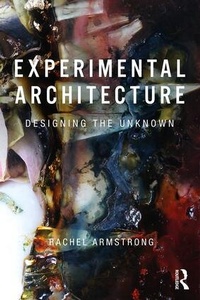
Experimental Architecture
Designing the Unknown
1st Edition
Published on 25. June 2019
Book
Hardback
228 pages
978-1-138-57524-0 (ISBN)
Description
In this ground-breaking book, the first to provide an overview of the theory and practice of experimental architecture, Rachel Armstrong explores how interdisciplinary, design-led research practices are beginning to redefine the possibilities of architecture as a profession. Drawing on experts from disciplines as varied as information technology, mathematics, poetry, graphic design, scenography, bacteriology, marine applied science and robotics, Professor Armstrong delineates original, cutting-edge architectural experiments through essays, quotes, poetry, equations and stories.
Written by an acknowledged pioneer of architectural experiment, this visionary book is ideal for students and researchers wishing to engage in experimental, practice-based architectural and artistic research. It introduces radical new ideas about architecture and provides ideas and inspiration which students and researchers can apply in their own work and proposals, while practitioners can draw on it to transform their creative assumptions and develop thereby a distinctive "edge" to stand out in a highly competitive profession.
Written by an acknowledged pioneer of architectural experiment, this visionary book is ideal for students and researchers wishing to engage in experimental, practice-based architectural and artistic research. It introduces radical new ideas about architecture and provides ideas and inspiration which students and researchers can apply in their own work and proposals, while practitioners can draw on it to transform their creative assumptions and develop thereby a distinctive "edge" to stand out in a highly competitive profession.
More details
Language
English
Place of publication
London
United Kingdom
Publishing group
Taylor & Francis Ltd
Target group
College/higher education
Professional and scholarly
Illustrations
4 s/w Zeichnungen, 24 s/w Abbildungen, 20 s/w Photographien bzw. Rasterbilder
4 Line drawings, black and white; 20 Halftones, black and white; 24 Illustrations, black and white
Dimensions
Height: 234 mm
Width: 156 mm
Weight
580 gr
ISBN-13
978-1-138-57524-0 (9781138575240)
Copyright in bibliographic data and cover images is held by Nielsen Book Services Limited or by the publishers or by their respective licensors: all rights reserved.
Schweitzer Classification
Other editions
Additional editions
Book
06/2019
1st Edition
Routledge
€71.98
Shipment within 10-20 days
E-Book
06/2019
1st Edition
Routledge
€55.49
Available for download
E-Book
06/2019
1st Edition
Routledge
€55.49
Available for download
Person
Rachel Armstrong is Professor of Experimental Architecture at Newcastle University. Her work focuses on establishing the conditions for a "living" architecture that couples the computational properties of the natural world with building structures and infrastructures. She is Director and founder of the Experimental Architecture Group (EAG) whose work has been published, exhibited and performed at international biennales, and Coordinator for the Living Architecture project, which is an ongoing collaboration of experts from universities in the UK, Spain, Italy and Austria. She has written a number of academic books including: Liquid Life: On Non-Linear Materiality (2019); Soft Living Architecture: An Alternative View of Bio-informed Practice (2018); Star Ark: A Living, Self-Sustaining Spaceship (2016); Vibrant Architecture: Matter as a CoDesigner of Living Structures (2015). Her fiction books include Invisible Ecologies (2019) and Origamy (2018).
Content
1. Architecture and Research Rachel Armstrong 1.1 Experimental Architecture Reader 1.2 Architecture as Discipline 1.3 Neoliberalism as Worldview 1.4 Ways of Knowing 1.5 Research 1.6 Nature of Architectural Research 1.7 Evaluation 1.8 Impact 1.9 Outreach 1.10 Research Environment 1.11 Research Context 1.12 Economic Importance of Architectural Research 1.13 Principles of Architectural Research: A "wicked" discipline 1.13.1 Personal Exploration 1.13.2 Academic Environment 1.13.3 Research and Education 1.13.4 Professional Practice 2. Experimental Architecture Rachel Armstrong 2.1 Designing Change 2.2 Experiments versus "Wicked" Experiments 2.3 Introducing Experimental Architecture 2.4 Ethics 2.5 Research Principles of Experimental Architecture 2.5.1 The Role of Apparatuses 2.5.2 Sorting, Ordering and Valuing 2.5.3 Laboratory Environments 2.5.4 Monstering 2.5.5 Question-making 2.6 Towards an Ecological Architecture 2.6.1 The Houme 3. Architectural Experiments 3.1 Short Experiments 3.1.1 Harvested Sunlight: An experiment with a novel photoautotrophic biomaterial Simon Park and Victoria Geaney 3.1.2 SuperTree Claudia Pasquero and Marco Poletto 3.1.3 Co-Occupancy Joyce Hwang 3.1.4 PolyBrick 3.0: DNA glaze and digital ceramics Jenny Sabin 3.1.5 Graphene Architecture: Integrated intelligence in soft responsive skins Areti Markopoulou 3.1.6 High-Resolution Architecture Designed/Built by Humans/AI/Robots Alisa Andrasek 3.1.7 Tempietto on Mylar T+E+A+M 3.018 Nightly Catie Newell 3.2 Long Experiments 3.2.1 Evolving, Growing, and Gardening Cyber-physical Systems Susan Stepney and colleagues 3.2.2 About the Architecture of the Human Mind: A mathematical experiment Francoise Chatelin 3.2.3 Nomadic Hamlet 2.0: Testing place and video space for audiences Esther M. Armstrong and Dick Straker 3.2.4 Exaptive Design: Radical co-authorship as method Simone Ferracina 3.2.5 The Cloud Chamber Andrew Ballantyne 3.2.6 The Third Thing Rolf Hughes 4. Afterword Rachel Armstrong