

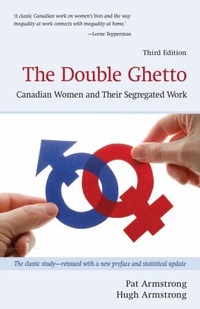
The Double Ghetto
Canadian Women and Their Segregated Work
3rd Edition
Published on 8. July 2010
Book
Paperback/Softback
272 pages
978-0-19-543832-1 (ISBN)
Description
Pat Armstrong is a 2011 Fellow of The Royal Society of Canada.
One of the classic studies of Canadian sociology - now reissued with a new introduction by the authors - The Double Ghetto is a thought-provoking examination of women in the workforce and how their roles have both changed and yet stayed the same over the past four decades.
The Double Ghetto surveys the work women do at home and on the job to analyze why work in this country is still segregated by sex. As the authors note, although women now account for a majority of those graduating from post-secondary educational institutions and their labour force participation rate equals that of men, at the same time "women continue to do women's work at women's wages" and are disproportionately concentrated in the lowest paying occupations.
Why, despite all the gains of the past four decades, does segregation still persist? And why has progress, if anything, slowed since the mid-1990s, when the previous edition of this book was issued?
As well as being of vital interest to anyone interested in the status of women in the Canadian workforce, The Double Ghetto is also a standard text for courses in sociology, social work, and women's studies departments.
One of the classic studies of Canadian sociology - now reissued with a new introduction by the authors - The Double Ghetto is a thought-provoking examination of women in the workforce and how their roles have both changed and yet stayed the same over the past four decades.
The Double Ghetto surveys the work women do at home and on the job to analyze why work in this country is still segregated by sex. As the authors note, although women now account for a majority of those graduating from post-secondary educational institutions and their labour force participation rate equals that of men, at the same time "women continue to do women's work at women's wages" and are disproportionately concentrated in the lowest paying occupations.
Why, despite all the gains of the past four decades, does segregation still persist? And why has progress, if anything, slowed since the mid-1990s, when the previous edition of this book was issued?
As well as being of vital interest to anyone interested in the status of women in the Canadian workforce, The Double Ghetto is also a standard text for courses in sociology, social work, and women's studies departments.
More details
Series
Edition
3rd Revised edition
Language
English
Place of publication
Toronto
Canada
Edition type
Revised edition
Illustrations
No illustrations
Dimensions
Height: 215 mm
Width: 141 mm
Thickness: 13 mm
Weight
228 gr
ISBN-13
978-0-19-543832-1 (9780195438321)
Copyright in bibliographic data and cover images is held by Nielsen Book Services Limited or by the publishers or by their respective licensors: all rights reserved.
Schweitzer Classification
Persons
Pat Armstrong is co-author or editor of more than a dozen books on health care, and she has also published on a wide variety of issues related to women's work and to social policy. Currently CHSRF/CIHR Chair in Heath Services and Nursing Research at York University, she has served as chair of the Department of Sociology at York and director of the School of Canadian Studies at Carleton University. She was a founding partner of the 'National Network on Environments and Womens Health and is the chair of Women and Health Care Reform, a working group on health reform. Her CIHR-funded project compares conditions in Canada's long-term care facilities with those in Nordic countries, which is the first step in a longer research program. Like most of her past research, this project relies primarily on the perspectives of those who actually provide or manage care within the system. Armstrong is a board member of the Canadian Health Coalition.
Hugh Armstrong is a professor in the School of Social Work and in the Institute of Political Economy at Carleton University. He currently serves on the Board of Directors for the Council on Aging of Ottawa and on the Community Advisory Committee of the Ottawa Hospital. His books include About Canada: Health Care (Halifax and Winnipeg: Ferwood Books, 2008) and, with Pat Armstrong, Wasting Away: The Undermining of Canadian Health Care, Second Edition (Oxford), also recently reissued in a Wynford edition. His research interests include women and work, unions and public policy, and the political economy of health and health care.
Hugh Armstrong is a professor in the School of Social Work and in the Institute of Political Economy at Carleton University. He currently serves on the Board of Directors for the Council on Aging of Ottawa and on the Community Advisory Committee of the Ottawa Hospital. His books include About Canada: Health Care (Halifax and Winnipeg: Ferwood Books, 2008) and, with Pat Armstrong, Wasting Away: The Undermining of Canadian Health Care, Second Edition (Oxford), also recently reissued in a Wynford edition. His research interests include women and work, unions and public policy, and the political economy of health and health care.
Content
Introduction to the Wynford Edition ; 1. Introduction ; 2. Women's Work in the Labour Force ; Female Participation in the Labour Force ; The Economic Context ; Industrial Segregation ; Occupational Segregation ; Women's Wages ; Differences Among Women ; The Causation of Work ; Conditions and Relations of Work ; 3. Women's Work in the Home ; The Historical Context ; Housework ; Reproduction and Child Care ; Care of the Elderly and the Disabled ; Tension Management ; Sexual Relations ; 4. Biological Determinism ; Difficulties in Establishing Differences ; Female and Male ; Feminine and Masculine ; Biology and Work In The Home ; Biology and Work In The Labour Force ; 5. Idealism ; Idealist Analysis ; Problems With Idealist Analysis ; Symbolic Interactionism ; Post-Marxist Theories ; 6. Materialism ; The Materialist Approach ; Work at Home and In The Labour Force ; Employer Demands and Family Economic Needs ; Women's Work In The Home and Women's Consciousness ; Women's Work In The Labour Force and Women's Consciousness ; Early Learning ; 7. Conclusion ; References