

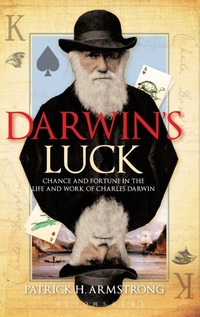
Darwin's Luck
Chance and Fortune in the Life and Work of Charles Darwin
Published on 15. February 2009
Book
Hardback
216 pages
978-1-84725-150-3 (ISBN)
Description
Just how far did Charles Darwin's luck - both good and bad - affect his life and scientific discoveries? One might make a case for saying that Darwin's life was dogged by ill-luck (or perhaps ill-fortune is more appropriate). His mother died when he was seven; he was sent to a school at which he 'learnt little'; he left Edinburgh Medical School after two years, unqualified. He undertook a five-year voyage although he was prone to sea-sickness; his girlfriend (of whom there is evidence he was very fond) married someone else a few months into this voyage. He was affected by ill-health throughout much of his life. One of his children appears to have been mentally handicapped and this child, and also his beloved Annie, died in infancy. In addition to all this, his brother became addicted to drugs.On the other hand one could argue that he had a privileged and fortunate life - perhaps the more common view. At a number of key points in his life he made a choice, or others made a choice, or circumstances occurred, that profoundly influenced the path that he took.
There is a school of thought, one that this book investigates, that although Darwin came to the right conclusions, he did not actually follow the right path in getting there. While his science was sometimes flawed, he had the distinct knack of good instinct. Whilst on his voyage to the Galapagos vital evidence that would have led to his theories becoming clearer quite literally slipped through his fingers - Galapagos turtles were caught, examined and their shells thrown overboard. Had he been more thorough, Darwin may have noticed that the clues to his theory of evolution were on these very shells.
There is a school of thought, one that this book investigates, that although Darwin came to the right conclusions, he did not actually follow the right path in getting there. While his science was sometimes flawed, he had the distinct knack of good instinct. Whilst on his voyage to the Galapagos vital evidence that would have led to his theories becoming clearer quite literally slipped through his fingers - Galapagos turtles were caught, examined and their shells thrown overboard. Had he been more thorough, Darwin may have noticed that the clues to his theory of evolution were on these very shells.
Reviews / Votes
Mention in Nature, 20 November 2008 "Patrick Armstrong has approached the great man's work from a novel perspective ... [he] gives a good summary of Darwin's achievements for the general reader" - Times Higher Education "Patrick Armstrong has written a charming biography, dealing with Darwin's voyage on the Beagle, his time at Down House near Bromley, his life with his family, the trauma of the death of some of his children, and, of course, his science." Church Times. 15 May 2009. "The book has a quite wonderful cover and numerous illustrations -- many of them photographs taken by the geographer author." - Church Times. 15 May 2009.More details
Language
English
Place of publication
London
United Kingdom
Publishing group
Bloomsbury Publishing PLC
Target group
Professional and scholarly
Illustrations
26
Dimensions
Height: 240 mm
Width: 161 mm
Thickness: 16 mm
Weight
487 gr
ISBN-13
978-1-84725-150-3 (9781847251503)
Copyright in bibliographic data and cover images is held by Nielsen Book Services Limited or by the publishers or by their respective licensors: all rights reserved.
Schweitzer Classification
Other editions
Additional editions
E-Book
02/2009
1st Edition
Continuum Publishing Corporation
€77.49
Available for download
Person
Patrick H. Armstrong is Senior Lecturer in Geography, University of Western Australia, Perth.
Content
1. Charles Robert Darwin: life of privilege or subject of ill-fortune?; 2. The advantages of family. The legacy of the Darwins and Wedgwoods; money, class, influence and genetics.; 3. Boyhood and school. Adversity and triumph, death of his mother; the origins of a naturalist.; 4. Edinburgh: the medicine manque: learning how to learn; observing humanity; boredom in lectures; the magnetic Dr Grant; dealing with failure; 'You care for nothing but shooting and rat catching and will become a disgrace to your family'.; 5. Cambridge; the importance of friendships and associations: Cousin Fox, John Henslow, Adam Sedgwick.; 6. The Origins of the Beagle Voyage: the role of chance.; 7. Good and bad luck during the voyage: the extraordinary good fortune of the order in which places were visited; islands and continents. Storm, tempest, earthquake, revolution, shipwreck and death. Darwin's mistakes.; 8. Fanny and Emma: Darwin's women - the girlfriend and the wife; the best woman won!; 9. Darwin's illness(es); tropical infection, poison or psychosomatics?; 10. The long period of rumination at Down: barnacles and gardens; home and family. Good years and bad.; 11. 'The bolt from the blue': Wallace's letter and the publication of the Origin.; 12. The vital role of friends: Lyell, Hooker and Huxley.; 13. Good times and bad in the later years.; 14. Final illness and death: the churchyard in Down or Westminster Abbey?