

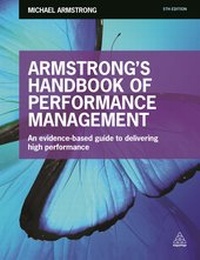
Armstrong's Handbook of Performance Management
An Evidence-Based Guide to Delivering High Performance
5th Edition
Published on 3. November 2014
Book
Paperback/Softback
416 pages
978-0-7494-7029-6 (ISBN)
Description
Managing staff performance is an effective mechanism for developing both staff and organizational growth. By clarifying an organization's objectives, translating these into clear individual goals and reviewing these goals regularly, performance management provides a well-structured and effective management tool. In the completely updated fifth edition of Armstrong's Handbook of Performance Management, Michael Armstrong considers the latest developments in this area, and how these can be applied to managing staff for increased performance. The new edition includes guidance on 360-degree feedback and the results of a far-reaching e-reward survey of performance management practices in 156 organizations.
Ideal for practitioners and students alike, Armstrong's Handbook of Performance Management is aligned to the CIPD standards for Performance Management and so is ideal for those working towards the intermediate and advanced level qualifications. It remains the most authoritative and engaging textbook on performance management. Online supporting resources include lecture slides, a glossary of terms and a literature review.
Ideal for practitioners and students alike, Armstrong's Handbook of Performance Management is aligned to the CIPD standards for Performance Management and so is ideal for those working towards the intermediate and advanced level qualifications. It remains the most authoritative and engaging textbook on performance management. Online supporting resources include lecture slides, a glossary of terms and a literature review.
Reviews / Votes
"If you come from the school of thought that believes appraisals should be swapped for something a little more holistic then Armstrong will give you much food for thought... There's enough here to keep the most pernickety HR manager happy." * Management Today * "It should be required reading for all line managers who propose that performance management is solely the job of the HR department, and for all those HR 'dinosaurs' who say the same." * Training Journal * "The timing of this book is perfect, as the shift from appraisal schemes to performance managing is hitting its stride." * Personnel Today * "Wealth of practical advice... [Armstrong] uses charts, subheadings and bullet points to make his ideas clear." * getAbstract.com *More details
Edition
5th Revised edition
Language
English
Place of publication
London
United Kingdom
Target group
College/higher education
Professional and scholarly
Edition type
Revised edition
Product notice
Paperback (trade)
Dimensions
Height: 240 mm
Width: 170 mm
Thickness: 20 mm
Weight
710 gr
ISBN-13
978-0-7494-7029-6 (9780749470296)
Copyright in bibliographic data and cover images is held by Nielsen Book Services Limited or by the publishers or by their respective licensors: all rights reserved.
Schweitzer Classification
Other editions
New editions
Michael Armstrong
Armstrong's Handbook of Performance Management
An Evidence-Based Guide to Performance Leadership
Book
01/2022
7th Edition
Kogan Page Ltd
€104.70
Shipment within 10-20 days
Michael Armstrong
Armstrong's Handbook of Performance Management
An Evidence-Based Guide to Delivering High Performance
Book
12/2017
6th Edition
Kogan Page Ltd
€65.79
Article exhausted; check for reprint
Person
Michael Armstrong is a former Chief Examiner of the Chartered Institute of Personnel and Development (CIPD), Managing Partner of E-Reward and an independent management consultant. He has spent 25 years as an HR practitioner, including 12 as HR Director of a publishing company. He has sold over 500,000 books on the subject of HRM, and is the author of a suite of several best-selling HR books, also published by Kogan Page.
Content
Chapter - 00: Introduction;
Section - ONE: Performance management fundamentals;
Chapter - 01: The essence of performance management;
Chapter - 02: The evolution of performance management;
Chapter - 03: The conceptual framework;
Chapter - 04: Issues in performance management;
Section - TWO: Performance management processes and skills;
Chapter - 05: Setting goals;
Chapter - 06: Providing feedback;
Chapter - 07: 360-degree feedback;
Chapter - 08: Conducting performance reviews;
Chapter - 09: Assessing performance;
Chapter - 10: Coaching;
Chapter - 11: Managing underperformers;
Section - THREE: Applications of performance management;
Chapter - 12: Managing organizational performance;
Chapter - 13: Managing team performance;
Chapter - 14: Performance management and employee engagement;
Chapter - 15: Performance management and talent management;
Chapter - 16: Performance management and learning;
Chapter - 17: Performance management and reward;
Chapter - 18: International performance management;
Section - FOUR: Performance management in action;
Chapter - 19: The impact of performance management;
Chapter - 20: The state of performance management;
Chapter - 21: Performance management models;
Section - FIVE: The development and management of performance management;
Chapter - 22: Developing performance management;
Chapter - 23: Managing performance management;
Chapter - 24: The performance management role of line managers;
Chapter - 25: Learning about performance management;
Chapter - 26: Evaluating performance management
Section - ONE: Performance management fundamentals;
Chapter - 01: The essence of performance management;
Chapter - 02: The evolution of performance management;
Chapter - 03: The conceptual framework;
Chapter - 04: Issues in performance management;
Section - TWO: Performance management processes and skills;
Chapter - 05: Setting goals;
Chapter - 06: Providing feedback;
Chapter - 07: 360-degree feedback;
Chapter - 08: Conducting performance reviews;
Chapter - 09: Assessing performance;
Chapter - 10: Coaching;
Chapter - 11: Managing underperformers;
Section - THREE: Applications of performance management;
Chapter - 12: Managing organizational performance;
Chapter - 13: Managing team performance;
Chapter - 14: Performance management and employee engagement;
Chapter - 15: Performance management and talent management;
Chapter - 16: Performance management and learning;
Chapter - 17: Performance management and reward;
Chapter - 18: International performance management;
Section - FOUR: Performance management in action;
Chapter - 19: The impact of performance management;
Chapter - 20: The state of performance management;
Chapter - 21: Performance management models;
Section - FIVE: The development and management of performance management;
Chapter - 22: Developing performance management;
Chapter - 23: Managing performance management;
Chapter - 24: The performance management role of line managers;
Chapter - 25: Learning about performance management;
Chapter - 26: Evaluating performance management