

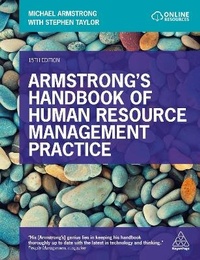
Armstrong's Handbook of Human Resource Management Practice
15th Edition
Published on 3. January 2020
Book
Hardback
776 pages
978-1-78966-103-3 (ISBN)
Description
Armstrong's Handbook of Human Resource Management Practice is the bestselling and definitive resource for HRM students and professionals, which helps readers to understand and implement HR in relation to the needs of the business.
This book covers in-depth all of the areas essential to the HR function such as employment law, employee relations, learning and development, performance management and reward, as well as the HR skills needed to ensure professional success, including leadership, managing conflict, interviewing and using statistics. Illustrated throughout in full colour and with a range of pedagogical features to consolidate learning (e.g. source review boxes, key learning points, summaries and case studies from international organizations such as IBM, HSBC and Johnson and Johnson), this fully updated 15th edition includes new chapters on the HRM role of line managers, evidence-based HRM, e-HRM and the gender pay gap, further case studies and updated content covering the latest research and developments.
Armstrong's Handbook of Human Resource Management Practice is aligned with the Chartered Institute of Personnel and Development (CIPD) profession map and standards and is suited to both professionals and students of both undergraduate degrees and the CIPD's level 5 and 7 professional qualifications. Online supporting resources include comprehensive handbooks for lecturers and students, lecture slides, all figures and tables, toolkits, and a literature review, glossary and bibliography.
This book covers in-depth all of the areas essential to the HR function such as employment law, employee relations, learning and development, performance management and reward, as well as the HR skills needed to ensure professional success, including leadership, managing conflict, interviewing and using statistics. Illustrated throughout in full colour and with a range of pedagogical features to consolidate learning (e.g. source review boxes, key learning points, summaries and case studies from international organizations such as IBM, HSBC and Johnson and Johnson), this fully updated 15th edition includes new chapters on the HRM role of line managers, evidence-based HRM, e-HRM and the gender pay gap, further case studies and updated content covering the latest research and developments.
Armstrong's Handbook of Human Resource Management Practice is aligned with the Chartered Institute of Personnel and Development (CIPD) profession map and standards and is suited to both professionals and students of both undergraduate degrees and the CIPD's level 5 and 7 professional qualifications. Online supporting resources include comprehensive handbooks for lecturers and students, lecture slides, all figures and tables, toolkits, and a literature review, glossary and bibliography.
Reviews / Votes
"There is a reason why Michael Armstrong's HR books represent a gold standard: they are both thorough and academically rigorous but benefit from real world experience and an informed perspective on practice." * Robert Jeffrey, Editor, People Management magazine * "Armstrong's authoritative handbook continues to be a paragon of HR texts. The new edition of this indubitably vital HR resource for students, tutors and practitioners alike, follows a tried and trusted, coherent format." * Lezlee-Jayne Stones, Associate Professor and School Director of Teaching & Learning, University of Lincoln * "This comprehensive book is a major resource and gives the reader both an in-depth and detailed view of all major assignments that the HR Manager will encounter in the work setting. It is also a valuable asset for the student of HR Management" * Thordur S. Oskarsson Ph.D. Adjunct Professor, School of Business, University of Iceland * "Armstrong and Taylor's text provides comprehensive and user-friendly coverage of key concepts and models of HRM, HRM processes and applications together with related delivery strategies. This 16th edition extends and updates earlier versions, and is testimony to its enduring relevance and appeal." * John Simmons, Lecturer, University of Liverpool Management School * "A detailed, yet accessible text suitable for all levels. This latest edition further establishes its position as the 'go to' text for HR students, academics and practitioners alike. I highly recommend it." * Dr. Edward O'Connor, Assistant Professor, Maynooth University School of Business * "Michael Armstrong could well be offering the definitive text in the field...an excellent book." * The Times Higher Education Supplement (about a previous edition) * "Topical, comprehensive, well-informed and student-friendly." * Dr Izabela Robinson, Senior Lecturer Human Resource Management, Northampton Business School (about a previous edition) * "The gold standard when it comes to HRM texts." * Connie Nolan, Senior Lecturer at Canterbury Christ Church University (about a previous edition) * "If any book is a contender for one of the standard references of the HR profession, this is it...it covers just about everything that might be considered broadly relevant to practising HR." * Personnel Today (about a previous edition) * "Armstrong's approach to HRM is sufficiently academic but tempered with good practice and common sense." * Dr Janet Astley, Senior Lecturer, York St John Business School (about a previous edition) * "This book [is] a must-read for everyone who has a strong interest in the management of human resources" * Niki Kyriakidou, Leeds Business School, on behalf of the International Journal of Training and Development (about a previous edition) *More details
Edition
15th Revised edition
Language
English
Place of publication
London
United Kingdom
Target group
College/higher education
Professional and scholarly
Edition type
Revised edition
Product notice
Cloth over boards
Dimensions
Height: 255 mm
Width: 195 mm
Thickness: 35 mm
Weight
1540 gr
ISBN-13
978-1-78966-103-3 (9781789661033)
Copyright in bibliographic data and cover images is held by Nielsen Book Services Limited or by the publishers or by their respective licensors: all rights reserved.
Schweitzer Classification
Other editions
New editions
Michael Armstrong | Stephen Taylor
Armstrong's Handbook of Human Resource Management Practice
A Guide to the Theory and Practice of People Management
Book
01/2023
16th Edition
Kogan Page Ltd
€211.50
Article exhausted; check for reprint
Additional editions
Michael Armstrong | Stephen Taylor
Armstrong's Handbook of Human Resource Management Practice
Book
01/2020
15th Edition
Kogan Page Ltd
€79.51
Article exhausted; check for reprint
Persons
Michael Armstrong is the UK's bestselling author of HRM books. With over a million copies sold, his books have been translated into 21 languages. He is managing partner of e-reward and was previously a chief examiner of the Chartered Institute of Personnel and Development (CIPD). He is the author of a number of other books on HR published by Kogan Page.
Stephen Taylor, Chartered CCIPD, is a senior lecturer in Human Resource Management at the University of Exeter Business School and a chief examiner for the CIPD. Before his academic career, he worked in a variety of management roles in the hotel industry and in the NHS.
Stephen Taylor, Chartered CCIPD, is a senior lecturer in Human Resource Management at the University of Exeter Business School and a chief examiner for the CIPD. Before his academic career, he worked in a variety of management roles in the hotel industry and in the NHS.
Content
Section - ONE: Fundamentals of human resource management;
Chapter - 01: Human resource management;
Chapter - 02: Strategic HRM;
Chapter - 03: HR strategy;
Chapter - 04: Human capital management;
Chapter - 05: The context of HRM;
Chapter - 06: HRM and performance;
Chapter - 07: International HRM;
Section - TWO: Delivering HRM;
Chapter - 08: The role of the HR function;
Chapter - 09: The role of HR professionals;
Chapter - 10: The HRM role of line managers;
Section - THREE: Human resource management processes;
Chapter - 11: Evidence-based HRM;
Chapter - 12: HR analytics;
Chapter - 13: e-HRM;
Chapter - 14: Artificial intelligence and HRM;
Chapter - 15: Knowledge management;
Chapter - 16: Competency-based HRM;
Chapter - 17: The ethical dimension of HRM;
Chapter - 18: Corporate social responsibility;
Section - FOUR: Organization;
Chapter - 19: Organizational behaviour;
Chapter - 20: Organization design;
Chapter - 21: Work design;
Chapter - 22: Job design;
Chapter - 23: Organization development;
Section - FIVE: Factors affecting the behaviour of people at work;
Chapter - 24: Motivation;
Chapter - 25: Commitment;
Chapter - 26: Employee engagement;
Section - SIX: People resourcing;
Chapter - 27: Workforce planning;
Chapter - 28: Recruitment and selection;
Chapter - 29: Talent management;
Section - SEVEN: Employment practices;
Chapter - 30: Managing employment;
Chapter - 31: Managing diversity and inclusion;
Chapter - 32: Managing flexibility;
Section - EIGHT: Learning and development;
Chapter - 33: The basis of learning and development;
Chapter - 34: The process of learning and development;
Chapter - 35: Learning and development practices;
Chapter - 36: Leadership and management development;
Section - NINE: Performance management;
Chapter - 37: The concept of performance management;
Chapter - 38: Performance management systems;
Chapter - 39: Reinventing performance management;
Section - TEN: Reward management;
Chapter - 40: The basis of reward management;
Chapter - 41: The practice of reward management;
Chapter - 42: Managing reward for special groups;
Chapter - 43: The gender pay gap;
Section - ELEVEN: Employment relations;
Chapter - 44: The basis of employment relations;
Chapter - 45: The employment relationship;
Chapter - 46: The psychological contract;
Chapter - 47: The practice of industrial relations;
Chapter - 48: Employee voice;
Chapter - 49: Employee communications;
Section - TWELVE: Employee wellbeing;
Chapter - 50: The principles and practice of employee wellbeing;
Chapter - 51: Health and safety;
Section - THIRTEEN: HRM policies and practices and employment law;
Chapter - 52: HR policies;
Chapter - 53: HR procedures;
Chapter - 54: HR information systems;
Chapter - 55: Employment law;
Section - FOURTEEN: People management skills;
Chapter - 56: Strategic people management skills;
Chapter - 57: Business skills;
Chapter - 58: Problem-solving and decision-making skills;
Chapter - 59: Analytical and critical skills;
Chapter - 60: Research skills;
Chapter - 61: Statistical skills;
Chapter - 62: Selection interviewing skills;
Chapter - 63: Job, role, competency and skills analysis;
Chapter - 64: Learning and development skills;
Chapter - 65: Negotiating skills;
Chapter - 66: Change management;
Chapter - 67: Influencing skills;
Chapter - 68: Leadership skills;
Chapter - 69: Handling people problems;
Chapter - 70: Handling challenging conversations;
Chapter - 71: Managing conflict;
Chapter - 72: Political skills;
Chapter - 73: Dealing with business issues from an HR perspective;
Chapter - 74: Project management
Chapter - 01: Human resource management;
Chapter - 02: Strategic HRM;
Chapter - 03: HR strategy;
Chapter - 04: Human capital management;
Chapter - 05: The context of HRM;
Chapter - 06: HRM and performance;
Chapter - 07: International HRM;
Section - TWO: Delivering HRM;
Chapter - 08: The role of the HR function;
Chapter - 09: The role of HR professionals;
Chapter - 10: The HRM role of line managers;
Section - THREE: Human resource management processes;
Chapter - 11: Evidence-based HRM;
Chapter - 12: HR analytics;
Chapter - 13: e-HRM;
Chapter - 14: Artificial intelligence and HRM;
Chapter - 15: Knowledge management;
Chapter - 16: Competency-based HRM;
Chapter - 17: The ethical dimension of HRM;
Chapter - 18: Corporate social responsibility;
Section - FOUR: Organization;
Chapter - 19: Organizational behaviour;
Chapter - 20: Organization design;
Chapter - 21: Work design;
Chapter - 22: Job design;
Chapter - 23: Organization development;
Section - FIVE: Factors affecting the behaviour of people at work;
Chapter - 24: Motivation;
Chapter - 25: Commitment;
Chapter - 26: Employee engagement;
Section - SIX: People resourcing;
Chapter - 27: Workforce planning;
Chapter - 28: Recruitment and selection;
Chapter - 29: Talent management;
Section - SEVEN: Employment practices;
Chapter - 30: Managing employment;
Chapter - 31: Managing diversity and inclusion;
Chapter - 32: Managing flexibility;
Section - EIGHT: Learning and development;
Chapter - 33: The basis of learning and development;
Chapter - 34: The process of learning and development;
Chapter - 35: Learning and development practices;
Chapter - 36: Leadership and management development;
Section - NINE: Performance management;
Chapter - 37: The concept of performance management;
Chapter - 38: Performance management systems;
Chapter - 39: Reinventing performance management;
Section - TEN: Reward management;
Chapter - 40: The basis of reward management;
Chapter - 41: The practice of reward management;
Chapter - 42: Managing reward for special groups;
Chapter - 43: The gender pay gap;
Section - ELEVEN: Employment relations;
Chapter - 44: The basis of employment relations;
Chapter - 45: The employment relationship;
Chapter - 46: The psychological contract;
Chapter - 47: The practice of industrial relations;
Chapter - 48: Employee voice;
Chapter - 49: Employee communications;
Section - TWELVE: Employee wellbeing;
Chapter - 50: The principles and practice of employee wellbeing;
Chapter - 51: Health and safety;
Section - THIRTEEN: HRM policies and practices and employment law;
Chapter - 52: HR policies;
Chapter - 53: HR procedures;
Chapter - 54: HR information systems;
Chapter - 55: Employment law;
Section - FOURTEEN: People management skills;
Chapter - 56: Strategic people management skills;
Chapter - 57: Business skills;
Chapter - 58: Problem-solving and decision-making skills;
Chapter - 59: Analytical and critical skills;
Chapter - 60: Research skills;
Chapter - 61: Statistical skills;
Chapter - 62: Selection interviewing skills;
Chapter - 63: Job, role, competency and skills analysis;
Chapter - 64: Learning and development skills;
Chapter - 65: Negotiating skills;
Chapter - 66: Change management;
Chapter - 67: Influencing skills;
Chapter - 68: Leadership skills;
Chapter - 69: Handling people problems;
Chapter - 70: Handling challenging conversations;
Chapter - 71: Managing conflict;
Chapter - 72: Political skills;
Chapter - 73: Dealing with business issues from an HR perspective;
Chapter - 74: Project management