

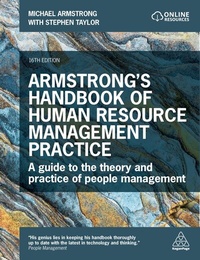
Armstrong's Handbook of Human Resource Management Practice
A Guide to the Theory and Practice of People Management
16th Edition
Published on 3. January 2023
Book
Paperback/Softback
760 pages
978-1-3986-0663-0 (ISBN)
Description
Armstrong's Handbook of Human Resource Management Practice is the definitive resource for HRM students and professionals, helping readers understand and implement HR to align with business needs.
This book provides detailed coverage of all areas essential to the HR function such as employment law, employee relations, learning and development, performance management and reward management. It also covers the HR skills needed to ensure professional success, including leadership, managing conflict, interviewing and using statistics. It is illustrated throughout in full colour and has a range of pedagogical features to consolidate learning such as source review boxes, key learning points and case studies from international organizations such as IBM, HSBC and Johnson and Johnson. This fully updated 16th edition includes new chapters on managing remote workers and developments in digital human resource management practices. There are also updates to reflect the changes throughout the HR function, such as performance leadership, 'smart' reward and employee wellbeing.
Armstrong's Handbook of Human Resource Management Practice
is suited to both professionals and students of undergraduate and postgraduate degrees. It is also aligned with the Chartered Institute of Personnel and Development (CIPD) profession map so can be used by those studying the Associate Level 5 and Advanced Level 7 qualifications. Online supporting resources include comprehensive handbooks for lecturers and students, lecture slides, all figures and tables, toolkits, and a literature review, glossary and bibliography.
Reviews / Votes
"Armstrong and Taylor's text provides comprehensive and user-friendly coverage of key concepts and models of HRM, HRM processes and applications together with related delivery strategies. This edition extends and updates earlier versions, and is testimony to its enduring relevance and appeal."More details
Language
English
Place of publication
London
United Kingdom
Target group
College/higher education
Professional and scholarly
Edition type
Revised edition
Product notice
Paperback (trade)
Dimensions
Height: 24.5 cm
Width: 19 cm
Thickness: 2.6 cm
Weight
1275 gr
ISBN-13
978-1-3986-0663-0 (9781398606630)
Schweitzer Classification
Other editions
New editions
Michael Armstrong | Stephen Taylor
Armstrong's Handbook of Human Resource Management Practice
A Guide to the Theory and Practice of People Management
E-Book
01/2026
17th Edition
Kogan Page Ltd
€61.49
Available for download
Michael Armstrong | Stephen Taylor
Armstrong's Handbook of Human Resource Management Practice
A Guide to the Theory and Practice of People Management
Book
01/2026
17th Edition
Kogan Page Ltd
€105.50
Shipment within 10-20 days
Michael Armstrong | Stephen Taylor
Armstrong's Handbook of Human Resource Management Practice
A Guide to the Theory and Practice of People Management
Book
01/2026
17th Edition
Kogan Page Ltd
€62.50
Available immediately
Additional editions
Michael Armstrong | Stephen Taylor
Armstrong's Handbook of Human Resource Management Practice
A Guide to the Theory and Practice of People Management
Book
01/2023
16th Edition
Kogan Page Ltd
€211.50
Article exhausted; check for reprint
Previous edition
Michael Armstrong | Stephen Taylor
Armstrong's Handbook of Human Resource Management Practice
Book
01/2020
15th Edition
Kogan Page Ltd
€79.51
Article exhausted; check for reprint
Persons
Author
Michael Armstrong is the UK's bestselling author of Human Resource Management books including Armstrong's Handbook of Human Resource Management Practice, Armstrong's Handbook of Strategic Human Resource Management, Armstrong's Handbook of Reward Management Practice and Armstrong's Handbook of Performance Management and several other titles published by Kogan Page. His books have sold over a million copies and have been translated into twenty-one languages.
Michael Armstrong is a Companion and former Chief Examiner of the Chartered Institute of Personnel and Development (CIPD), a managing partner of E-Reward and an independent management consultant. Prior to this he was an HR director of a publishing company. He is based in London, UK.
ISNI:
ISNI:
Stephen Taylor, Chartered CCIPD, is a Senior Lecturer in Human Resource Management at the University of Exeter Business School and a Chief Examiner for the CIPD. Before his academic career he worked in a variety of management roles in the hotel industry and in the NHS. He is also a widely published author, having co-authored Armstrong's Handbook of Human Resource Management Practice, also published by Kogan Page.
ISNI:
ISNI:
Content
- Section - One: Fundamentals of human resource management;
-
- Chapter - 01: The essence of HRM;
- Chapter - 02: Human capital management;
- Chapter - 03: The context of HRM;
- Chapter - 04: The future of work;
- Chapter - 05: HRM and organizational performance;
- Chapter - 06: The ethical dimension of HRM;
- Chapter - 07: Corporate social responsibility;
- Section - TWO: The strategic approach to HRM;
-
- Chapter - 08: Strategic HRM;
- Chapter - 09: HR strategy;
- Section - THREE: Delivering HR;
-
- Chapter - 10: The role of HR;
- Chapter - 11: The HRM role of line managers;
- Section - FOUR: Human resource management processes;
-
- Chapter - 12: Evidence-based HRM;
- Chapter - 13: HR analytics;
- Chapter - 14: Digital HRM;
- Chapter - 15: Knowledge Management;
- Chapter - 16: Competency-based HRM;
- Section - FIVE: Organization;
-
- Chapter - 17: Organizational behaviour;
- Chapter - 18: Organizational design;
- Chapter - 19: Work design;
- Chapter - 20: Job design;
- Chapter - 21: Organizational development;
- Section - SIX: Factors affecting the behaviour of people at work;
-
- Chapter - 22: Motivation;
- Chapter - 23: Commitment;
- Chapter - 24: Employee engagement;
- Section - SEVEN: People resourcing;
-
- Chapter - 25: Resourcing strategy;
- Chapter - 26: Workforce Planning;
- Chapter - 27: Recruitment and selection;
- Chapter - 28: Talent Management;
- Section - EIGHT: Employment practices;
-
- Chapter - 29: The employee experience;
- Chapter - 30: Managing empployment;
- Chapter - 31: Managing diversity and inclusion;
- Chapter - 32: Managing flexibility;
- Chapter - 33: Managing home and hybrid working;
- Section - NINE: Learning and development;
-
- Chapter - 34: The basis of learning and development;
- Chapter - 35: Strategic learning and development;
- Chapter - 36: Organisational learning and the learning organization;
- Chapter - 37: Individual learning;
- Chapter - 38: The practice of learning and development;
- Chapter - 39: The practice of learnign and development;
- Chapter - 40: Leadership and management development;
- Section - TEN: Performance management;
-
- Chapter - 41: The basis of performance management;
- Chapter - 42: Performance management;
- Chapter - 43: Performance leadership;
- Section - ELEVEN: Reward management;
-
- Chapter - 44: The bases of reward management;
- Chapter - 45: Reward strategy;
- Chapter - 46: The practice of reward management;
- Chapter - 47: Managing reward for special groups;
- Chapter - 48: Reducing the gender pay gap;
- Section - TWELVE: Employment relations;
-
- Chapter - 49: The basis of employment relations;
- Chapter - 50: Employment relations strategy;
- Chapter - 51: The employment relationship;
- Chapter - 52: The psychological contract;
- Chapter - 53: The practice of industrial relations;
- Chapter - 54: Employee voice;
- Chapter - 55: Employee communications;
- Section - THIRTEEN: Employee wellbeing;
-
- Chapter - 56: Principles and practice of employee wellbeing;
- Chapter - 57: Health and Safety;
- Section - FOURTEEN: HR practices;
-
- Chapter - 58: HR policies;
- Chapter - 59: HR procedures;
- Chapter - 60: Dealing with the legal aspects of employment;
- Section - FIFTEEN: International HRM;
-
- Chapter - 61: The basis of international HRM;
- Chapter - 62: The practice of international HRM;
- Chapter - 63: Managing expatriates;
- Section - SIXTEEN: People management skills and competencies;
-
- Chapter - 64: Strategic people management skills;
- Chapter - 65: Business skills;
- Chapter - 66: Dealing with business issues from an HR perspective;
- Chapter - 67: Problem-solving and decision-making;
- Chapter - 68: Analytical and critical skills;
- Chapter - 69: Research skills;
- Chapter - 70: Statistical skills;
- Chapter - 71: Selection interviewing skills;
- Chapter - 72: Job, role and skills analysis and competency modelling;
- Chapter - 73: Learning and development skills;
- Chapter - 74: Negotiating skills;
- Chapter - 75: Change management;
- Chapter - 76: Influencing skills;
- Chapter - 77: Leadership;
- Chapter - 78: Handling people problems;
- Chapter - 79: Handling challenging conversations;
- Chapter - 80: Managing conflict;
- Chapter - 81: Political skills;
- Chapter - 82: Project management;
- Section - SEVENTEEN: Conclusion;
-
- Chapter - 83: Trends in HRM