

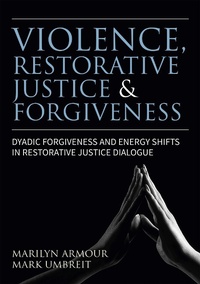
Violence, Restorative Justice, and Forgiveness
Dyadic Forgiveness and Energy Shifts in Restorative Justice Dialogue
Published on 18. January 2018
Book
Paperback/Softback
336 pages
978-1-78592-795-9 (ISBN)
Description
A groundbreaking book founded on extensive original research, designed to determine how restorative dialogue works, and the role of forgiveness within it.
The research involved interviews with 20 victims who went through a Victim Offender Dialogue (used in crimes of severe violence), and documents how the shifts in energy during the course of their dialogue moves the toxicity associated with the crime to a different place. This study explores the role of bilateral forgiveness in restorative work and addresses key questions about the role of forgiveness in restorative justice, such as how it can be measured. It also outlines a model which explains how the energy flow of dyadic forgiveness in restorative justice dialogue is formed.
Rich in data and in findings, this book will deepen understanding of how restorative justice works, and will inform future research and practice in the field.
The research involved interviews with 20 victims who went through a Victim Offender Dialogue (used in crimes of severe violence), and documents how the shifts in energy during the course of their dialogue moves the toxicity associated with the crime to a different place. This study explores the role of bilateral forgiveness in restorative work and addresses key questions about the role of forgiveness in restorative justice, such as how it can be measured. It also outlines a model which explains how the energy flow of dyadic forgiveness in restorative justice dialogue is formed.
Rich in data and in findings, this book will deepen understanding of how restorative justice works, and will inform future research and practice in the field.
Reviews / Votes
Armour and Umbreit make a giant leap in the restorative justice discussion. Fascinating reading, and this is a truly new way of speaking about and thinking about the Victim Offender Meditation/Dialogue. This is well worth the read! -- Everett L. Worthington, Jr., Author of Forgiveness and Spirituality in Psychotherapy: A Relational Approach (with Steven J. Sandage; APA Books) An important new theoretical model based on the best of qualitative research-a deep dive into 20 restorative justice dialogues to explain how these encounters created profound psychological transformation for victims of terrible violence. -- David R. Karp, PhD, Professor of Sociology, Skidmore CollegeMore details
Language
English
Place of publication
London
United Kingdom
Target group
College/higher education
Professional and scholarly
Product notice
Paperback (UK-trade)
Illustrations
n/a
Dimensions
Height: 244 mm
Width: 173 mm
Thickness: 23 mm
Weight
658 gr
ISBN-13
978-1-78592-795-9 (9781785927959)
Copyright in bibliographic data and cover images is held by Nielsen Book Services Limited or by the publishers or by their respective licensors: all rights reserved.
Schweitzer Classification
Other editions
Additional editions
Marilyn Armour | Mark S. Umbreit
Violence, Restorative Justice, and Forgiveness
Dyadic Forgiveness and Energy Shifts in Restorative Justice Dialogue
E-Book
01/2018
Jessica Kingsley Publishers
€82.99
Available for download
Persons
Marilyn Armour is a University Distinguished Teaching Professor and founding Director of the Institute for Restorative Justice and Restorative Dialogue, in the School of Social Work at the University of Texas at Austin.
Dr. Mark Umbreit is a Professor and the founding Director of the Center for Restorative Justice & Peacemaking at the University of Minnesota School of Social Work.
Dr. Mark Umbreit is a Professor and the founding Director of the Center for Restorative Justice & Peacemaking at the University of Minnesota School of Social Work.
Content
Preface; 1. Dyadic Forgiveness in Restorative Justice: A Review of the Field and a Proposed Model; 2. Victim Case Narratives and Analysis; 3. Mapping Dyadic Forgiveness: An Analysis of Positive Energy Shifts in Restorative Justice Dialogue; A. Crime and its Impact. B. Motivation and Preparation. C. Dyadic Dialogue. D. Resolution and Post Dialogue Outcomes. E. Dyadic Forgiveness; Tables and Figures; Appendices