

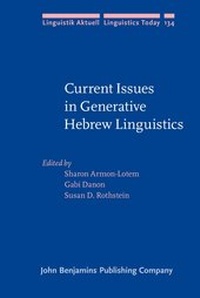
Current Issues in Generative Hebrew Linguistics
Published on 19. December 2008
Book
Hardback
393 pages
978-90-272-5517-4 (ISBN)
Description
This volume presents a collection of specially commissioned papers devoted to analyzing the linguistics of Modern Hebrew from a number of perspectives. Various aspects of Modern Hebrew grammar are discussed including the structure of the lexicon, grammatical features and inflectional morphology, as well as the grammaticalization of semantic and pragmatic distinctions. The psycholinguistic issues addressed include the acquisition of morphological knowledge, the pro-drop parameter and question formation, as well as language use in hearing-impaired native speakers. The collection of these papers together in a single volume allows these phenomena to be considered not in isolation but in the context of the grammatical system of which the language is an expression. As a consequence, more general issues connected to Modern Hebrew begin to emerge, such as the role of the inflectional morphological system in the grammar, and a rich set of facts and analyses relevant for many related issues are made available to the reader.
More details
Series
Language
English
Place of publication
Amsterdam
Netherlands
Target group
Professional and scholarly
Dimensions
Height: 245 mm
Width: 164 mm
Weight
860 gr
ISBN-13
978-90-272-5517-4 (9789027255174)
Copyright in bibliographic data and cover images is held by Nielsen Book Services Limited or by the publishers or by their respective licensors: all rights reserved.
Schweitzer Classification
Other editions
Additional editions
Sharon Armon-Lotem | Gabi Danon | Susan D. Rothstein
Current Issues in Generative Hebrew Linguistics
E-Book
12/2008
1st Edition
John Benjamins Publishing Company
€136.99
Available for download
Persons
Content
1. Acknowledgement; 2. Current issues in generative Hebrew linguistics (by Armon-Lotem, Sharon); 3. Part I. The structure of the lexicon; 4. Morphologically conditioned V-O alternation in Hebrew: Distinction among nouns, adjectives & participles, and verbs (by Bat-El, Outi); 5. The special status of nif'al in Hebrew (by Schwarzwald, Ora); 6. Object gap constructions: Externalization and operator movement (by Botwinik-Rotem, Irena); 7. Active lexicon: Adjectival and verbal passives (by Horvath, Julia); 8. Part II. Grammatical features and inflectional morphology; 9. Definiteness agreement with PP modifiers (by Danon, Gabi); 10. Predication and equation in Hebrew (nonpseudocleft) copular sentences (by Greenberg, Yael); 11. Morphological knowledge without morphological structure: Morphology-prosody interface in the first Hebrew verbs (by Adam, Galit); 12. The interaction between question formation and verbal morphology in the acquisition of Hebrew: A minimalist perspective (by Armon-Lotem, Sharon); 13. On child subjects in a partially pro-drop language (by Schaeffer, Jeannette); 14. Resumptive pronouns as a last resort when movement is impaired: Relative clauses in hearing impairment (by Friedmann, Naama); 15. Part III. Semantics, pragmatics and discourse; 16. Bare minimizers (by Sharvit, Yael); 17. Hebrew negative polarity Items - sum and af (by Levy, Alissa); 18. A two-layered analysis of the Hebrew exceptive xuc mi (by Sevi, Aldo); 19. Codifying apparent inconsistencies in discourse: The case of Hebrew ma (by Ziv, Yael); 20. Index