

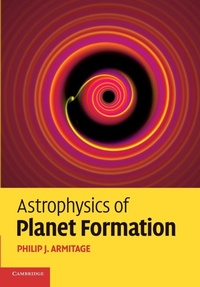
Astrophysics of Planet Formation
Published on 24. October 2013
Book
Paperback/Softback
296 pages
978-1-107-65308-5 (ISBN)
Description
The study of planet formation has been revolutionized by recent observational breakthroughs, which have allowed the detection and characterization of extrasolar planets, the imaging of protoplanetary disks, and the discovery of the Solar System's Kuiper Belt. Written for beginning graduate students, this textbook provides a basic understanding of the astrophysical processes that shape the formation of planetary systems. It begins by describing the structure and evolution of protoplanetary disks, moves on to the formation of planetesimals, terrestrial and gas giant planets, and concludes by surveying new theoretical ideas for the early evolution of planetary systems. Covering all phases of planet formation - from protoplanetary disks to the dynamical evolution of planetary systems - this introduction can be understood by readers with backgrounds in planetary science, and observational and theoretical astronomy. It highlights the physical principles underlying planet formation and the areas where more research and new observations are needed.
Reviews / Votes
'This excellent book is a superb introduction to modern cosmogony, beautifully produced and with an extremely useful and up-to-date reference section.' The Observatory 'Astrophysics of Planet Formation is organized into self-contained but connected chapters that generally follow the chronology of planet formation: disk characteristics and evolution, planetesimal formation, terrestrial planet formation, and giant planet formation. The book concludes with a brief chapter on the dynamics of planetary systems ... Two pedagogical approaches make it an outstanding introductory text: Armitage concentrates on the essentials rather than getting lost in details, and he carefully walks the reader through the derivation of equations, highlighting their physical meaning. He also gives technical references for in-depth reading at the end of each chapter ... [he] delivers on the book's aim to 'provide a concise introduction to the classical theory of planet formation and to more recent developments spurred by new observations' ... an excellent main text for a course in astronomy, astrophysics, or planetary science.' Diana Valencia, Massachusetts Institute of TechnologyMore details
Language
English
Place of publication
Cambridge
United Kingdom
Target group
Professional and scholarly
Product notice
Paperback (trade)
Illustrations
Worked examples or Exercises; Printed music items
Dimensions
Height: 244 mm
Width: 170 mm
Thickness: 17 mm
Weight
515 gr
ISBN-13
978-1-107-65308-5 (9781107653085)
Copyright in bibliographic data and cover images is held by Nielsen Book Services Limited or by the publishers or by their respective licensors: all rights reserved.
Schweitzer Classification
Other editions
New editions
Philip J. Armitage
Astrophysics of Planet Formation
Book
01/2020
2nd Edition
Cambridge University Press
€97.60
Shipment within 15-20 days
Person
Philip J. Armitage is a Professor in the Department of Astrophysical and Planetary Sciences at the University of Colorado, Boulder, and a Fellow of JILA. His research focuses on theoretical and computational studies of protoplanetary disks, planet formation and black hole astrophysics. He has extensive teaching experience at the advanced undergraduate and graduate level.
Content
Preface; 1. Observations of planetary systems; 2. Protoplanetary disk structure; 3. Protoplanetary disk evolution; 4. Planetesimal formation; 5. Terrestrial planet formation; 6. Giant planet formation; 7. Early evolution of planetary systems; Appendixes; References; Index.