

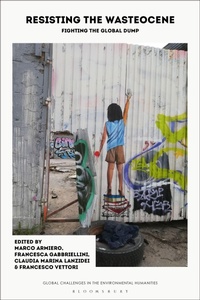
Resisting the Wasteocene
Fighting the Global Dump
Will be published approx. on 18. February 2027
Book
Hardback
272 pages
978-1-350-54643-1 (ISBN)
Description
Challenging the dominant narrative of the Anthropocene, Resisting the Wasteocene highlights wasting relationships that produce both wasted people and ecosystems. This book exposes how such relationships seek to turn communities into socioecological dumps, while also tracing their forms of resistance.
Across case studies from Eastern Europe, Bangladesh, China, Senegal, Cuba, Italy, and more-and drawing on history, anthropology, cultural studies, and geography-it maps the toxic infrastructures that silence and normalize injustice. With its global, interdisciplinary scope and provocative critique of Anthropocene discourse, this volume makes the Wasteocene visible while opening possible pathways for resisting and escaping it.
Across case studies from Eastern Europe, Bangladesh, China, Senegal, Cuba, Italy, and more-and drawing on history, anthropology, cultural studies, and geography-it maps the toxic infrastructures that silence and normalize injustice. With its global, interdisciplinary scope and provocative critique of Anthropocene discourse, this volume makes the Wasteocene visible while opening possible pathways for resisting and escaping it.
More details
Series
Language
English
Place of publication
London
United Kingdom
Publishing group
Bloomsbury Publishing PLC
Target group
Professional and scholarly
Product notice
sewn/stitched
Cloth over boards
With dust jacket
Illustrations
8 bw illus
Dimensions
Height: 234 mm
Width: 156 mm
Thickness: 28 mm
Weight
503 gr
ISBN-13
978-1-350-54643-1 (9781350546431)
Copyright in bibliographic data and cover images is held by Nielsen Book Services Limited or by the publishers or by their respective licensors: all rights reserved.
Schweitzer Classification
Persons
Marco Armiero is a Research Professor at the University of Santiago de Compostela and associate researcher at the Autonomous University of Barcelona, Spain.
Francesca Gabbriellini holds a PhD in History from the University of Bologna, Italy, and currently works at the Feltrinelli Foundation in Milan.
Claudia Marina Lanzidei holds a PhD in Cultural Anthropology from the University of Bologna, Italy.
Francesco Vettori holds a PhD in Cultural Anthropology from the University of Bologna, Italy. He is a member of the European Association of Social Anthropology (EASA).
Francesca Gabbriellini holds a PhD in History from the University of Bologna, Italy, and currently works at the Feltrinelli Foundation in Milan.
Claudia Marina Lanzidei holds a PhD in Cultural Anthropology from the University of Bologna, Italy.
Francesco Vettori holds a PhD in Cultural Anthropology from the University of Bologna, Italy. He is a member of the European Association of Social Anthropology (EASA).
Content
1. Introduction, Marco Armiero (University of Santiago de Compostela, Spain)
2. Organizing the Human: Subverting the Wasteocene, Melanie Samson (University of Johannesburg, South Africa)
3. Commoning, Consumption, and the Body on Montevideo's Waste-scape, Patrick O'Hare (University of St Andrews, UK)
4. Circular Logics: Proposals and Counter-Proposals for Extended Producer Responsibility, Christine Hegel (Western Connecticut State University, USA) and Taylor Cass Talbott (International Alliance of Waste Pickers, North America)
5. Decolonizing the Wasteocene: the Black female collectivity of Brazilian waste pickers, Dieric Guimaraes (Federal University of Bahia, Brazil) and Flavia Maximo
6. The Dump in Cuba, Claudia Lanzidei (Independent Researcher, Italy)
7. Waste as a lens: Unpicking toxic narratives of climate migrants in Dakar and Saint Louis, Senegal, Sarah Walker (University of Bologna, Italy)
8. Green Ship Recycling: A Toxic Narrative of the Wasteocene? Camelia Dewan (Uppsala University, Sweden)
9. Wasting Peace: Environmental Violence and its Vicissitudes in Post-war Bosnia and Herzegovina, Damir Arsenijevic (University of Tuzla, Bosnia and Herzegovina)
10. Culinary Garbo-politics: Marginalized communities, discarded foods, and repressive governmentalities in India, Sayan Dey (Bayan College, Oman) & Tias Maity (Alliance University, Bangalore)
11. The Socialist Experience of Waste and Recycling from Soviet Ukraine to State-Socialist Hungary, Viktor Pal (University of Ostrava, Czechia) and Tetiana Perga (National Academy of Sciences of Ukraine)
12. In the cracks of the Wasteocene. Building circular communities through solidarity networks in central Italy, Francesco Vettori (University of Bologna, Italy)
13. Wasteocene as Method: Reimagining Narratives, Value(s) and Commons, Julie Sze (University of California, Davis, USA)
14. The Waste of the West? Sandra Swart (Stellenbosch University, South Africa)
15. What Would a Multispecies Wasteocene Look Like? Lingjing Wu (Renmin University of China)
16. Wasting the World. Class, Capital & Cheap Toxification in the Capitalist World-Ecology, Jason Moore (Binghamton University, USA)
17. Conclusion, Claudia Marina Lanzidei (Independent Researcher, Italy) and Francesco Vettori (University of Bologna, Italy)
2. Organizing the Human: Subverting the Wasteocene, Melanie Samson (University of Johannesburg, South Africa)
3. Commoning, Consumption, and the Body on Montevideo's Waste-scape, Patrick O'Hare (University of St Andrews, UK)
4. Circular Logics: Proposals and Counter-Proposals for Extended Producer Responsibility, Christine Hegel (Western Connecticut State University, USA) and Taylor Cass Talbott (International Alliance of Waste Pickers, North America)
5. Decolonizing the Wasteocene: the Black female collectivity of Brazilian waste pickers, Dieric Guimaraes (Federal University of Bahia, Brazil) and Flavia Maximo
6. The Dump in Cuba, Claudia Lanzidei (Independent Researcher, Italy)
7. Waste as a lens: Unpicking toxic narratives of climate migrants in Dakar and Saint Louis, Senegal, Sarah Walker (University of Bologna, Italy)
8. Green Ship Recycling: A Toxic Narrative of the Wasteocene? Camelia Dewan (Uppsala University, Sweden)
9. Wasting Peace: Environmental Violence and its Vicissitudes in Post-war Bosnia and Herzegovina, Damir Arsenijevic (University of Tuzla, Bosnia and Herzegovina)
10. Culinary Garbo-politics: Marginalized communities, discarded foods, and repressive governmentalities in India, Sayan Dey (Bayan College, Oman) & Tias Maity (Alliance University, Bangalore)
11. The Socialist Experience of Waste and Recycling from Soviet Ukraine to State-Socialist Hungary, Viktor Pal (University of Ostrava, Czechia) and Tetiana Perga (National Academy of Sciences of Ukraine)
12. In the cracks of the Wasteocene. Building circular communities through solidarity networks in central Italy, Francesco Vettori (University of Bologna, Italy)
13. Wasteocene as Method: Reimagining Narratives, Value(s) and Commons, Julie Sze (University of California, Davis, USA)
14. The Waste of the West? Sandra Swart (Stellenbosch University, South Africa)
15. What Would a Multispecies Wasteocene Look Like? Lingjing Wu (Renmin University of China)
16. Wasting the World. Class, Capital & Cheap Toxification in the Capitalist World-Ecology, Jason Moore (Binghamton University, USA)
17. Conclusion, Claudia Marina Lanzidei (Independent Researcher, Italy) and Francesco Vettori (University of Bologna, Italy)