

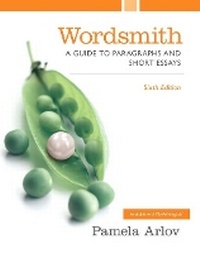
Wordsmith
A Guide to Paragraphs and Short Essays
6th Edition
Published on 8. January 2015
Book
Paperback/Softback
552 pages
978-0-321-97415-0 (ISBN)
Description
NOTE: You are purchasing a standalone product; MyWritingLab (TM) does not come packaged with this content. If you would like to purchase both the physical text and MyWritingLab, search for:
0133928578 / 9780133928570 Wordsmith: A Guide to Paragraphs and Short Essays Plus MyWritingLab (TM) with Pearson eText -- Access Card Package, 6/e
Package consists of:
0133944131 / 9780133944136 MyWritingLab with Pearson eText - Glue In Access Card
013394414X / 9780133944143 MyWritingLab with Pearson eText - Inside Star Sticker
0321974158 / 9780321974150 Wordsmith: A Guide to Paragraphs and Short Essays
For courses in Developmental Writing.
Helping students to craft direct, clear, and engaging writing
Briefer and more readable than full-length texts, Wordsmith: A Guide to Paragraphs and Short Essays, Sixth Edition is the antidote to dry, overwrought, and overly expansive writing guides. Wordsmith engages students, serves multiple skill levels, and teaches enduring writing techniques in a way that's actionable, contemporary, hands-on, and fun.
Wordsmith: A Guide to Paragraphs and Short Essays, Sixth Edition is a powerful tool for students and teachers alike. With appealing, topical readings and expanded writing exercises, the updated text empowers instructors to meet students where they are and engage their collective interests. A three-part layout allows the freedom to mix and match the writing chapters, grammar chapters, and readings. Pam Arlov's structured yet flexible approach to writing encourages clarity and creativity. Her direct, conversational, student-friendly approach is used throughout, with light-hearted chapter openings that promote a positive and playful approach to learning.
Also Available with MyWritingLab (TM)
This title is also available with MyWritingLab -an online homework, tutorial, and assessment program designed to work with this text to engage students and improve results. Within its structured environment, students practice what they learn, test their understanding, and pursue a personalized study plan that helps them better absorb course material and understand difficult concepts. In addition to the full eText activities directly from the text are available within MyWritingLab. These include the small scrawl written assignments, readings from the text, review exercises and more.
0133928578 / 9780133928570 Wordsmith: A Guide to Paragraphs and Short Essays Plus MyWritingLab (TM) with Pearson eText -- Access Card Package, 6/e
Package consists of:
0133944131 / 9780133944136 MyWritingLab with Pearson eText - Glue In Access Card
013394414X / 9780133944143 MyWritingLab with Pearson eText - Inside Star Sticker
0321974158 / 9780321974150 Wordsmith: A Guide to Paragraphs and Short Essays
For courses in Developmental Writing.
Helping students to craft direct, clear, and engaging writing
Briefer and more readable than full-length texts, Wordsmith: A Guide to Paragraphs and Short Essays, Sixth Edition is the antidote to dry, overwrought, and overly expansive writing guides. Wordsmith engages students, serves multiple skill levels, and teaches enduring writing techniques in a way that's actionable, contemporary, hands-on, and fun.
Wordsmith: A Guide to Paragraphs and Short Essays, Sixth Edition is a powerful tool for students and teachers alike. With appealing, topical readings and expanded writing exercises, the updated text empowers instructors to meet students where they are and engage their collective interests. A three-part layout allows the freedom to mix and match the writing chapters, grammar chapters, and readings. Pam Arlov's structured yet flexible approach to writing encourages clarity and creativity. Her direct, conversational, student-friendly approach is used throughout, with light-hearted chapter openings that promote a positive and playful approach to learning.
Also Available with MyWritingLab (TM)
This title is also available with MyWritingLab -an online homework, tutorial, and assessment program designed to work with this text to engage students and improve results. Within its structured environment, students practice what they learn, test their understanding, and pursue a personalized study plan that helps them better absorb course material and understand difficult concepts. In addition to the full eText activities directly from the text are available within MyWritingLab. These include the small scrawl written assignments, readings from the text, review exercises and more.
More details
Edition
6th edition
Language
English
Place of publication
United States
Publishing group
Pearson Education (US)
Target group
College/higher education
Dimensions
Height: 229 mm
Width: 185 mm
Thickness: 20 mm
Weight
744 gr
ISBN-13
978-0-321-97415-0 (9780321974150)
Copyright in bibliographic data and cover images is held by Nielsen Book Services Limited or by the publishers or by their respective licensors: all rights reserved.
Schweitzer Classification
Other editions
Content
PART 1: COMPOSITION
1. The Writing Process
The Writing Process
Prewriting
Planning
Drafting
Revising
Proofreading
Expect the Unexpected
The Writing Process: Stephanie's Paragraph
Writing for Right-Brained Writers
2. Preparing to Write
Prewriting
Prewriting Methods
Brainstorming
Freewriting
Invisible Writing: A Computer Technique
Clustering
Outlining
Journal Writing
Progressive Writing Assignment
3. Writing Paragraphs: Direction
Characteristics of an Effective Paragraph
Topic Sentences: Setting the Direction of a Paragraph
Writing Topic Sentences That Fit
Where Should a Topic Sentence Go?
Topic Sentence First
Topic Sentence After an Introductory Sentence
Progressive Writing Assignment
4. Writing Paragraphs: Support
Characteristics of an Effective Paragraph
The Difference Between Topic Sentences and Supporting Sentences
Support: Using Specific Detail
Recognizing Specific Detail
Using Specific Words
Making Sentences Specific
Progressive Writing Assignment
5. Writing Paragraphs: Unity and Coherence
Characteristics of an Effective Paragraph
Unity: Sticking to the Point
Reinforcing Unity: The Summary Sentence
Coherence: Holding the Paragraph Together
Transitional Expressions
Repetition of Key Words and Phrases
Progressive Writing Assignment
6. Revising, Proofreading, and Formatting
Revising
Checklist for Revision
Proofreading
The Top-Down Technique
The Bottom-Up Technique
The Targeting Technique
Proofreading the Computer-Generated Paragraph
Formatting
Handwritten Documents
Computer-Generated Documents
Progressive Writing Assignment
7. Showing and Telling: Description, Narration, and Example
Description, Narration, and Example in Action
Description
Laying the Groundwork for Descriptive Writing
1. The Writing Process
The Writing Process
Prewriting
Planning
Drafting
Revising
Proofreading
Expect the Unexpected
The Writing Process: Stephanie's Paragraph
Writing for Right-Brained Writers
2. Preparing to Write
Prewriting
Prewriting Methods
Brainstorming
Freewriting
Invisible Writing: A Computer Technique
Clustering
Outlining
Journal Writing
Progressive Writing Assignment
3. Writing Paragraphs: Direction
Characteristics of an Effective Paragraph
Topic Sentences: Setting the Direction of a Paragraph
Writing Topic Sentences That Fit
Where Should a Topic Sentence Go?
Topic Sentence First
Topic Sentence After an Introductory Sentence
Progressive Writing Assignment
4. Writing Paragraphs: Support
Characteristics of an Effective Paragraph
The Difference Between Topic Sentences and Supporting Sentences
Support: Using Specific Detail
Recognizing Specific Detail
Using Specific Words
Making Sentences Specific
Progressive Writing Assignment
5. Writing Paragraphs: Unity and Coherence
Characteristics of an Effective Paragraph
Unity: Sticking to the Point
Reinforcing Unity: The Summary Sentence
Coherence: Holding the Paragraph Together
Transitional Expressions
Repetition of Key Words and Phrases
Progressive Writing Assignment
6. Revising, Proofreading, and Formatting
Revising
Checklist for Revision
Proofreading
The Top-Down Technique
The Bottom-Up Technique
The Targeting Technique
Proofreading the Computer-Generated Paragraph
Formatting
Handwritten Documents
Computer-Generated Documents
Progressive Writing Assignment
7. Showing and Telling: Description, Narration, and Example
Description, Narration, and Example in Action
Description
Laying the Groundwork for Descriptive Writing