

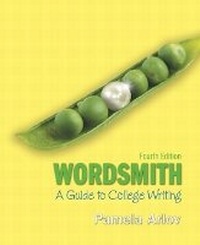
Wordsmith
A Guide to College Writing
4th Edition
Published on 12. March 2009
Book
Paperback/Softback
606 pages
978-0-13-605054-4 (ISBN)
Description
The Wordsmith series is the value-priced option that students will appreciate while mastering key writing and grammar skills.
Pam Arlov wrote a textbook series that counters many of the objections students had about textbooks, such as:
Students find textbooks dry and tedious. Arlov includes thought-provoking chapter openers, plenty of visuals, and a conversational, engaging writing style that students really respond to.
Students find textbooks irrelevant to their lives. Arlov's coverage of the rhetorical modes is realistic and models real-life writing. She includes "Real Writing" examples in the modes chapters to make Wordsmith relevant to students' lives.
Students become frustrated if the entire text is not used in class. Wordsmith is 100 pages briefer than similar texts on the market and an affordable option. This more concise approach also does not overwhelm students with too much information. Wordsmith provides students with just the right balance of instruction and practice.
Pam Arlov wrote a textbook series that counters many of the objections students had about textbooks, such as:
Students find textbooks dry and tedious. Arlov includes thought-provoking chapter openers, plenty of visuals, and a conversational, engaging writing style that students really respond to.
Students find textbooks irrelevant to their lives. Arlov's coverage of the rhetorical modes is realistic and models real-life writing. She includes "Real Writing" examples in the modes chapters to make Wordsmith relevant to students' lives.
Students become frustrated if the entire text is not used in class. Wordsmith is 100 pages briefer than similar texts on the market and an affordable option. This more concise approach also does not overwhelm students with too much information. Wordsmith provides students with just the right balance of instruction and practice.
More details
Edition
4th edition
Language
English
Place of publication
United States
Publishing group
Pearson Education (US)
Target group
College/higher education
Dimensions
Height: 232 mm
Width: 191 mm
Weight
812 gr
ISBN-13
978-0-13-605054-4 (9780136050544)
Copyright in bibliographic data and cover images is held by Nielsen Book Services Limited or by the publishers or by their respective licensors: all rights reserved.
Schweitzer Classification
Other editions
Previous edition
Book
03/2006
3rd Edition
Pearson
€35.89
Article exhausted; check for reprint
Content
PART I: Composition
1. The Writing Process
2. Preparing to Write
3. Building a Framework: Thesis and Organization
4. Introducing the Essay
5. Developing Body Paragraphs
6. Concluding the Essay
7. Revising, Proofreading, and Formatting
8. Showing and Telling: Description, Narration, and Example
9. Limiting and Ordering Definition, Classification, and Process
10. Examining Logical Connections: Comparison-Contrast, Cause-Effect, and Argument
11. Writing a Summary
12. Writing a Research Paper
PART II: Grammar
13. Verbs and Subjects
14. Subject-Verb Agreement
15. Coordination and Subordination
16. Run-on Sentences
17. Sentence Fragments
18. Pronoun Case
19. Pronoun Agreement, Reference, and Point of View
20. Misplaced and Dangling Modifiers
21. Parallel Structure
22. Verb Shifts
23. Sentences with Style
24. Commas
25. Other Punctuation
26. Word Choice
27. Words Commonly Confused
28. Capital Letters
29. Apostrophes
30. Quotation Marks, Underlining, and Italics
Part III: Readings
Two Ways of Seeing a River, Mark Twain
Growing Up Bilingual, Sara Gonzalez
The Game of My Life, Jeff Obafemi Carr
When Words Get in the Way, Athlone G. Clarke
Letting in Light, Patricia Raybon
Coping with Procrastination, Roberta Moore, Barbara Baker, and Arnold H. Packer
Migraine Blues, Candace Dyer
The Right to Die, Norman Cousins
The Brutal Business of Boxing, John Head
Date Rape: Exposing Dangerous Myths, John J. Macionis
Education Unplugged, Floyd Allen
1. The Writing Process
2. Preparing to Write
3. Building a Framework: Thesis and Organization
4. Introducing the Essay
5. Developing Body Paragraphs
6. Concluding the Essay
7. Revising, Proofreading, and Formatting
8. Showing and Telling: Description, Narration, and Example
9. Limiting and Ordering Definition, Classification, and Process
10. Examining Logical Connections: Comparison-Contrast, Cause-Effect, and Argument
11. Writing a Summary
12. Writing a Research Paper
PART II: Grammar
13. Verbs and Subjects
14. Subject-Verb Agreement
15. Coordination and Subordination
16. Run-on Sentences
17. Sentence Fragments
18. Pronoun Case
19. Pronoun Agreement, Reference, and Point of View
20. Misplaced and Dangling Modifiers
21. Parallel Structure
22. Verb Shifts
23. Sentences with Style
24. Commas
25. Other Punctuation
26. Word Choice
27. Words Commonly Confused
28. Capital Letters
29. Apostrophes
30. Quotation Marks, Underlining, and Italics
Part III: Readings
Two Ways of Seeing a River, Mark Twain
Growing Up Bilingual, Sara Gonzalez
The Game of My Life, Jeff Obafemi Carr
When Words Get in the Way, Athlone G. Clarke
Letting in Light, Patricia Raybon
Coping with Procrastination, Roberta Moore, Barbara Baker, and Arnold H. Packer
Migraine Blues, Candace Dyer
The Right to Die, Norman Cousins
The Brutal Business of Boxing, John Head
Date Rape: Exposing Dangerous Myths, John J. Macionis
Education Unplugged, Floyd Allen