

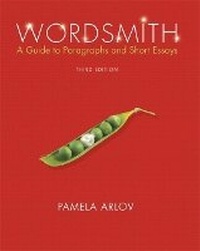
Wordsmith
A Guide to Paragraphs and Short Essays (with MyWritingLab Student Access Code Card)
3rd Edition
Published on 20. May 2008
Book
Mixed media product
608 pages
978-0-13-601628-1 (ISBN)
Description
Wordsmith: A Guide to Paragraphs and Essays, 3E is appropriate for basic writing courses covering paragraphs and essays. This text ships automatically with MyWritingLab.
What do your students want in a textbook?
Your life's work is centered on connecting to your students and preparing them for productive futures. Pamela Arlov created the Wordsmith series to help you connect with your students. We asked professors what they thought their students would want in a textbook. Here's what we heard and how Wordsmith addresses today's students:
1) Students find textbooks dry and tedious. Arlov includes engaging grammar openers, plenty of visuals, and has a writing style that is second to none!
2) Students find textbooks irrelevant to their lives. Arlov's combination of the rhetorical modes is realistic and models real life writing. She has also added "Real Writing" examples in the modes chapters to make Wordsmith even more relevant to students' lives.
3) Students become frustrated if the entire text is not used in class. Wordsmith is 100 pages briefer than similar texts on the market and an affordable option. This concise approach also does not overwhelm students with too much information. Wordsmith provides students with just the right balance of instruction and practice!
TheWordsmith series is your value-packed option that students will appreciate while mastering key writing and grammar skills.
What do your students want in a textbook?
Your life's work is centered on connecting to your students and preparing them for productive futures. Pamela Arlov created the Wordsmith series to help you connect with your students. We asked professors what they thought their students would want in a textbook. Here's what we heard and how Wordsmith addresses today's students:
1) Students find textbooks dry and tedious. Arlov includes engaging grammar openers, plenty of visuals, and has a writing style that is second to none!
2) Students find textbooks irrelevant to their lives. Arlov's combination of the rhetorical modes is realistic and models real life writing. She has also added "Real Writing" examples in the modes chapters to make Wordsmith even more relevant to students' lives.
3) Students become frustrated if the entire text is not used in class. Wordsmith is 100 pages briefer than similar texts on the market and an affordable option. This concise approach also does not overwhelm students with too much information. Wordsmith provides students with just the right balance of instruction and practice!
TheWordsmith series is your value-packed option that students will appreciate while mastering key writing and grammar skills.
More details
Edition
3rd edition
Language
English
Place of publication
New Jersey
United States
Publishing group
Pearson Education (US)
Target group
College/higher education
Dimensions
Height: 232 mm
Width: 191 mm
Weight
939 gr
ISBN-13
978-0-13-601628-1 (9780136016281)
Copyright in bibliographic data and cover images is held by Nielsen Book Services Limited or by the publishers or by their respective licensors: all rights reserved.
Schweitzer Classification
Other editions
New editions
Pamela Arlov
Wordsmith
A Guide to Paragraphs and Short Essays (with MyWritingLab with Pearson eText Student Access Code Card)
Book
04/2012
4th Edition
Longman Inc
€85.53
Article is exhausted; no reprint

Book
01/2010
4th Edition
Pearson
€47.03
Article is exhausted; no reprint
Previous edition
Book
05/2006
3rd Edition
Pearson
€38.37
Article exhausted; check for reprint
Content
PART 1. COMPOSITION.
1. The Writing Process.
2. Preparing to Write.
3. Writing Paragraphs: Topic Sentences.
4. Writing Paragraphs: Support.
5. Writing Paragraphs: Unity and Coherence.
6. Revising, Proofreading, and Formatting.
7. Showing and Telling: Description, Narration and Example.
8. Limiting and Ordering: Definition, Classification, and Process.
9. Examining Logical Connections: Comparison-Contrast, Cause-Effect and Argument.
10. Writing an Essay.
11. Writing Summary Reports.
PART 2. GRAMMAR.
12. Verbs and Subjects.
13. Subject-Verb Agreement.
14. Verb Shift.
15. Sentence Variety.
16. Run-on Sentences.
17. Sentence Fragments.
18. Pronoun Case.
19. Pronoun Agreement, Reference, and Point of View.
20. Adjectives, Adverbs, and Articles.
21. Capital Letters.
22. Words Commonly Confused.
23. Word Choice.
24. Commas.
25. Other Punctuation.
26. Apostrophes.
27. Quotation Marks.
PART 3. READINGS.
1. The Writing Process.
2. Preparing to Write.
3. Writing Paragraphs: Topic Sentences.
4. Writing Paragraphs: Support.
5. Writing Paragraphs: Unity and Coherence.
6. Revising, Proofreading, and Formatting.
7. Showing and Telling: Description, Narration and Example.
8. Limiting and Ordering: Definition, Classification, and Process.
9. Examining Logical Connections: Comparison-Contrast, Cause-Effect and Argument.
10. Writing an Essay.
11. Writing Summary Reports.
PART 2. GRAMMAR.
12. Verbs and Subjects.
13. Subject-Verb Agreement.
14. Verb Shift.
15. Sentence Variety.
16. Run-on Sentences.
17. Sentence Fragments.
18. Pronoun Case.
19. Pronoun Agreement, Reference, and Point of View.
20. Adjectives, Adverbs, and Articles.
21. Capital Letters.
22. Words Commonly Confused.
23. Word Choice.
24. Commas.
25. Other Punctuation.
26. Apostrophes.
27. Quotation Marks.
PART 3. READINGS.